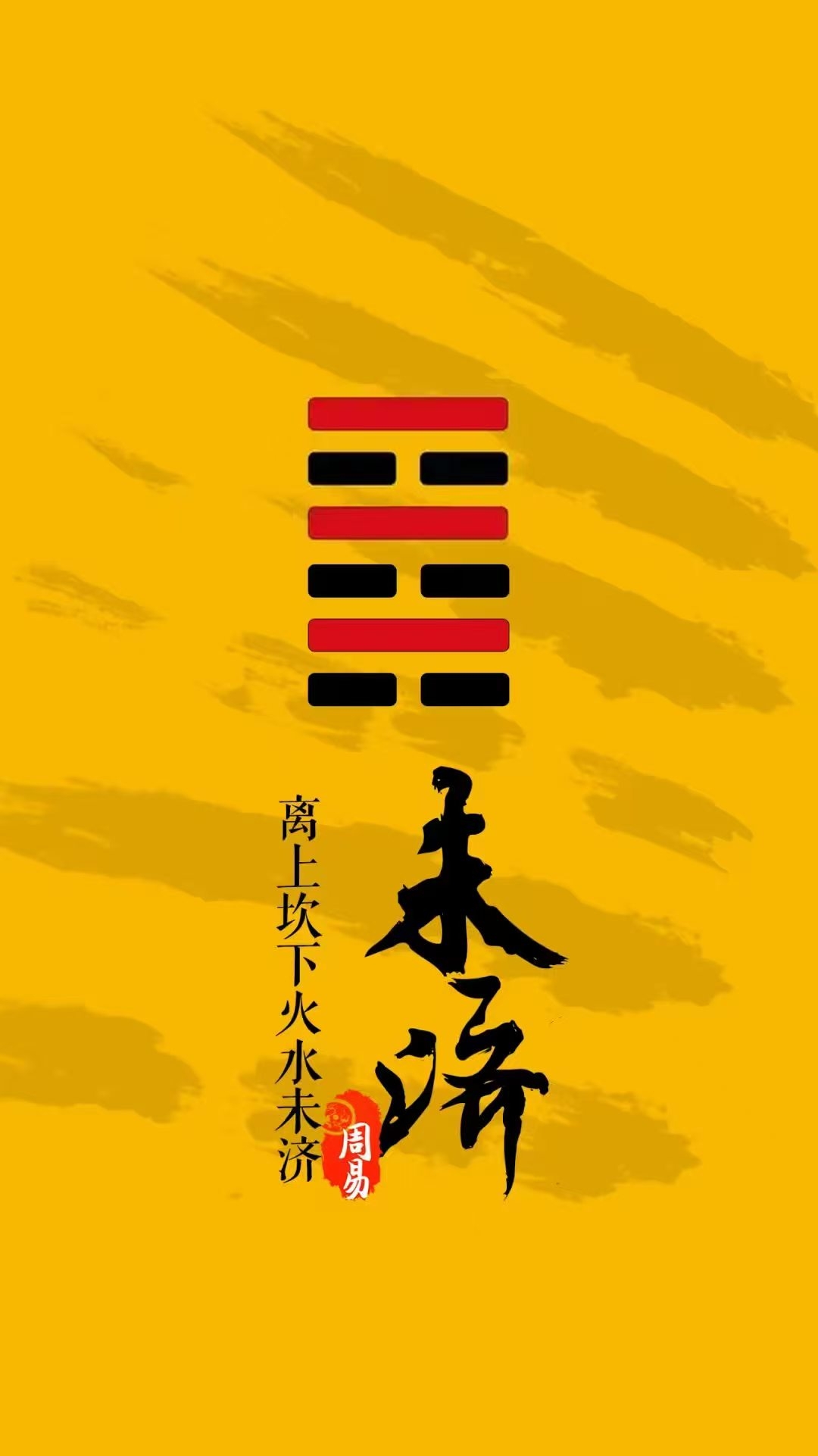
I used to wonder why the last hexagram of the (I Ching) would be the hexagram Not Yet Frought.
From the sixty-four hexagrams, starting with Qian: Heaven’s movement is ever vigorous; thus the noble one continually strives for self-improvement without ceasing. It is a pure, upward creative momentum. Over the course of its evolution, by the time we reach the sixty-third hexagram, After Completion—fire and water interminge, and each thing finds its proper place; perfection and fulfillment are achieved. In theory, this should be the end. But afterward there is still one more hexagram, called Not Yet Frought. Fire lies atop water—completely misaligned, unable to cross over. The book does not end with a triumphant finish; instead, it halts abruptly on an unresolved action.
Why did the ancients arrange things this way? I thought about it for a long time.
Later, I suddenly discovered something quite interesting. In our lifetime, from being confused and clueless as teenagers, we go through all kinds of learning and eventually enter society. In theory, the learning process has already gone through a complete loop. But once you finish it and enter society, it’s a brand-new beginning. Then after you do your work to the point of completion, you encounter relationships again—dating, getting married, building a family. After you’ve built a family, there’s the next step: raising the next generation. Even if you’ve done everything you can, it’s still not finished—you have to start over again for the goals of the next generation.
In that moment, I suddenly understood: the opening hexagram Qian is actually the endpoint; the final hexagram Wei Ji is actually the starting point. Because when you begin a new stretch of road, it means you’ve already finished one. And when you finish that stretch, it means the next stretch has to begin as well.
This cycle doesn’t change according to anyone’s will—unless it completely disappears.
This is the objective and inevitable law governing all life and all matter. Once I figured this out, I found that this logic could dissolve many worries.
For example, success and failure.
We often set success and failure against each other, splitting life into two halves: one half is the joy of success, the other is the pain of failure. But if you look at it within this cycle, failure is not really “doing something wrong.” It’s the system telling you: this form of fulfillment has come to an end—it’s time to move into the next form. Failure isn’t a negation of you; it’s a signal to turn.
But what about success? Success isn’t a final prize or trophy. It’s you reaching a certain hexagram of Qian—yet if you cling to it, that’s “the dragon soars too high and brings regret.” The true meaning of success is that it provides the capital and potential energy to help you start the next unfinished (uncompleted) stage.
It’s not meant to stop you so you can enjoy it. It’s meant to give you the capacity to begin the next stretch of the journey.
As the saying goes, “Failure is the mother of success.” It sounds simple. But at the underlying level, the logic is this: success and failure are not opposites at all—they are different phases of the same cycle. Like the text of the hexagram Ji Ji (Already Fording): it begins with “Good fortune at first, then disorder at the end”—the moment when everything seems complete is when confusion and new change begin simultaneously. And the hexagram Wei Ji (Not Yet Fording), which appears to be indistinct chaos, precisely contains the greatest potential—everything is ready to flourish.
Laozi said: “Being and non-being generate each other; difficulty and ease complete each other; length and shortness show each other; high and low lean toward each other.” Success and failure are exactly such a relationship that gives rise to each other. It’s not a timeline where failure comes first and success later. Instead, failure itself contains the seed of success, and success itself contains the sprout of failure. To treat success and failure as opposites is a human way of cutting them apart. When you place them in the whole of the cycle, you realize they were always one.