




At the beginning of the New Year, the decentralized perpetual contract exchange Lighter launched the Lighter Infrastructure Token (LIT) airdrop program, which was originally regarded as a 'model of feedback' in the DeFi space, but is now embroiled in suspicions of 'insider manipulation.' According to on-chain analysts, a group of wallets is suspected of coordinating operations to preemptively position and divide over 26 million dollars worth of LIT tokens, triggering strong backlash and distrust from the community.
Five wallet operations: 5 million USDC invested for 9,999,999.6 LIT
Famous on-chain analyst @mlmabc posted a detailed analysis on the social platform X, pointing out that a group composed of five wallets collectively deposited a total of 5 million dollars in USDC into Lighter's liquidity provider pool (LLP) about nine months ago. These wallets subsequently received an incredibly precise allocation of 9,999,999.6 LIT tokens — calculated at the current token price, the total value reaches 26 million dollars, accounting for about 1% of the total supply of LIT and 4% of the circulating supply.
Even more noteworthy is that this data does not yet include the additional earnings they obtained from participating in LLP, estimated to be between $1 million and $2 million. According to on-chain tracking, more than $7 million worth of tokens have already been rapidly sold off after the airdrop.
'Scores unattainable by ordinary players': On-chain data exposes the 'self-serving model'?
@mlmabc specifically pointed out in the analysis that these wallets not only exhibited extremely high synchronicity in capital investment and token receipt but also collectively obtained as much as 500,000 points in airdrop rewards, far exceeding the points that ordinary players could achieve with similar capital. He candidly stated, 'Under normal circumstances, these wallets cannot obtain 500,000 points,' implying that this is likely a collective operation controlled by the team or related parties.
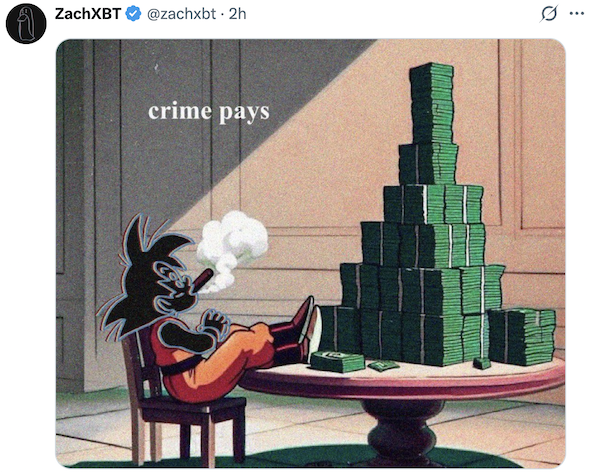
The post quickly sparked attention, with renowned on-chain investigator ZachXBT (@zachxbt) responding with a sarcastic meme 'crime pays,' further intensifying external doubts and criticisms regarding this incident.
Community outrage: From VC favoritism to a comprehensive questioning of DeFi airdrop fairness.
This incident has triggered a massive backlash in the community, with many users vehemently criticizing it as a typical case of 'VC favoritism,' 'self-serving for insiders,' 'pseudo-decentralized airdrops,' and other chaotic phenomena. Even though Lighter seemingly generously allocated 25% of the tokens for airdrops to early participants, the distribution to the team (26%) and investors (24%) still occupies half of the total supply, raising suspicions from many: 'Is such a distribution truly decentralized?'
Some users bluntly stated, 'The airdrop is not for rewarding the community, but for insiders to cash out.'
24 hours after TGE, a massive capital flight occurred, with $250 million flowing out of the platform in an instant.
With the token generation event (TGE) officially launched, the market reacted quite intensely. According to on-chain data, the Lighter platform saw approximately $250 million flow out within just 24 hours after the TGE, which is seen as a result of airdrop players exiting and arbitrageurs taking their profits. Although the fully diluted valuation (FDV) of the LIT token once broke through $3 billion, the price performance has come under significant pressure amid continuous questioning and market volatility.
The rapidly rising Layer-2 star cannot escape old problems: Where is the fairness in DeFi?
In recent years, Lighter has gained rapid popularity due to its high performance and low-fee Layer-2 perpetual contract trading experience, even briefly ranking among the top three perp DEXs in trading volume in 2025. However, this 'airdrop scandal' once again highlights the persistent issues in the DeFi world—airdrop fairness, insider manipulation, and a crisis of community trust.
As of now, the Lighter team has not made any public response to the related accusations. This has prompted many to re-evaluate the 'points-based airdrop' model: while it effectively attracts liquidity and user participation, if it lacks transparency mechanisms and anti-cheating measures, it will ultimately become a capital game for a few.
Who should the airdrop serve?
The LIT airdrop from Lighter was originally an experiment symbolizing decentralization and community governance, but it has fallen into a trust crisis due to suspected insider manipulation. This is not only a warning for a single project but a moment for the entire DeFi ecosystem to re-examine its reward mechanisms, fairness, and governance structures. For emerging protocols on the rise, whether 'airdrops can truly reward the earliest supporters' may be a more important question than valuation.
This article reveals that Lighter has a 'whistleblower airdrop scandal'! The mysterious allocation of 9,999,999.6 LIT has sparked controversy, with the community angrily condemning the self-serving chaos in DeFi, first reported by Chain News ABMedia.