
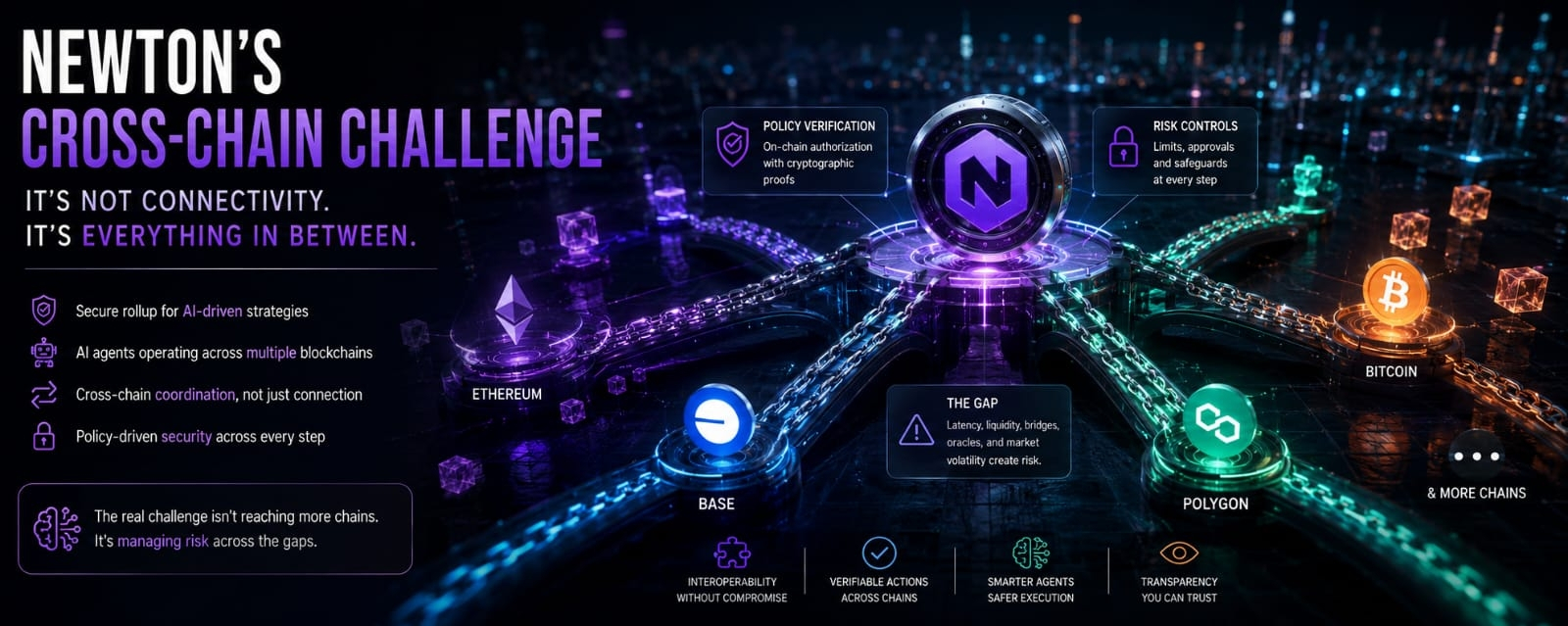
Cross-Chain often sounds more impressive than it really is.
Most people hear it and imagine assets moving freely between networks as if the chains were all connected by invisible highways. Reality is usually messier. Every bridge, every message and every confirmation introduces another place where something can go wrong.
That's why I keep looking at Newton from a different angle.
I don't think the hardest part is helping an AI agent reach another chain. The harder part is making sure the agent still behaves safely while everything between those chains is changing.
Imagine a simple arbitrage opportunity.
An AI notices ETH trading cheaper on one network than another. On paper, it looks like easy money. Buy here, sell there and collect the spread.
But anyone who's spent time in DeFi knows how quickly that picture falls apart.
The price can move before the second trade happens. Liquidity can disappear. Bridge fees can change. A message can arrive late. One side of the trade can execute while the other never does.
Suddenly the opportunity isn't an opportunity anymore.
Newton can help make sure the agent follows the rules. It can verify permissions, spending limits and approved actions.
What it can't do is freeze time.
That's an important difference.
I've seen people assume that once an action is verified, it's automatically safe. I don't think that's how markets work. A trade can be perfectly valid when it's approved and become a bad idea a few seconds later.
Time matters just as much as permission.
That's why I think Newton becomes more valuable when it's treated as a risk manager instead of a trading engine.
Rather than approving every single trade, I can imagine it defining the boundaries an agent has to stay inside.
Maybe the agent can only trade on certain chains.
Maybe it can only use approved bridges.
Maybe the expected profit has to stay above a minimum after fees.
Maybe execution stops automatically if prices drift too far apart or liquidity suddenly dries up.
Those rules won't stop markets from changing.
They simply reduce the damage when they do.
Something else keeps coming to mind.
Most discussions about cross-chain AI focus on finding opportunities. Very few talk about recovering from incomplete ones.
What happens if the buy succeeds but the sell doesn't?
What happens if capital gets stuck halfway through a bridge?
What happens if an oracle updates after the first transaction but before the second?
Those aren't edge cases.
They're normal conditions in a multi-chain world.
That's why I think every cross-chain strategy should have an exit plan before it has an entry plan.
Knowing how to unwind a position is just as important as knowing when to open one.
I also don't think Newton needs to compete with bridges or messaging protocols.
LayerZero, Axelar, IBC and others are already solving different parts of that problem.
Newton's role feels different to me.
Let the bridge move the assets.
Let the messaging protocol deliver the instructions.
Let Newton decide how much freedom the agent should have before anything starts moving.
That feels like a much cleaner separation of responsibilities.
Recent development across Newton's contracts, SDK and policy tools suggests the project is continuing to build around policy enforcement and transaction authorization across multiple environments.
To me, that's the more interesting direction.
Not because it makes cross-chain trading easier.
Because it might make cross-chain mistakes less expensive.
After watching enough market cycles, I've stopped believing that automation wins because it can move faster than everyone else.
The systems that survive are usually the ones that know when to slow down.
For me, that's the real question behind Newton.
Not whether an AI agent can trade across five different chains.
Whether it knows when it shouldn't.