
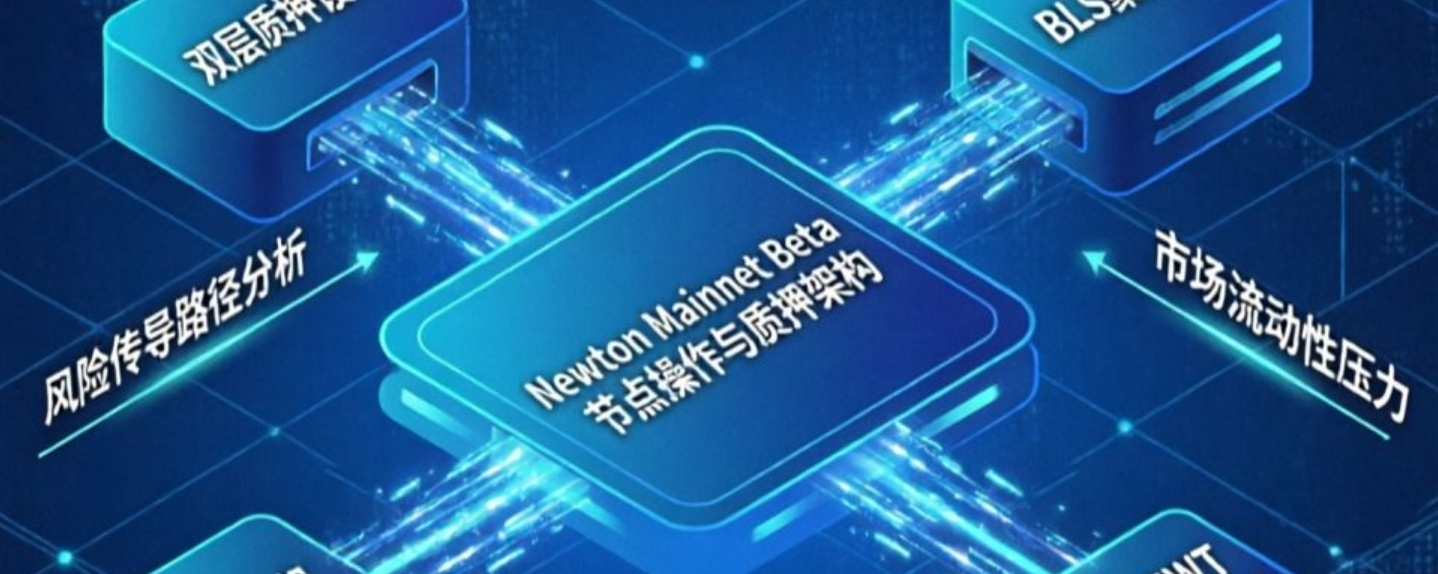

I’ve seen many common issues with automated L1 chains: the cost for nodes to do malicious acts is extremely low. Even if they tamper with data or execute incorrect strategies, the consequences are usually only minor penalties, leaving users with no way to get compensated and with no fallback mechanism at all. Because I’ve fallen into this kind of mechanism flaw, I recently specifically reviewed Newton’s whitepaper Chapter 22, and—together with long-term Beta testing on the mainnet and on-chain transaction flow replays—objectively broke down the real pros and cons of its slashing and dispute-verification system.
This mechanism is the core foundation of Newton’s whole-network security, fully implemented in the current mainnet version. All computation nodes must stake NEWT in order to participate in network operations. If anyone engages in malicious behavior such as submitting forged data or executing disallowed strategies, anyone can initiate an on-chain dispute challenge. The system uses ZK proofs to reconstruct the complete execution process, verifies the malicious conduct, and then directly cuts the staked tokens of the offending node. All confiscated funds are transferred into the risk insurance pool, which is used to compensate users for losses to their assets—forming a complete risk-control closed loop.
The project also adopts a dual-layer verification mechanism: daily consensus is efficiently reached through BLS aggregated signatures. If data deviates, a recheck is automatically triggered to strictly prevent nodes from colluding to fabricate records—this is also the key highlight that makes it better than most similar public chains, and in real-world testing there are currently no batch node violation records on-chain.
But if you dig deeper into the real-world testing details, the current structural weaknesses are very clear. First, the dispute-verification threshold is too high. It requires professional on-chain search and smart-contract operation skills, so ordinary users cannot really participate in supervision. Across the whole network, verifications mainly rely on institutions and official entities, making “decentralized oversight” essentially a formality. Second, the node staking threshold is relatively high; small individual nodes cannot easily enter the ecosystem. Over time, computing power will concentrate toward large holders, weakening the network’s decentralization.
The biggest risk is concentrated in extreme market conditions: when volatility spikes, automated tasks increase dramatically, and the capacity of the fixed evidence-submission window is insufficient. Large amounts of anomalous data cannot be verified in time, and incorrect records will be permanently written to the blockchain. More importantly, the insurance pool’s payout capacity is tied to the $NEWT market value—when the coin price experiences a deep correction, the backup coverage shrinks significantly, and extreme liquidation scenarios cannot cover all of users’ losses.
Here’s a practical suggestion for friends who will participate in interactions: try to avoid starting fully automated trading during periods of sharp market volatility. For large transactions, proactively retain block evidence. Use your personal risk controls to compensate for the shortcomings of the mechanism.
Do you think this forfeiture-as-a-backup system can truly protect users’ assets during an extreme bear market?#Newt $NEWT @NewtonProtocol