



Key market indicators (Hong Kong time 16:00 July 6 → 16:00 July 13)
BTC/USD: flat (62,900 USD → 62,900 USD)
ETH/USD: up 1.1% (1,765 USD → 1,785 USD)
BTC/USD spot technical outlook
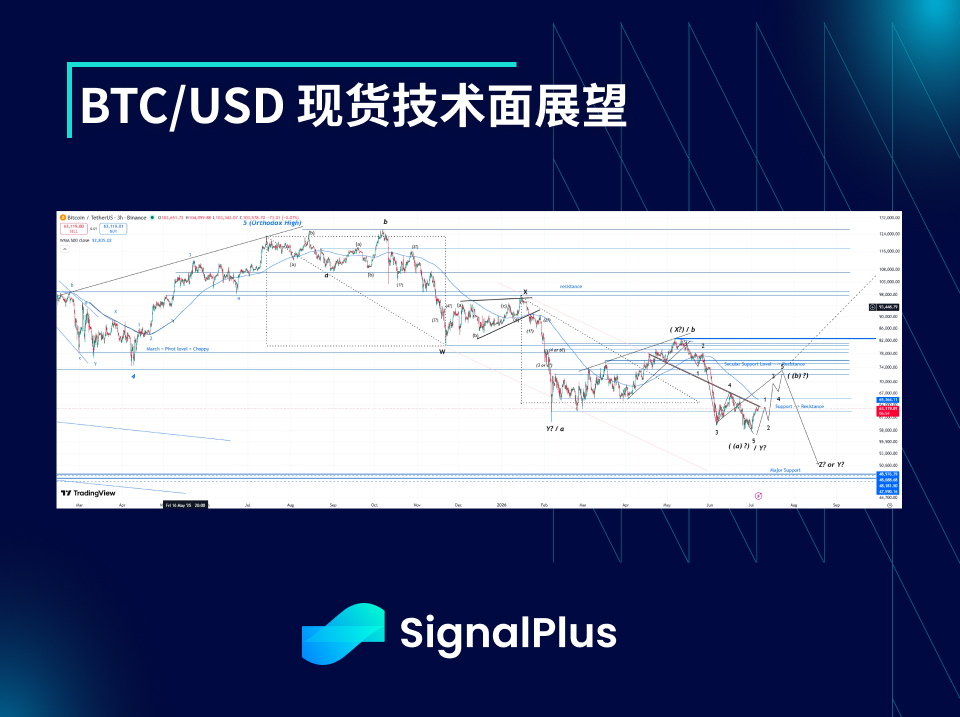
Last week, BTC spot prices continued to trade sideways, consistent with the technical indicator structure we have been tracking over the past several weeks. In the short term, after news broke that MicroStrategy (MSTR) would sell BTC, the market saw a knee-jerk reaction with a rapid drop, but found support around $61,000; meanwhile, in the latter half of the week, when prices moved up into the $64,000–$64,500 range, they met with clear resistance.
At present, we still expect BTC to maintain a range-bound but relatively bullish pattern. We also think there is a possibility of one more dip into the $60,000–$61,000 support zone, after which BTC should gradually rise to $68,000 over the next 4–6 weeks.
If the $60,000–$61,000 support breaks, the price would most likely first pull back to $58,000, and it may even complete a round of a larger correction, dipping into the $50,000–$55,000 area.
Conversely, if it can effectively break above the $64,500–$65,000 resistance level, it would first attempt to break through $68,000, and then challenge the more important resistance at $74,000. At that time, the market will ultimately decide:
whether the current low has already been confirmed, thereby kick-starting a new uptrend; or
whether it will fall again and finally break below $60,000 to complete the last dip, laying the foundation for a larger up-move later this year.
Market theme
Last week’s overall risk appetite improved somewhat. Although the situation between the US and Iran became tense again at one point, because negotiations between the two sides are still ongoing, the market largely ignored the impact of the initial escalation. However, the latest developments over the weekend showed that the conflict has further escalated, so today the market has returned to a risk-averse mode. Oil prices are once again pressing near last week’s high, almost fully recouping the earlier pullback after that spike. The global economy is still showing fairly strong resilience—for example, China relies more on prior reserves rather than continuing to purchase at elevated oil prices. But if the Middle East situation remains unresolved for the long term, this persistent uncertainty will continue to weigh on the performance of risk assets throughout the summer. (If there were a clear solution, the earlier rounds of talks should have already produced results.)
Although MicroStrategy announced in its weekly disclosure that it sold approximately 3,500 BTC in the prior week, overall sentiment in the crypto market has improved compared with the week before. The market finally saw its first net ETF inflow in several weeks. However, BTC in the $64,000–$64,500 area is still facing strong resistance, and today’s overall risk appetite is down again, dragging prices lower. In terms of positioning, the market’s overall allocation remains relatively light:
Short-term traders clearly covered shorts when the price was squeezed higher toward the $64,000 area;
Meanwhile, medium-term investors have continued to reduce positions over the past 4–6 weeks;
The trend of miners continuing to sell BTC is still ongoing. Therefore, we still expect BTC to trade sideways in the $60,000–$65,000 range. Unless there is a clear escalation in the Middle East conflict, it will be difficult to open up new downside room.
BTC US dollar options: ATM implied volatility, BTC ATM implied volatility
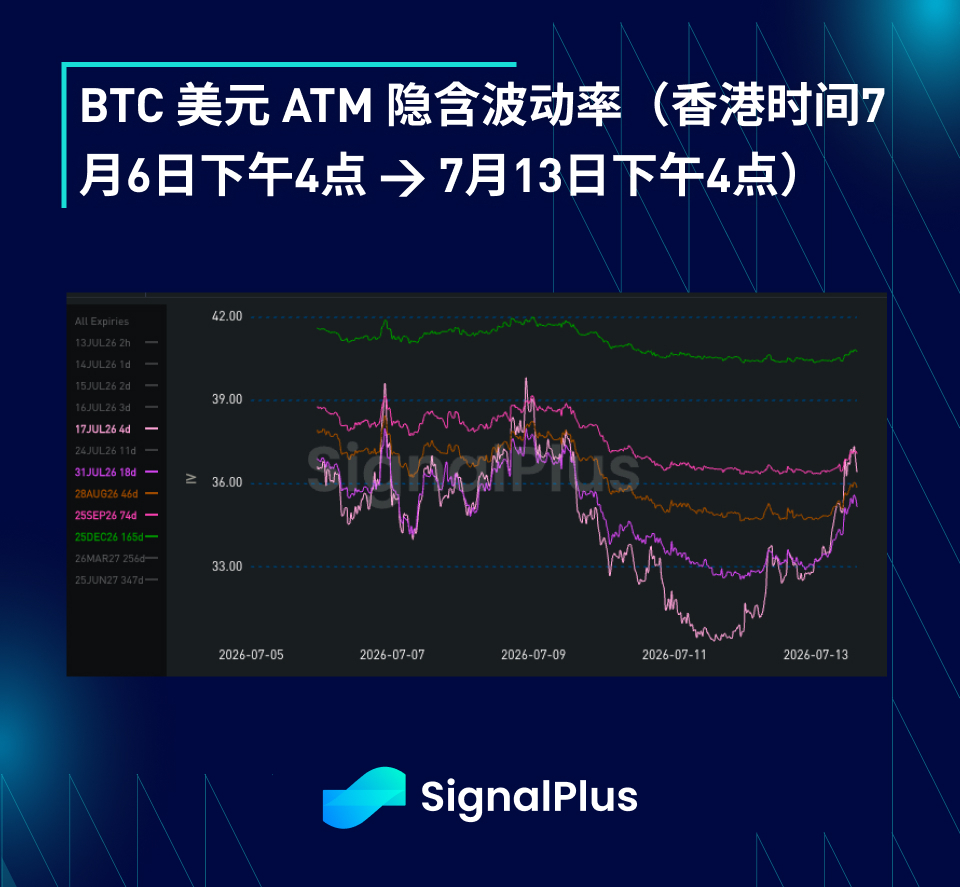
Implied volatility continued to decline last week, tracking down alongside realized volatility. Especially when measured using daily official settlement prices, the 1-week fix-to-fix realized volatility was about 20%; by comparison, the high-frequency realized volatility was slightly higher, around 38%. Although market volatility rose briefly after the release of MSTR-related news, the overall price range narrowed noticeably. Throughout the week, BTC mainly traded in the $61,300–$64,600 range, with most settlement times clustering around $63,000. This implies that spot and perpetual futures trading volumes were relatively light, and the market as a whole is in a Long Gamma state—therefore, volatility is being suppressed.
As we move into the traditional summer off-season, BTC has gradually found a new equilibrium range, and the volatility term structure has started to steepen again. We still expect implied volatility after September to rise again. The main reasons are that US midterm elections are approaching and the macro environment remains full of uncertainty (market expectations for the timing of the Fed’s first rate cut have shifted from July–August to September–October).
BTC options:
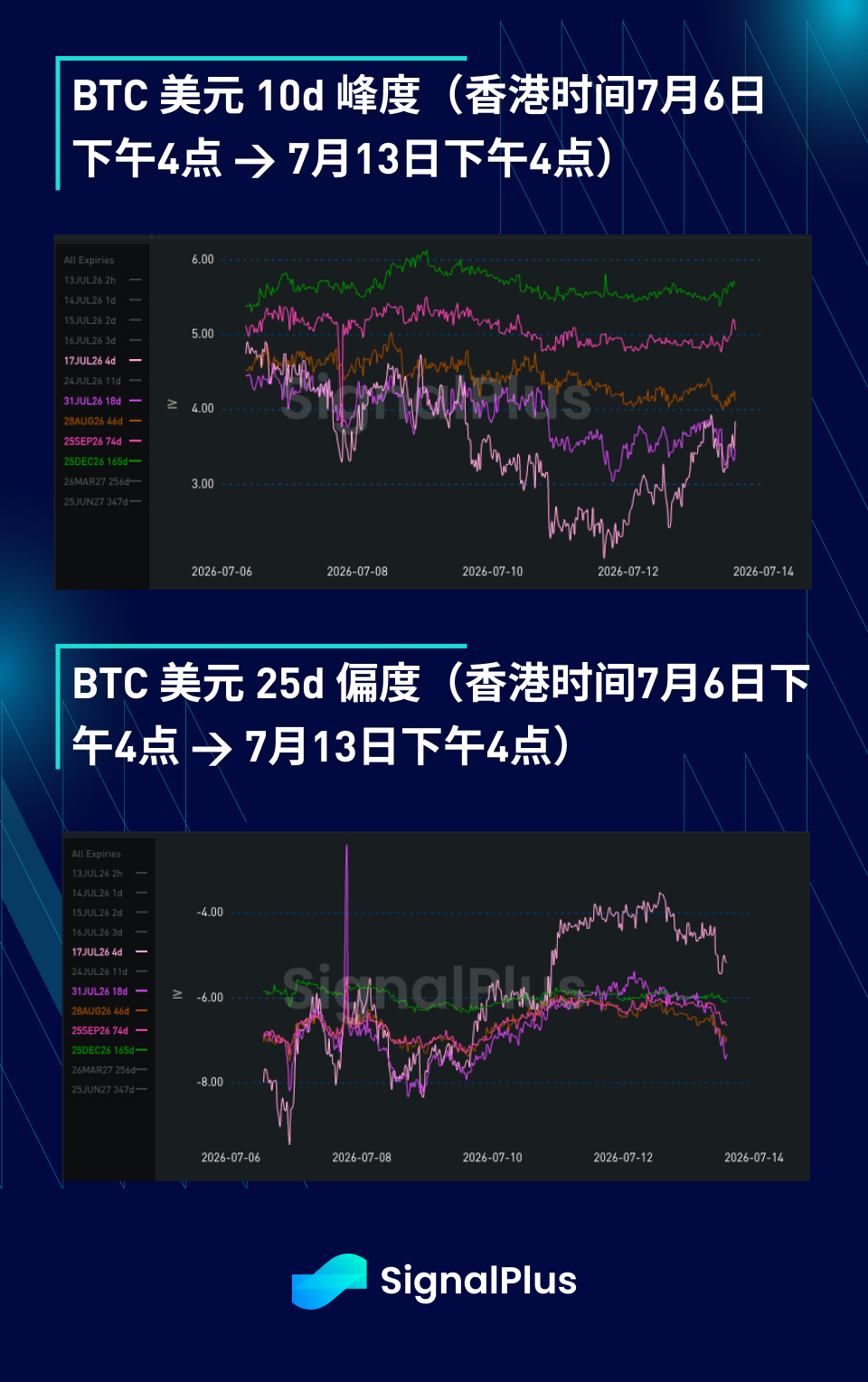
Last week’s change in skewness price was overall not large. Currently, the market continues to face substantial call-selling from hedging/selling counterparties on the upside. Because the call side has one-way order flow, the market is unwilling to further raise implied volatility on that side. At the same time, since BTC is still moving sideways and consolidating, the cost of continuing to hold a skewness position at the current relatively high level is becoming increasingly expensive. Therefore, we expect skewness to remain roughly stable around current levels and slightly decline in the future.
Skewness is slowly declining overall. The main reasons include the market’s continued absorption of large amounts of selling from the upper tail (far out-of-the-money calls). At the same time, the pricing of downside tail risk (fat tails) has also started to fall, and the high cost of holding downside protection has become increasingly evident. Meanwhile, the fundamentals have improved somewhat. The market has gradually digested the negative impact of MicroStrategy selling BTC, so investors believe extreme downside tail risk has weakened. Looking at last week: skewness pricing around the curve’s middle (belly) remained basically stable; however, skewness for very short maturities continues to face pressure because the time-value decay is faster and the upper wing of short-dated options remains affected by supply from hedging/selling counterparties.
Wishing you a smooth trading week!
