


Key takeaways
A honeypot scam can let you buy smoothly, but then block you from selling, trapping you in tokens you can’t transfer out.
Please watch for danger signals, such as “only buy orders,” unverified contracts, and control permissions that allow token owners to change the rules after the token goes live.
The Binance Wallet will use available data to help flag token risk signals and high-risk warnings, but before purchasing any token, you must still do your own research.
Imagine buying a token that rockets up steadily on the chart—your gains keep climbing—only to suddenly find you can’t sell. No matter how many times you try, the transaction fails. This is a honeypot scam, and it’s one of the traps that DEX beginner traders are most likely to encounter first. In this article, we’ll break down what a honeypot scam is, how it works, what danger signs to watch for, and introduce a wallet that can help you avoid getting caught.
What is a pig-butchering scam?
A pig-butchering scam is a type of malicious token designed to lure buyers. Getting in is easy, but getting out is either impossible or only possible with losses. When you’re ready to sell, transactions fail again and again, or the amount you actually receive is far less than expected.
How do pig-butchering scams work?
Although the exact mechanisms vary, they all ultimately lead to the same trap. Scammers typically use the following tactics alone or in combination to create a pig-butchering scam:
Block selling: Contract logic causes sell transactions to revert or fail. Buying can go through normally, but selling will never complete.
Selling limitations: The token only allows very small amounts to be sold, or only allows selling at certain times—creating a false sense of safety while preventing holders from exiting at any meaningful size.
Whitelist and blacklist control: The contract allows only approved addresses (whitelist) to sell, blocks specific addresses (blacklist) from selling, or uses a combination of both.
Fee trap: Selling itself can succeed, but the fee is set extremely high (95%+). Even if you manage to sell, you’ll end up with almost nothing left. For example, if you sell a token worth $1,000, you might only receive $20–50.
Hidden switch: The token behaves normally until the owner switches a setting. Once switched, selling is restricted. When the token lacks credible project backing, tokens with strong owner privileges carry higher risk.
Token siphoning: Some contracts include logic that, after you buy, quietly transfers tokens away from your wallet—for example, by embedding malicious transfer behavior in the code.
No matter how it’s built, the underlying pattern is always the same: you can enter trades, but you can’t exit under fair conditions.
Why do pig-butchering scams work?
Pig-butchering scams succeed because they weaponize urgency and fear of missing out (FOMO). When most holders can’t sell, sell pressure is low, the market looks healthy, and the price rises steadily—exactly the setup that attracts buyers to enter. The illusion itself can do a lot, but scammers also use basic human psychology to close the net.
To avoid missing the next big move, new users often act quickly, skipping checks that could reveal the risks. Instead of verifying signals like transaction history, contract verification status, or ownership control permissions, they trade based on rising charts, viral posts, or group hype. As more buyers flood in, their funds further deepen the liquidity pool that the scammer is waiting to drain.
Danger signals you should check before buying any token
Before buying any token, slow down, do your due diligence, and check for these danger signals:
Abnormal price charts: Continuous buying with little or no selling. Healthy markets typically have both buy and sell activity.
Suspicious wallet patterns: A small number of addresses dominate volume, or many wallets trade at similar sizes and around the same time points.
Artificial urgency: When a countdown timer appears in group chats or on social media, when people are pressured with “Buy Now” tactics, and when there are “limited-time” discounts, these are typical scam signals.
Owner-controlled risk: The fact that ownership hasn’t been renounced means the owner can change fees, pause trading, or restrict addresses. This doesn’t necessarily mean it’s a scam, but it is strong reason to verify the project and the team.
Unverified contract: If the contract source code isn’t verified, it could include hidden code that controls whether you can sell. Treat this as a major risk.
A real example: a “hidden switch” that prevents selling
One common pig-butchering scam uses a “switch” controlled by the owner. It stops selling after buyers have already entered. In this case, the scammer urged people in a Telegram group to buy a token, claiming it “is exploding in popularity.” Early buyers would be promised huge profits. Driven by fear of missing out (FOMO), victims continued despite seeing warnings, and ultimately lost their funds.
To understand the trick, it helps to first know what typically happens on a DEX:
You buy: Your funds go into the liquidity pool, and the token returns to your wallet.
You sell: Your tokens go back into the liquidity pool, and the funds move into your wallet.
This hidden switch breaks the “sell” process step-by-step, as follows:
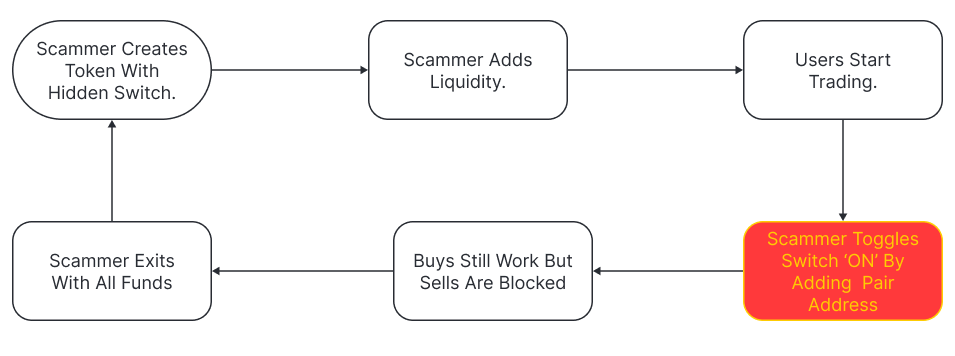
Figure 1: Flowchart showing how the hidden switch blocks selling
The scammers deploy the token, add liquidity, and promote it across multiple groups to push victims to buy quickly.
They keep contract ownership, allowing them to control all functions.
The contract also includes a setting to store addresses as a list; the token code checks this list before allowing selling. The list is initially empty.
Once enough funds accumulate in the liquidity pool, the scammer quietly adds the liquidity pool address to the list.
As a result, before any trade happens, it first checks the addresses in the list.
Therefore, any trade that uses the liquidity pool as the counterparty address (i.e., an attempt to sell) will fail.
Victims are ultimately left holding tokens that can’t be sold. Meanwhile, because buying is still possible, new buyers continue to enter.
The scammer then withdraws the profits and disappears.
Using a Binance Wallet is safer
A Binance Wallet will screen tokens using available data and may prompt you with reminders or high-risk warnings, encouraging you to pause and reassess before swapping. These reminders may appear in multiple places, including the audit page, the swap page, the token page, or even as pop-up alerts. Even so, whether to proceed is always your decision.
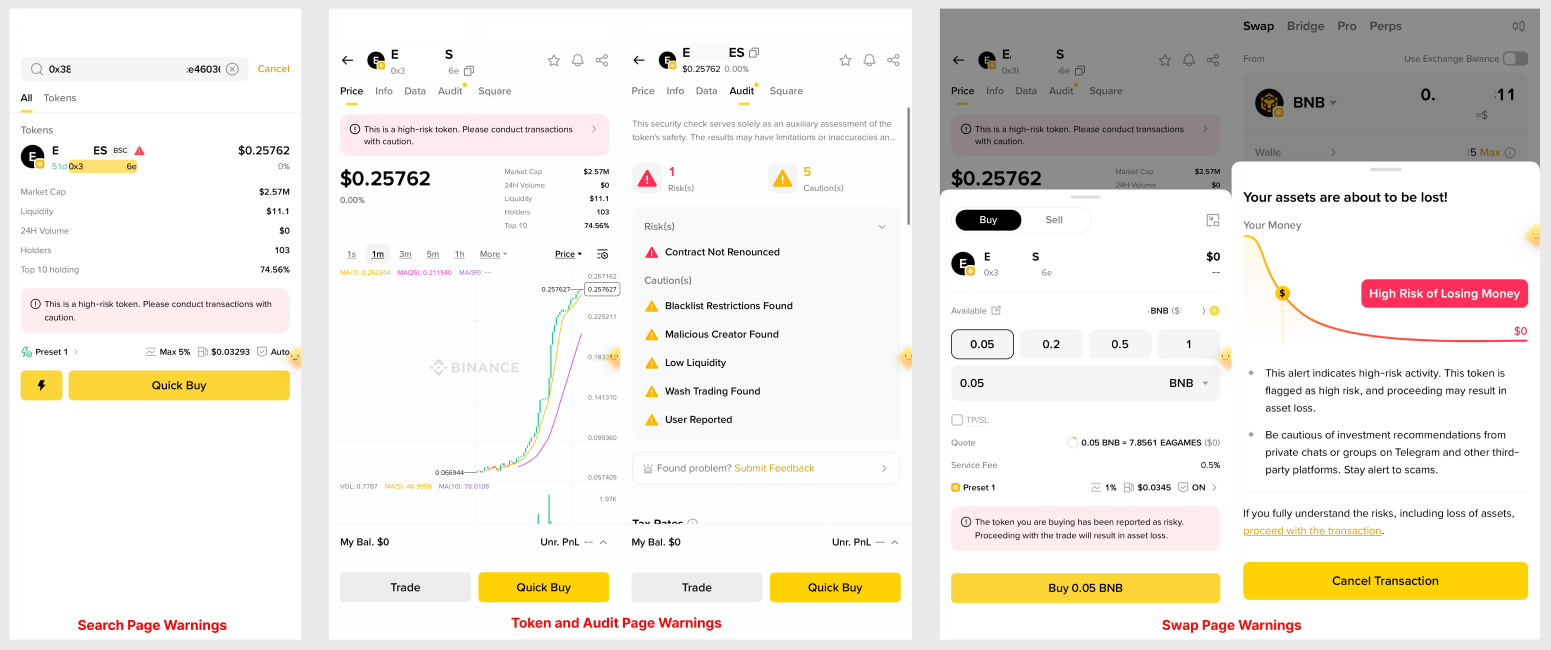
Warnings may not always appear, and no screening system can catch every new scam variant in real time. Treat them as risk signals, not definitive proof, and verify what you see through your own checks: transaction history, contract verification status, ownership control, and the project’s credibility. Whenever a token shows warnings or high-risk alerts, you should treat it as a reason to stop and investigate before continuing.
Conclusion
Pig-butchering scams rely on urgency and chart-driven decision-making. They pressure you into buying before you have time to check. The best protection is to slow down, learn how pig-butchering scams work, watch for basic warning signs, and let the built-in alerts of Binance Wallet serve as your checkpoint before every swap.
But remember: no tool can make the final judgment for you. You are the last line of defense. Trade with Binance Wallet to leverage real-time risk screening, then use your own judgment to stay one step ahead of scammers.
Further reading
Please note: There may be differences between the English original content and the translated version (the translated version may be generated by AI). If there are any discrepancies, refer to the English original for the latest or most accurate information.