


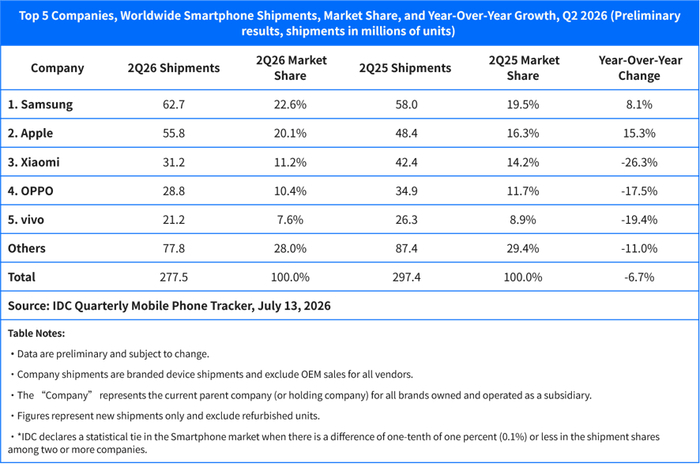
IT Home, July 14 — According to preliminary data released today by International Data Corporation (IDC) (Global Quarterly Mobile Phone Tracking Report), global smartphone shipments in Q2 2026 totaled 277.5 million units, down 6.7% year over year.
This is already the second consecutive quarter showing year-on-year declines. The memory crisis continues to disrupt the market, not only driving costs up significantly, but also causing supply tightness.
Nabila Popal, Senior Research Director for Consumer Devices at IDC, said: Memory costs have risen by nearly 300% compared with the same period last year. In low-end models, memory accounts for more than 65% of the total bill of materials cost. As a result, vendors that rely primarily on low-end products are finding it increasingly difficult to keep going. The Q2 data fully confirms our earlier judgment — this downturn is not evenly distributed across the market. The memory-chip crisis benefits high-end brands, while dealing a severe blow to vendors that depend on low-end models.
Apple and Samsung have been the only two vendors among the top five to record shipment growth for two consecutive quarters. Apple’s Q2 shipments reached a record high for the same period, driven mainly by strong demand for the iPhone 17 series and consumers bringing forward purchases because they expect subsequent price increases. Based on this trend, Apple’s full-year market share could reach 22%, the highest level in history.
Nabila Popal believes that low-end vendors are doing their best to adjust their strategies, cut costs, and shift their product lines toward models with higher profit. However, the key issue is not the strategy itself, but how to get consumers to accept the higher-priced products from these traditional low-end brands. When the price gap narrows and installment payments are relatively convenient, consumers often lean toward choosing high-end brands.
IDC’s Vice President for Client Devices Worldwide, Francisco Jeronimo, said that in Q2 2026, the divergence between the high-end and low-end markets further intensified. Samsung and Apple both achieved year-on-year growth in shipments, with market shares expanding by 3.2 and 3.8 percentage points respectively, further solidifying their leading positions.
This memory crisis is splitting the smartphone market into two completely different camps. On the high-end side, Apple and Samsung have been able to keep expanding their advantages because they locked in memory supply early, and memory costs represent a relatively lower share of their overall bill of materials. On the low-end side, vendors that rely on cheap volume-driven models are bearing heavy pressure, and their target consumer groups are also affected. Ultimately, this crisis benefits vendors that have scale advantages, strong supply-chain relationships, and high-end product portfolios.
Kiranjeet Kaur, Deputy Research Director for Consumer Devices at IDC, added that the rankings of Xiaomi, OPPO, and vivo have not changed compared with the previous quarter, but the rate of decline among Chinese vendors has accelerated. Most leading vendors have seen double-digit year-on-year shipment drops.
In the market segments below $200, those areas are still crucial for moving volume for them. Therefore, many vendors have had to refresh older model lineups or re-release 4G versions to hold the price band, while also keeping other costs under control as much as possible.
Xiaomi saw the largest decline among leading vendors, but that was intentional — it proactively reduced shipments of low-end models to protect profit margins and shifted its focus to higher-priced markets. Huawei was the exception, achieving 20.9% year-on-year growth. This was mainly due to maintaining stable prices in the domestic market (while other Android rivals raised prices), running targeted promotional campaigns, leveraging strong brand loyalty in the local market, and expanding its product lineup to cover more price segments. According to a report obtained by IT Home, in Q2 2026, China’s smartphone market shipped about 66.01 million units, down 4.3% year over year, with year-on-year declines occurring for five consecutive quarters. Starting from the late March period, Android manufacturers were forced to gradually raise product prices or adjust configuration plans due to continued increases in costs for key core components such as memory, which clearly suppressed consumers’ willingness to upgrade.
At the same time, the demand-boosting effect of the “national subsidy” policy is gradually weakening. As a result, during this year’s “618” sales promotion period, China’s smartphone total sales fell by nearly 15% compared with the same period last year, indicating weakness in short-term demand.
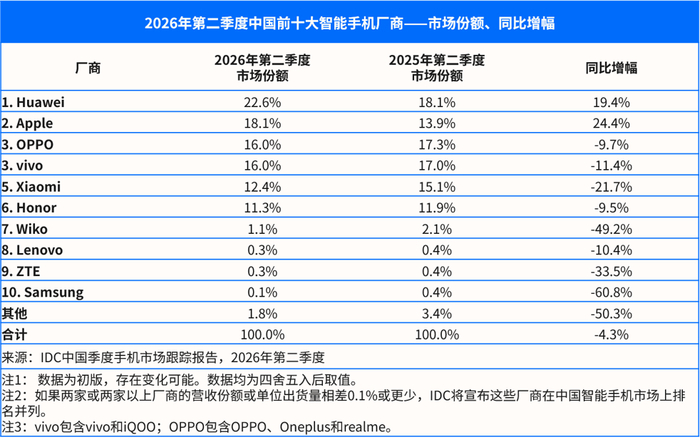
Against the backdrop of a sluggish overall market, leading vendors Huawei and Apple performed exceptionally well, with both seeing roughly 20% year-on-year growth in shipments in the second quarter, making them standouts in the market. On one hand, the two major brands continued to attract consumers thanks to strong brand pull; on the other hand, amid widespread price increases among Android vendors, Huawei and Apple not only did not raise their prices, but instead rolled out targeted优惠 promos to further strengthen their competitiveness. In addition, Huawei has continuously enriched its product lineup to cover a broader range of user needs; Apple, meanwhile, released expectations for higher prices on second-half new products early, prompting some consumers to bring forward their purchasing decisions and buy the iPhone 17 series ahead of schedule, further boosting shipments for the quarter.
The report suggests that as the low-cost inventory materials purchased earlier by various vendors gradually run out, cost pressure will be concentrated in the second half of the year. It is expected that in H2 2026, the year-on-year decline in shipments in China’s smartphone market could widen to around 20%. Looking ahead to 2027, there is likely to be little room for a noticeable drop in storage prices, and the broader market will still face severe challenges. But there’s no need to be overly pessimistic — consumers’ need to use smartphones hasn’t gone away; it’s simply being delayed. As smartphones are indispensable personal devices for everyone, their core position won’t change. It is expected that by 2028 to 2029, with the arrival of a new phone upgrade cycle, the market will have a better chance to recover.