

On July 6, Ripple announced that it had received formal MiCA authorization from the Luxembourg financial regulator CSSF as a crypto-asset service provider (CASP). The company described this as a compliance foundation covering 30 countries in the European Economic Area, and said that regulated crypto payment products can be offered to local financial institutions and enterprises.
This message can be most easily condensed into one sentence: Ripple has gotten the “European passport.” But if you directly equate a license with RLUSD, XRP, or the availability of all Ripple services across Europe, you skip several key steps.
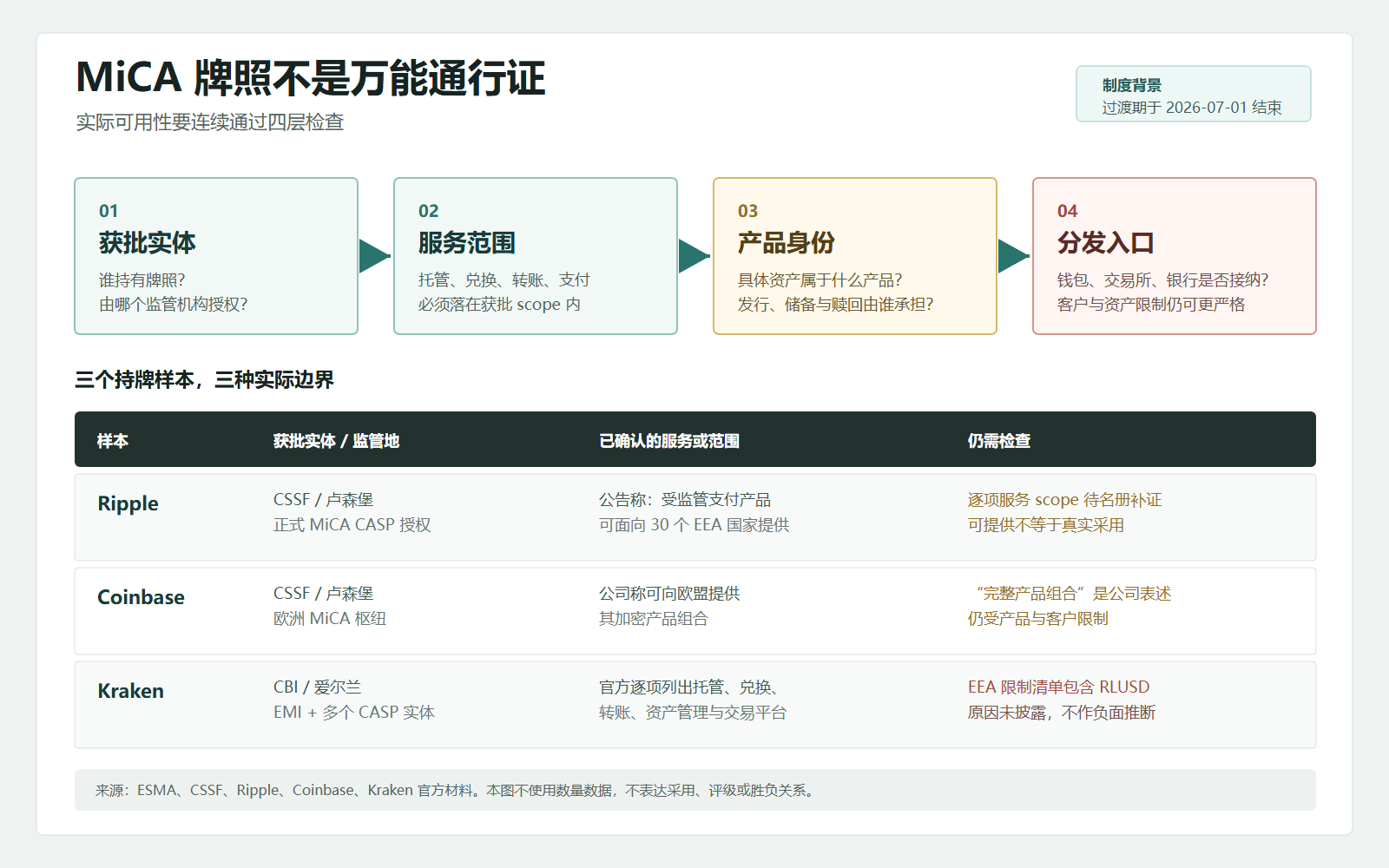
A more accurate judgment is that what MiCA authorization opens up is a regulatory pathway for approved entities to cross-border provide approved services. Whether a product ultimately reaches users depends, in sequence, on the scope of services, the product identity, and the distribution entry point. A license is a necessary condition, but it is not the complete answer to whether a product is reachable.
From transitional status to formal operating qualification
The importance of this authorization first comes from the timing. ESMA states that the latest transition period for CASP under MiCA ends on July 1, 2026; Luxembourg’s CSSF also clearly indicated that the 18-month transition arrangement that existing domestic VASPs can rely on in that country ends on the same day. After that, old national registration is no longer a long-term substitute for continuing to operate.
Therefore, Ripple’s journey from the initial approval in June to the formal authorization on July 6 is not merely adding one more compliance label. It moves its European business from a state of “waiting for regulatory completion” to a state where it can conduct cross-border passporting based on the approved entity and service scope. For institutional clients seeking payment, custody, or liquidity services, whether the counterparty can continue operating has become part of the procurement structure.
However, passporting follows the approved legal entity and specific services—not all products under the group brand. CSSF’s explanation of MiCA shows that CASP is constrained by authorization, prudential, and organizational requirements; different services must fall within the scope of the license. Ripple’s announcement confirmed the formal authorization and geographic scope, but the materials available in this round have not yet shown the itemized service list from the CSSF/ESMA registries. As a result, “can provide regulated payment products to 30 EEA countries” can be cited as a company-communications description of business scope, but it cannot be expanded into “all Ripple products have been approved for sale.”
The same MiCA framework still creates different product boundaries
Similar cases make this difference even clearer. After Coinbase obtained its MiCA authorization from CSSF in 2025, it made Luxembourg the European hub and said it could provide its crypto product suite to all 27 EU member states. Kraken, on the other hand, holds its EMI and MiCA CASP licenses through an Irish entity; its official page lists services in detail, including custody, exchange, order execution, transfers, asset management, and trading platforms.
These companies can all say they have a MiCA regulatory basis, but the actual boundaries are not the same. The location of the legal entity differs, the approved service combinations differ, and the product catalog differs as well. The license provides a unified framework, and it will not turn each company’s business structure into the same kind of product.
Kraken’s official EEA page also provides a more direct counterexample: even if the platform itself holds MiCA CASP and EMI licenses, it still lists a set of assets that certain EEA customers cannot deposit or trade, including RLUSD. The page does not explain the specific reason for this restriction, so you cannot infer that Kraken or the regulator made a negative judgment about RLUSD. But it is enough to prove that being licensed as an issuer or service provider does not automatically require another licensed entry point to accept a given asset.
In other words, the distribution of digital assets in Europe must pass at least four layers of checks: who the approved entity is, what services it is authorized to provide, what regulatory product type a given asset falls under locally, and whether wallets, exchanges, banks, or payment platforms allow customers to use it. If any one layer is not connected, the “coverage of 30 countries” users see will be narrower than the geographic scope stated in the announcement.
Regulatory identity has become a product attribute
The significance for RWA and stablecoin research is not that “compliance necessarily leads to adoption,” but that the regulatory identity has already become part of the product structure itself. When analyzing stablecoins in the past, the market often first looked at reserves and the peg. Once you enter the institutional distribution stage, you also have to ask which entity provides the services, who assumes redemption or payment responsibility, which customers and assets the interface allows, and where users can exit in stress scenarios.
Coinfound is more suitable for recording this relationship as structured fields rather than compressing “licensed” into a yes-or-no label: the regulatory entity, the competent authority, the CASP service scope, the EMI or EMT status, the passport geography, interface restrictions, and the actually available products should be recorded separately. Only then can you distinguish regulatory standing, product risk, and real adoption.
Ripple’s authorization has already shown that a single, unified European license can bring a large service provider into a formal cross-border operating framework; what current evidence cannot prove is that RLUSD or the Ripple payment network therefore achieves widespread usage. In the next 3 to 12 months, three more effective validation signals will be: (1) the complete service scope disclosed in the CSSF or ESMA registries, (2) RLUSD going live and the changes to restrictions at compliant entry points within the EEA, and (3) data on European customers, payment volumes, or settlement volumes.
MiCA licensing is not the endpoint of the story. It only moves the question from “can it enter Europe” to a more specific layer: through which entity, which services, and which products, via which interface they enter.
Source
Ripple: Full MiCA CASP Authorization
CSSF: Markets in Crypto-Assets (MiCA/MiCAR)
ESMA: MiCA transitional period ends
Coinbase: MiCA licence in Luxembourg
Kraken: Where is Kraken licensed or regulated?