


(Source: Vico.com robot)
"Guangzhou Huangpu Released" reports that on a recent date, the Guangdong Provincial People's Government and JD Group successfully signed a strategic cooperation agreement, along with the launch ceremony for JD Industrial Development's RoboBase project.
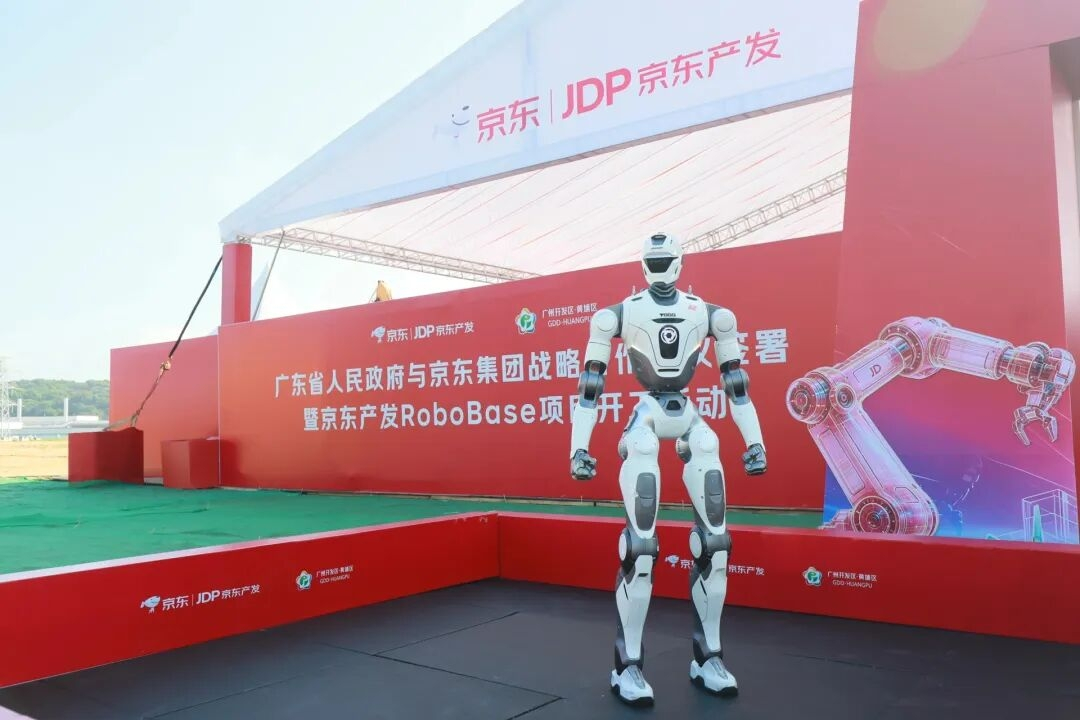
It is reported that JD Industrial Development's RoboBase project started construction in Guangzhou Science City in Huangpu. This is the first RoboBase project that JD has rolled out globally in the field of robotics. Liang Mian, Deputy General Manager of JD Industrial Development for the South China region, said that the project is positioned as an "industrial infrastructure operator." It does not directly engage in robot R&D or manufacturing, but aims to become "the company that understands robots best."
The project covers a total construction area of approximately 190,000 square meters. It is JD.com’s core layout in the advanced manufacturing and robotics sectors. The project aims to develop an integrated system of “R&D—manufacturing—applications—services,” to create a fusion platform of “high-end manufacturing + technological innovation + ecosystem services,” and to build a complete closed-loop ecosystem for the robotics industry. The project is expected to be fully completed by the end of 2028, with commissioning and production to begin in 2029, reaching full capacity in 2030. After reaching full capacity, the annual output value will be 1.75 billion yuan.
Worth noting is that from obtaining the land to starting construction took only a little over two months. This May, Guangzhou Jinhao Intelligent Manufacturing Co., Ltd. won the JGQG-D5-5 plot for 156 million yuan. The plot is located northeast of the Guangzhou Petrochemical Ethylene Plant in the Huangpu District, east of the extension line of Kaida Road, and south of Dongji Road. It will be used to build the JD.com Guangzhou Artificial Intelligence Manufacturing Industrial Park.
As an e-commerce powerhouse, in the robotics sector JD.com—grounded in self-developed logistics robots—extends upward into embodied-intelligence technology R&D and investment layouts in related fields, and goes downward to deepen application ecosystems on the consumer and industrial sides. Through a step-by-step approach, it has built its own competitive advantages in the industry.
Since 2016, JD Logistics has stepped up efforts to develop intelligent delivery vehicles and apply them in front-line scenarios, continuously advancing technology and iterative upgrades. Currently, based on the “collaboration” philosophy of the Wolf Pack, JD Logistics has successfully incubated the “Wolf Pack” embodied-robot legion, covering the entire logistics chain, including storage, handling, sorting, and last-mile delivery. Last October, JD Logistics officially announced that over the next five years it will purchase 3 million robots, 1 million unmanned vehicles, and 100,000 drones, fully deploying end-to-end logistics supply-chain scenarios and achieving a comprehensive intelligent upgrade of logistics processes.
In the field of embodied intelligence, in July 2025, JD.com announced that its in-house large-model brand would be upgraded to JoyAI, and it has reached deep cooperation with nearly 200 brands of robots and other intelligent terminal devices. In March 2026, JD.com announced it would build the world’s largest embodied-intelligence data collection center with the most comprehensive range of scenarios; within two years, it is expected to accumulate over 10 million hours of high-quality data.
In addition to self-development, JD.com has also continued to make strong moves in the capital arena, precisely positioning itself in key tracks such as general humanoids, quadruped special robots, embodied AI algorithms, and core robotic components, while also laying out multiple niche tracks such as cooking robots. Companies such as Qianxun Intelligent, Zhongqing Robot, Zhujidongli, Yuan Yuan Robot, Yunshenchu Technology, Xinglu Technology, Pasini, RoboScience, and Xinghai Map—all have JD.com’s involvement.
According to the China Business Industry Research Institute, the market size for embodied intelligence in China will reach 1,090.4 billion yuan in 2026. Behind the trillion-level market scale are comprehensive improvements in technology maturity, scenario fit, and industry supporting capabilities—meaning the industry has officially entered a high-speed period of large-scale and industrialized development.