July 12, CCTV Finance and Economics cited a CNBC report: The U.S. employment consulting firm "Challenger" (Challenger, Gray & Christmas) released its monthly report. As of the end of June, layoffs accumulated in the U.S. tech industry in the first half of this year were close to 140,000, mainly due to restructuring and automation brought about by AI.
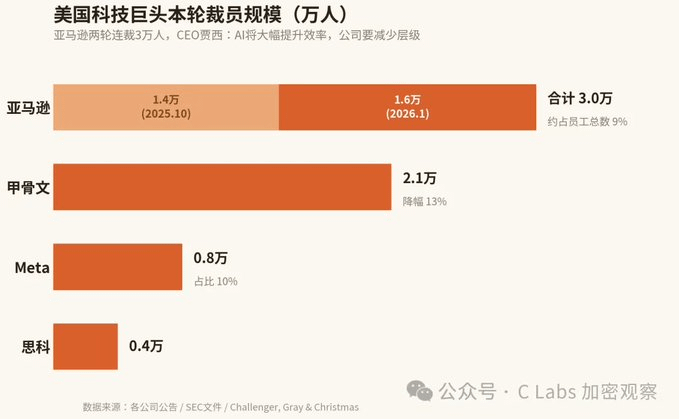
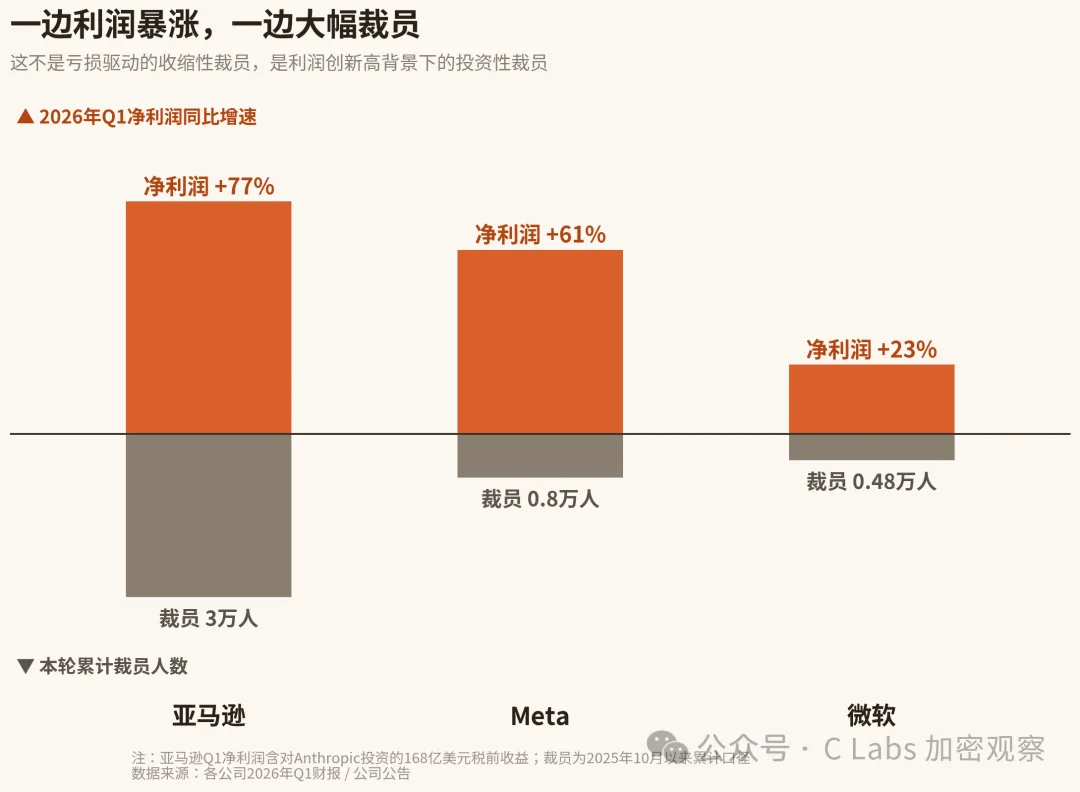
The hardest hit was Amazon $AMZN — it laid off 16,000 in January alone. Just three months earlier, it had already laid off 14,000. Across the two rounds, the total accounted for about 9% of the company’s total employees.
CEO Garsi’s remarks were blunt: In the next few years, AI will significantly improve efficiency, and the company needs to reduce layers to stay flexible.
$META This year has also involved multiple rounds of operations; the latest one was in May, when 8,000 people were laid off, accounting for 10%. Oracle and Cisco followed suit.
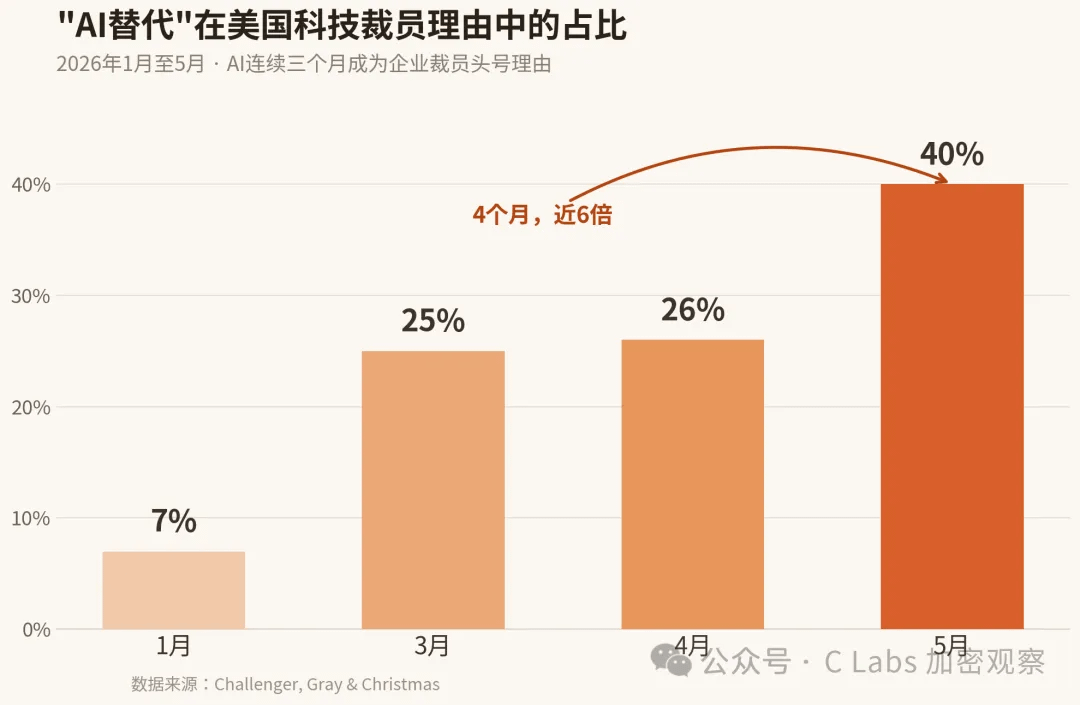
140,000 people in half a year—this figure is close to the whole-year number for 2025. And “AI replacement” has already become the largest share of U.S. tech layoffs, reaching 40%...
And at the same time, tech companies here in China have also been laying off plenty of staff.
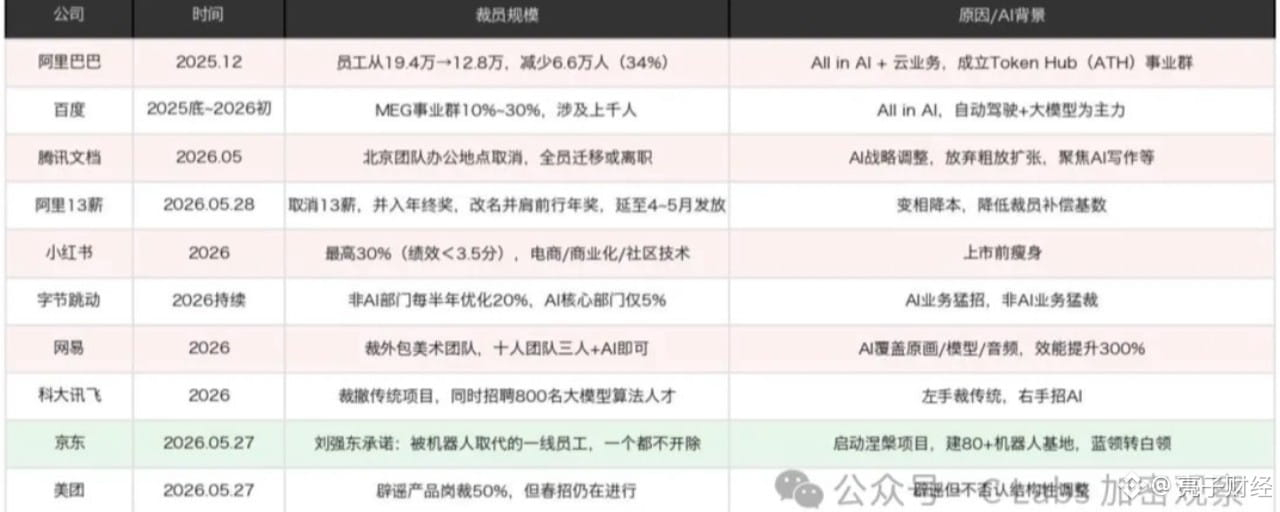
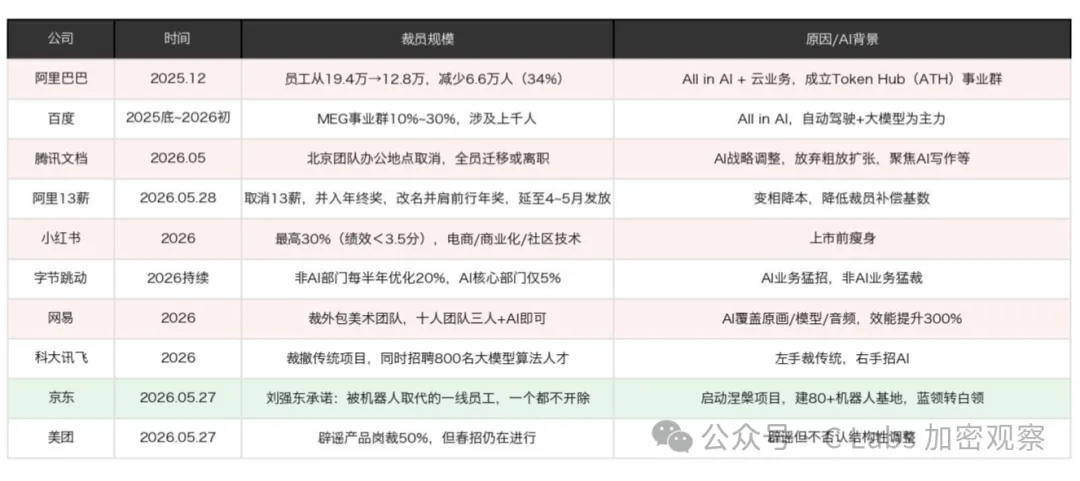
For example, Alibaba has 66,000 fewer staff in a year and has set up the Token Hub business group while canceling the 13th salary.
ByteDance internal leaks say that non-AI departments optimize rolling processes by about 20% every half year, while the core AI departments only do 5%.
In the wake of layoffs, Tencent Docs’ Beijing team was reportedly entirely dismantled in May, with employees given deadlines to leave, and pregnant women were no exception. The official response was “internal transfers are open,” but the Beijing office location effectively disappeared for real. The product logic has also changed—abandoning traffic expansion and shifting to high-paying scenarios in Tencent Cloud’s B2B ecosystem, such as AI writing and intelligent PowerPoint.
In Baidu’s MEG business group, some departments optimized by 20%–30%. From cutting fresh graduates to cutting up to ten-year veteran employees, some teams have effectively disappeared as whole units.
Xiaohongshu also carried out layoffs before going public. Rumor has it that the proportion could be as high as 30%, targeting employees with performance ratings below 3.5.
Meituan and NetEase have also reportedly carried out large-scale layoffs...
Against the backdrop of layoffs, these tech companies’ profits are still rising in parallel—and the higher the profit, the more ruthless the layoffs...
From this logic, it’s not that many tech companies are laying off because they don’t have money; rather, employees’ future performance growth no longer has much effect.
But AI isn’t actually cheaper than human employees. Meta’s AI capital expenditures this year are 125–145 billion USD, almost double last year; Microsoft expects 190 billion for the full year; Google has raised it to 180–190 billion; and Amazon will burn 200 billion for the full year. The industry total is about 725 billion USD.
And with about 140,000 people laid off in the first half in the U.S., at 250,000 USD per person, they’ll save about 35 billion for the whole year—just enough to pay 5% of the Silicon-based bills.
To raise money for AI, U.S. tech companies have cumulatively developed 182 billion this year, which is up by 13 billion compared with the same period in 2025.
Based on data compiled by Bloomberg, the five companies with the largest data-center investment in the U.S. (Alphabet, Amazon, Meta, Microsoft, and Oracle) added about 350 billion USD in debt over the past five years, doubling the scale of their debt.
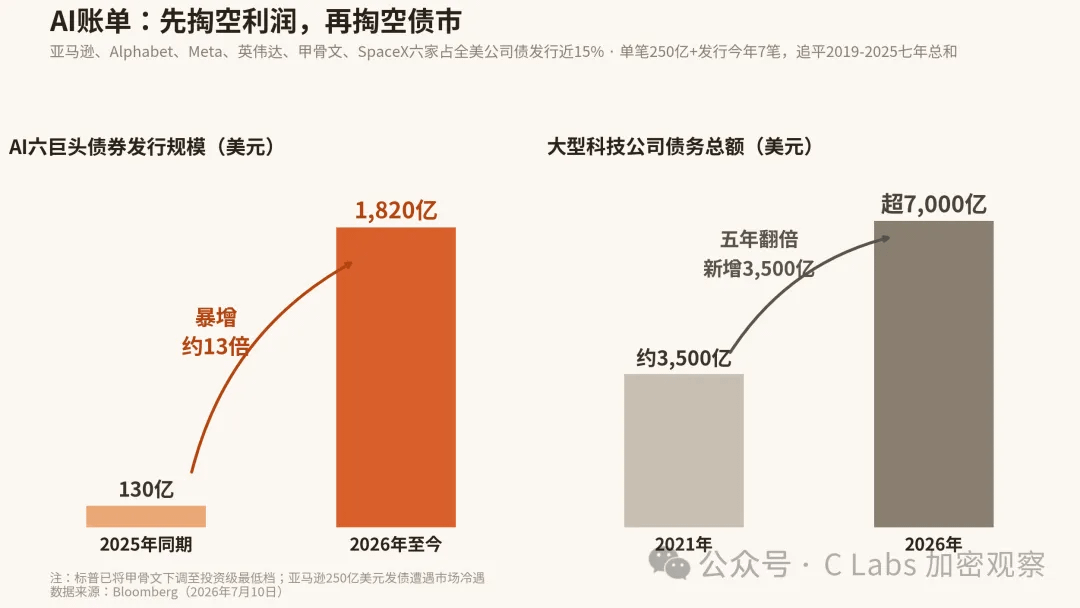
Among them, Oracle $ORCL was even downgraded by S&P for excessive debt issuance, with its debt rating cut to “BBB-”, only one notch above junk status.
In its rating report, S&P explicitly listed OpenAI as Oracle’s “critical credit risk.” It pointed out that Oracle’s AI business cash burn is far higher than expected. Capital expenditure projections have been sharply raised from the earlier 60 billion USD to 95 billion in 2027, while the corresponding revenues won’t be realized until years later.
In Oracle’s contract obligations worth 638 billion USD, OpenAI accounts for about half. S&P warns that if OpenAI faces an operating crisis, Oracle will be stuck with a large data-center capacity that can’t be digested, dramatically amplifying financial pressure.
Other tech companies’ expansion logic is basically the same as Oracle’s as well: the investment is also focused on data centers.
Once there’s even a slight whiff of change in optimistic expectations for AI’s future, you can’t even imagine what this would look like...