
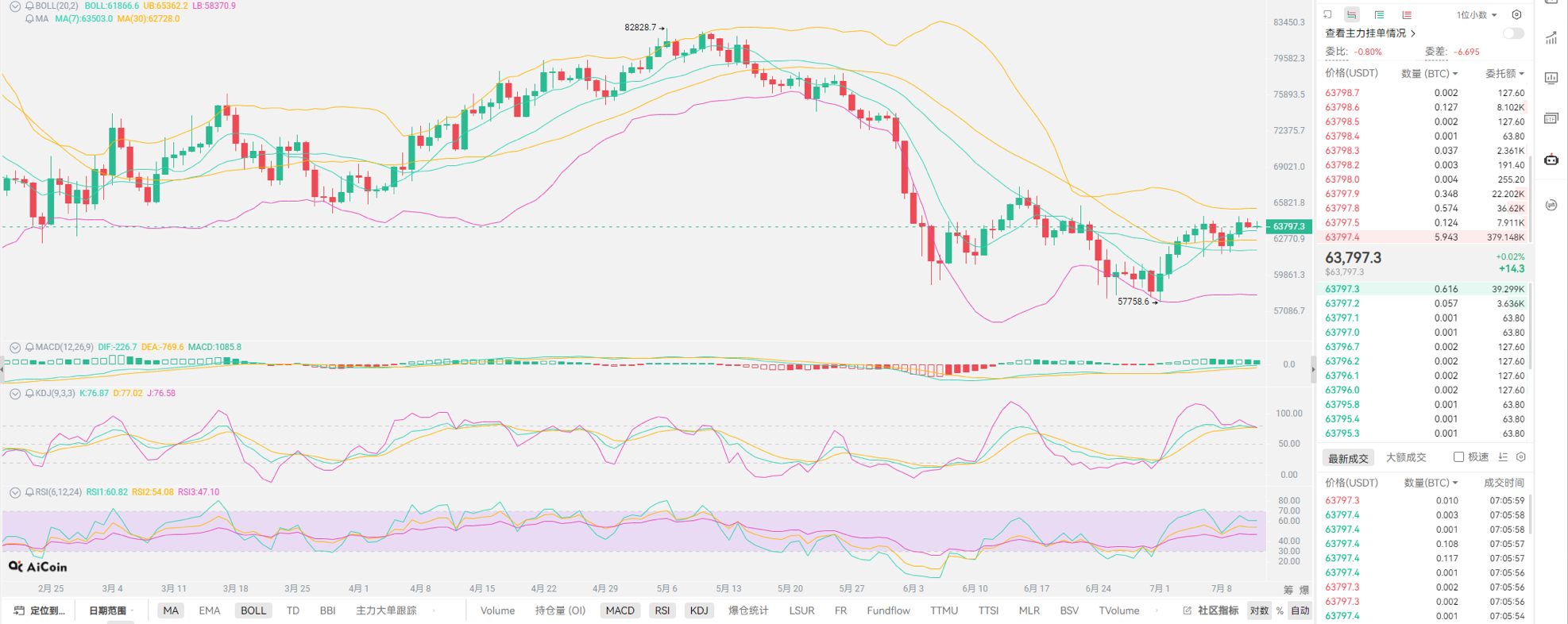

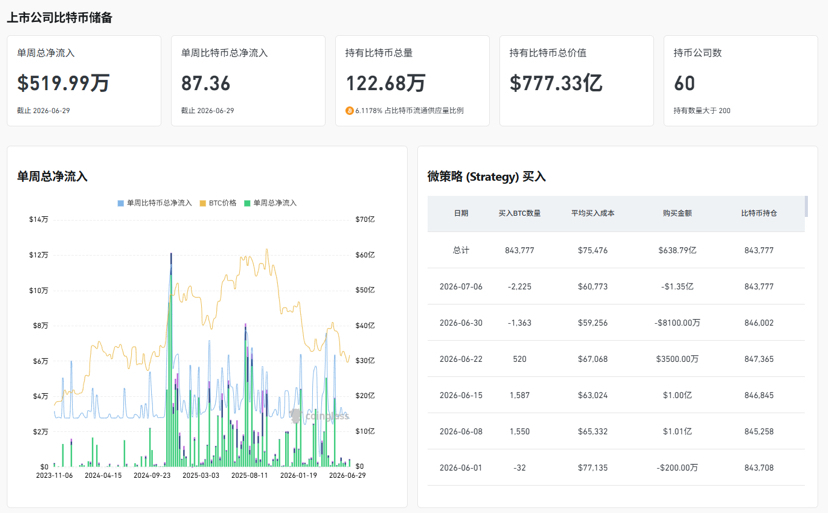
The latest June data from the “old Americans” has been fully released, and the crypto market has cooled down again. Even though the prior employment data was so disappointing, this round’s meeting minutes still did not choose to loosen policy or take measures to cut interest rates. Internally, opinions on the tools for controlling interest rates are not unanimous, and this has caused the market to lurch back and forth repeatedly, in a kind of tightening squeeze. Coupled with the recent leaks of MicroStrategy data, as long as Bitcoin rebounds too aggressively, large capital will sell. The anticipated interest-rate-cut tailwind has nearly been worn out already. In the later stage, the market may well fall back into a bearish phase again. Do you think the survival pressure in the crypto space has increased by multiples? For the bull market to come, do you truly still have confidence? No more idle talk—think about it: why can even the internal views within the Federal Reserve not be unified? Before this, Waish has been candid: the expectation for the 2% inflation target will not change, almost as if laying the groundwork in advance for this year’s rate hikes. So will this year see rate hikes or rate cuts?
This is where everyone needs to understand the rules of financial markets. When you combine it with real-world conditions, you may also have some feelings about the polarization. In China, both housing and the prices of major durable goods have been falling steadily, while living costs are rising. Faced with these changes, it’s hard to understand whether cash is losing value or increasing it. Lao Cui’s view is that the flow of wealth is changing, and this is also what drives domestic demand. The logic behind it is extremely simple: with insufficient income expectations, people naturally buy fewer big-ticket items, leading to weaker consumption in the market and pushing prices downward. So this gap has to be taken up by another market—demand-driven news naturally becomes more valuable. Right now, the financial market is also like this: demand-driven assets appreciate, while concepts decline. MATE has painstakingly promoted the metaverse for years, then moved to AI, and only after that—up to the current sale of computing power—did it start to turn a profit. This alone explains a lot.
From this perspective, the hardest part of investing in the crypto market is valuation. It doesn’t belong to anything that’s true “necessity demand,” and it also isn’t just about “concept.” Instead, it genuinely tests the decision-making and resolve of those at the top. When rice falls to 50 cents, someone will still buy it; when gold rises to $2K, someone will still sell it. A company’s stock valuation has profits and scale as reference points. But in reality, Bitcoin’s price increase has no comparable benchmark. As stablecoins are increasingly accepted by more people, Bitcoin’s practical value is being gradually eroded. Its “channel operation” capability is being questioned, and it isn’t suitable for real-world applications. You don’t need to speculate wildly either—Bitcoin’s collectible value is still very hot. In the future, with platform and team optimization, its computational capability will also undergo innovation and upgrades. The disadvantages in the short term don’t indicate anything too serious. The impact from the military side will gradually be eliminated. Before rate cuts, these issues can be resolved, and the market will return to its proper track.
Lao Cui summarizes: Through recent volatility, as you all have observed in the past two months’ trend, you can see that if someone wants to make a new low and also hit a short-term new high, capital will hesitate. This hesitation is not unique to just the crypto market; it comes from the fact that the definition of higher-level direction is vague—wanting to support a flourishing era in finance, yet being unable to effectively control inflation. When policy is tugged back and forth between rate cuts and rate hikes, it creates an unclear outlook for the current trend. Lao Cui himself believes that at least one rate cut will occur this year, so he firmly thinks there will still be a time window for bullish pressure to strike. It may come later, but it will arrive. For spot users looking to bottom-fish: around sixty thousand can be acted upon; don’t wait for a new low. An unclear trend will only show up this year. As troublesome events gradually get resolved, what comes next is only a bullish counterattack. Also, don’t easily trust the so-called financial crisis—this is not a drawback for the crypto market. A financial crisis could even be a rescue for crypto. Fundamentally, crypto has the ability to withstand inflation—it just depends on how capital chooses. For futures users: as long as you can’t break into the 64,000 position, that’s the time to short. In the short term, the outlook is still bearish.