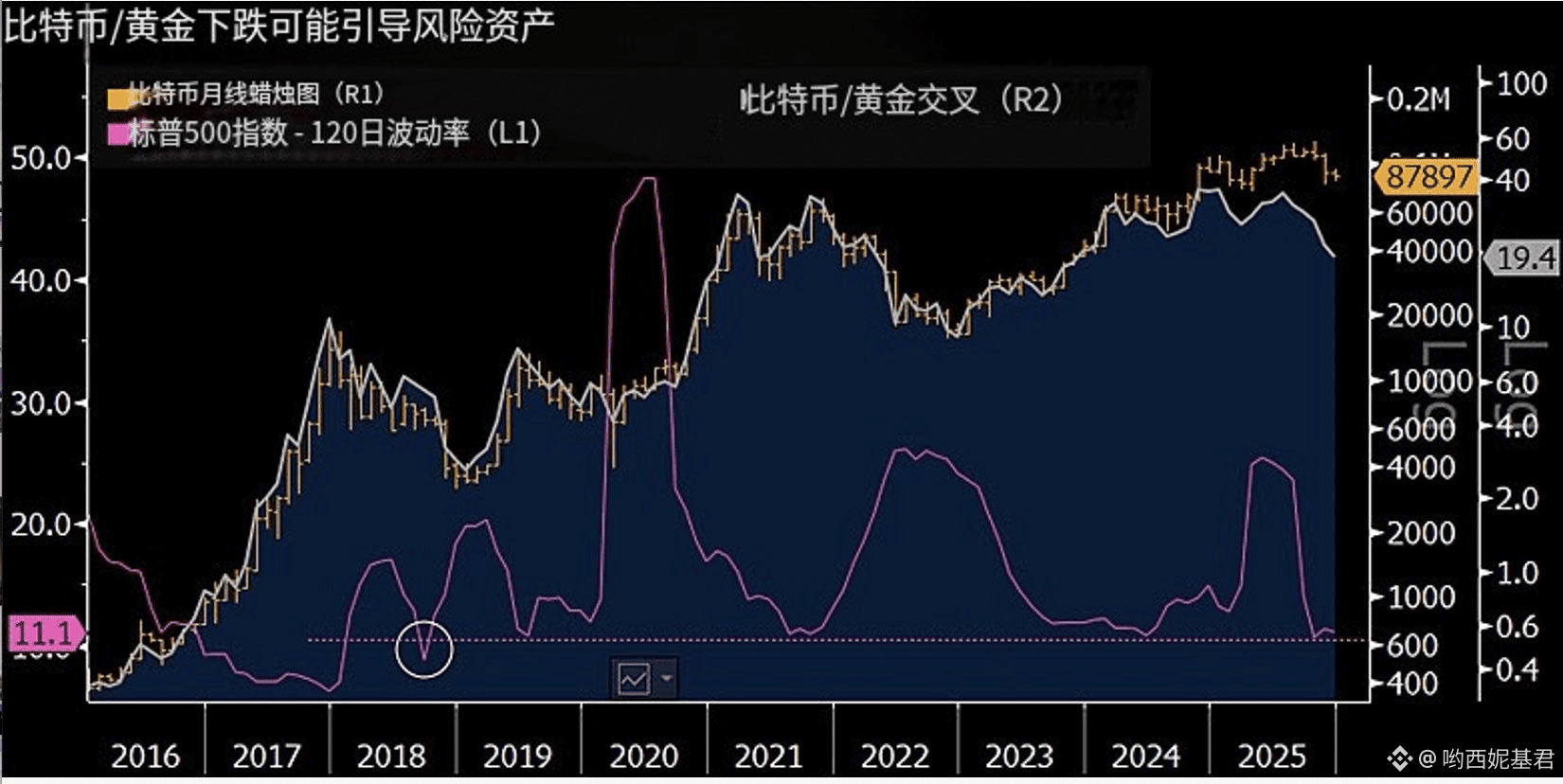
Bloomberg predicts BTC will drop to $10,000. After reviewing major institutions' forecasts for Bitcoin next year, I found something quite interesting: almost everyone is bullish, except for Bloomberg, which is forecasting a harsh fall to $10,000.
Looking back at Bloomberg's prediction history, in 2018, when BTC was at $10,000, Bloomberg said it would drop to $1,500, but the actual lowest was $3,200; in 2021, Bloomberg predicted a sky-high price of $400,000, but the highest it reached was only $69,000.
How to put it… their prediction style has always been quite reckless. As for this time, Bloomberg analyst Mike McGlone's logic seems somewhat detached from reality. He said there are millions of crypto competitors for Bitcoin, unlike gold which only has a few opponents like silver—this sounds reasonable on the surface, but those who have been in the crypto space for a while understand: your grandpa is still your grandpa.
BTC's position in the crypto world is no longer something that can be shaken by the number of competing coins. Its consensus, liquidity, institutional allocation weight, and even its role in macro narratives cannot be replaced by other altcoins. If it really drops to $10,000, let alone miners, I estimate that most exchanges, asset management institutions, and Layer 2 ecosystems would have to rewrite their scripts. That’s not a correction; that’s a complete reset.
Of course, we shouldn’t completely deny the risks. If gold continues to strengthen under risk-averse sentiment next year, U.S. stocks and Bitcoin could indeed face pressure in the short term, but that is a different matter from dropping to $10,000. A more likely scenario is that gold strengthens, Bitcoin oscillates at high levels, and altcoins differentiate further. In the current irreversible institutionalization process, BTC's volatility may converge, but the probability of an extreme crash is actually decreasing.
In short, investing ultimately needs to return to logic and data, rather than anxiety and speculation.
#加密市场观察 $BTC $ETH