I spent the whole afternoon in a coffee shop. I originally planned to write something else, but two people next to me kept talking about trading platforms.
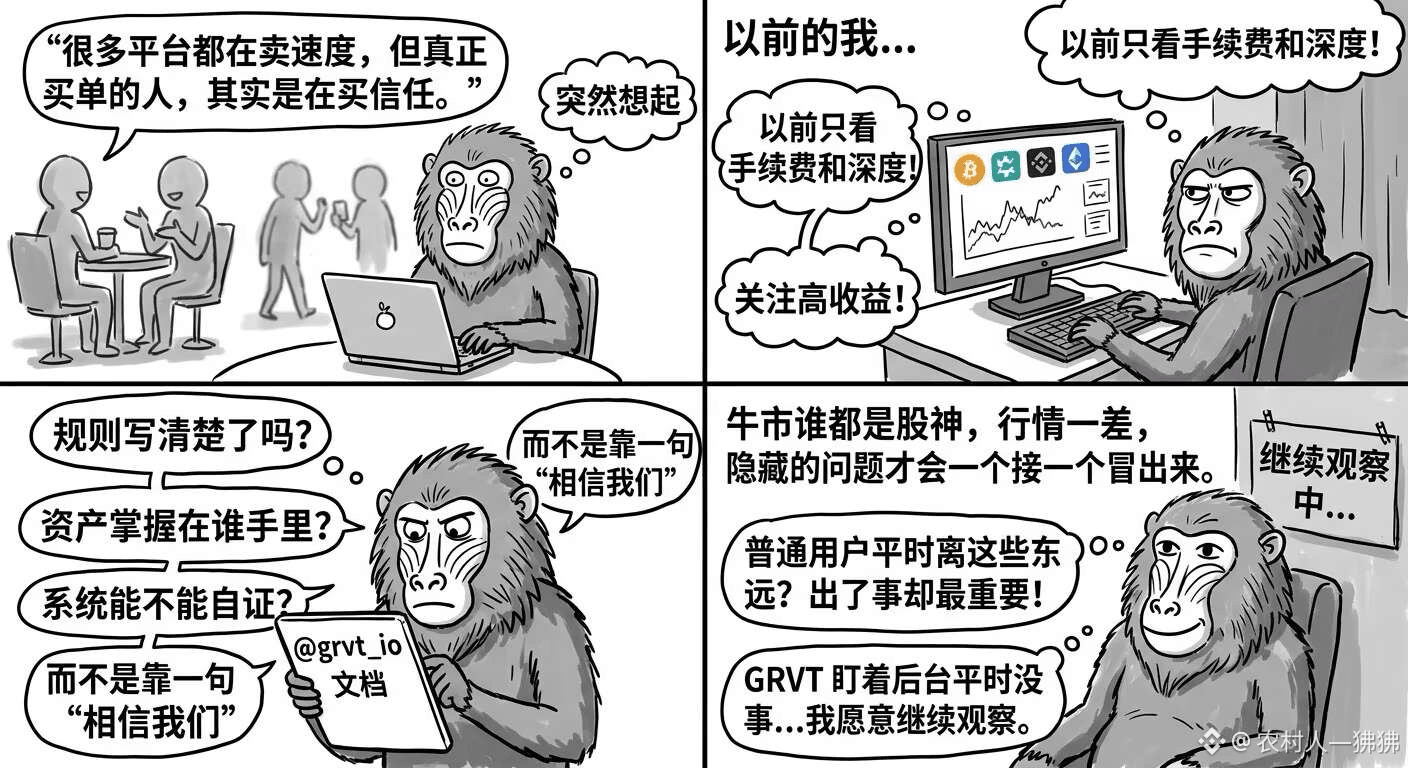
One of them said something, and I still remember it to this day: “Many platforms sell speed, but the people who actually place orders are really buying trust.” 🥹
At the time, I didn’t jump in. But after I got home, I couldn’t stop thinking about that line.
Later, I opened the document for @grvt_io and reviewed it again. Suddenly I realized that a lot of its design is really answering one question—if one day the platform has a problem, will users still be able to understand what exactly happened?
In the past, when I chose a trading platform, what I cared about most was trading fees and liquidity depth. Now, that’s changed. What matters more to me is whether the rules are written clearly, who truly controls the assets, and whether the system can verify itself—not by relying on a phrase like “trust us.”
Many people think these things are far removed from ordinary users, but I’ve always believed that what truly determines the experience is never the easy, tailwind situation. In a bull market, everyone looks like a stock god—when the market turns, all kinds of hidden problems start surfacing one after another. 🤓 $BTC
At least, GRVT lets me see that it doesn’t just focus on the front-end user experience. It also puts effort into the back-end—the things nobody praises when everything is fine, but that are the most important when something goes wrong. For a project like this, I’d be willing to spend more time continuing to observe it. @grvt_io #grvt
One of them said something, and I still remember it to this day: “Many platforms sell speed, but the people who actually place orders are really buying trust.” 🥹
At the time, I didn’t jump in. But after I got home, I couldn’t stop thinking about that line.
Later, I opened the document for @grvt_io and reviewed it again. Suddenly I realized that a lot of its design is really answering one question—if one day the platform has a problem, will users still be able to understand what exactly happened?
In the past, when I chose a trading platform, what I cared about most was trading fees and liquidity depth. Now, that’s changed. What matters more to me is whether the rules are written clearly, who truly controls the assets, and whether the system can verify itself—not by relying on a phrase like “trust us.”
Many people think these things are far removed from ordinary users, but I’ve always believed that what truly determines the experience is never the easy, tailwind situation. In a bull market, everyone looks like a stock god—when the market turns, all kinds of hidden problems start surfacing one after another. 🤓 $BTC
At least, GRVT lets me see that it doesn’t just focus on the front-end user experience. It also puts effort into the back-end—the things nobody praises when everything is fine, but that are the most important when something goes wrong. For a project like this, I’d be willing to spend more time continuing to observe it. @grvt_io #grvt