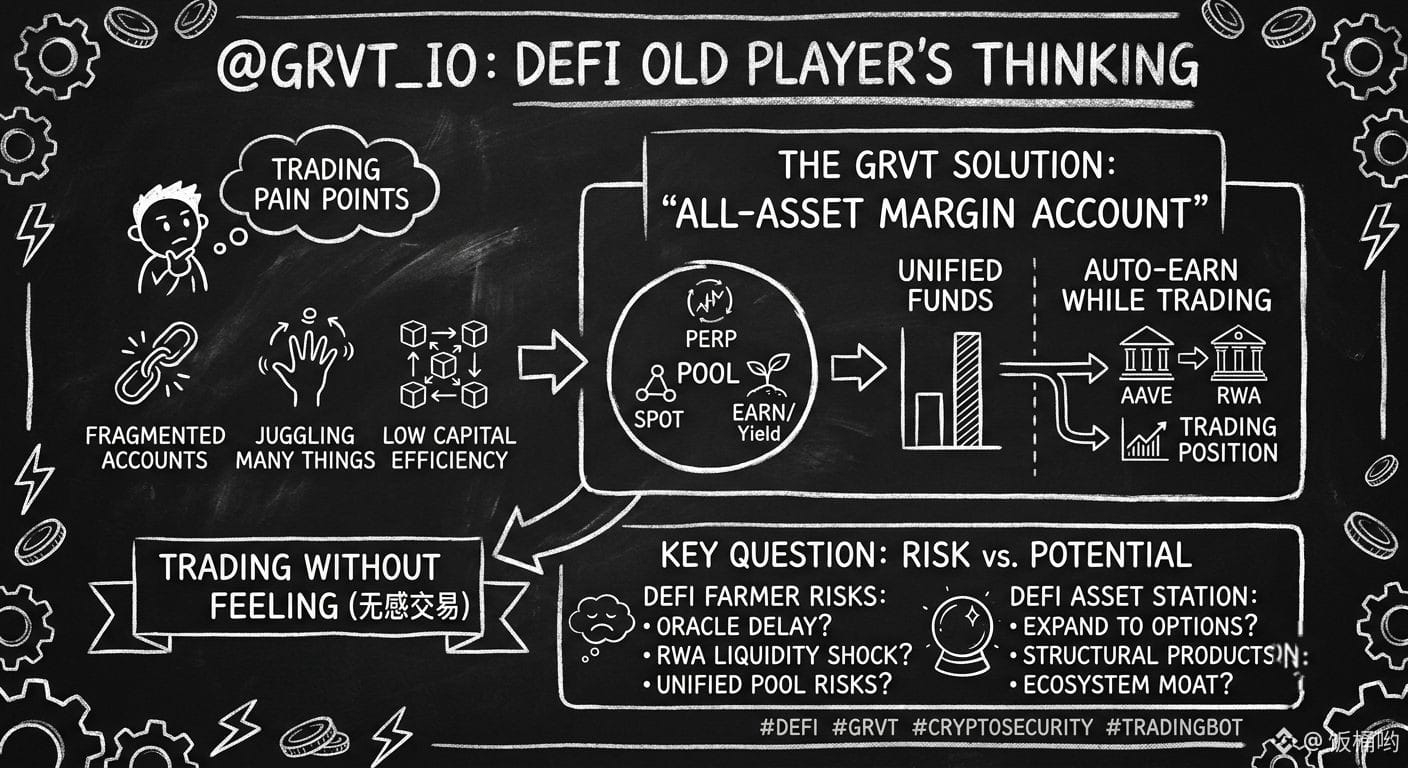
Recently I’ve seen quite a few people discussing the technical whitepaper of @grvt_io . After carefully thinking it through, I believe its core logic has really nailed one of the pain points for DeFi veterans. In the past, doing trades on-chain was basically like playing a “funds-moving laborer” game: if you wanted to hedge with derivatives, you had to go to a DEX; if you wanted to do stablecoin mining, you still had to withdraw and switch chains. Between endless signatures, approvals, and Gas fees, capital gets scattered across multiple smart contracts, and efficiency is as low as a product from the last century. The “all-asset margin account” approach promoted by GRVT, put simply, is to replicate in a decentralized world the “one account does everything” experience you’d have with brokerage-style platforms like Futu or Interactive Brokers. This idea really hits the urgent need.
A few days ago, I went to try their testnet. The most direct feeling is that it’s seamless. In the past, we either compromised with the centralized risks of CEXs or endured DeFi’s cumbersome processes. But GRVT connects perpetuals, spot, and underlying earning channels—such as Aave and some RWA protocols—so that when your funds are idle, they can automatically earn without you having to place orders. Once you need to open a position, these earning assets can directly serve as collateral. This “liquidity perpetual-motion machine” concept is indeed far more sophisticated than the single-purpose protocols fighting their own battles in the market.
That said, as a DeFi farmer who has stepped into countless traps, in my eyes it’s not just about returns—there are also risks. A tightly coupled liquidity setup like #grvt puts extreme pressure on the oracle’s price-feeding speed and the liquidation mechanism. If an extreme black-swan event hits and the liquidity of underlying assets like RWAs temporarily slips out of peg or experiences delays, would the unified account trigger cascading liquidations? Also, putting all your eggs into one “super pool” means the audit boundaries of the smart contract and code security directly determine the fate of retail users. Whether the isolation mechanisms that prevent the collapse of one block will hold up—well, that’s still a big question.
I actually hope they further expand horizontally into other derivatives categories—whether structured finance products or more complex volatility-based products can also be placed into this unified account. If the moat of the ecosystem can deepen as more asset classes are added, then GRVT won’t just be a handy trading tool—it could have a chance to become an all-in-one on-chain asset management endpoint.
At the end of the article, I want to ask everyone: do you think this grvt model is promising?
A few days ago, I went to try their testnet. The most direct feeling is that it’s seamless. In the past, we either compromised with the centralized risks of CEXs or endured DeFi’s cumbersome processes. But GRVT connects perpetuals, spot, and underlying earning channels—such as Aave and some RWA protocols—so that when your funds are idle, they can automatically earn without you having to place orders. Once you need to open a position, these earning assets can directly serve as collateral. This “liquidity perpetual-motion machine” concept is indeed far more sophisticated than the single-purpose protocols fighting their own battles in the market.
That said, as a DeFi farmer who has stepped into countless traps, in my eyes it’s not just about returns—there are also risks. A tightly coupled liquidity setup like #grvt puts extreme pressure on the oracle’s price-feeding speed and the liquidation mechanism. If an extreme black-swan event hits and the liquidity of underlying assets like RWAs temporarily slips out of peg or experiences delays, would the unified account trigger cascading liquidations? Also, putting all your eggs into one “super pool” means the audit boundaries of the smart contract and code security directly determine the fate of retail users. Whether the isolation mechanisms that prevent the collapse of one block will hold up—well, that’s still a big question.
I actually hope they further expand horizontally into other derivatives categories—whether structured finance products or more complex volatility-based products can also be placed into this unified account. If the moat of the ecosystem can deepen as more asset classes are added, then GRVT won’t just be a handy trading tool—it could have a chance to become an all-in-one on-chain asset management endpoint.
At the end of the article, I want to ask everyone: do you think this grvt model is promising?