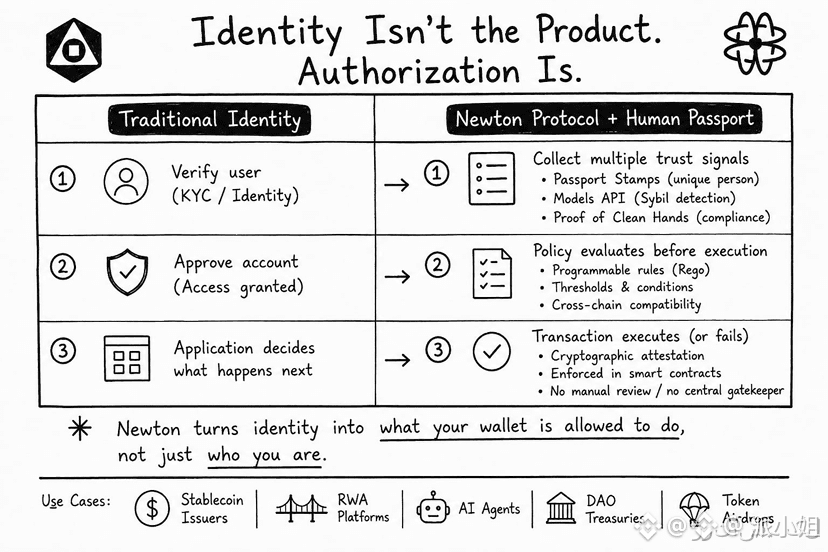
There’s no shortage of narratives in the crypto space—but the only four-word bottom line I run scripts and build interactions on is: put survival first. Instead of staring at the K-line charts being repeatedly harvested by macro sentiment, I’d rather go into GitHub and dissect the underlying layer. For DeFi protocols, I’ve always insisted on three questions: Who makes the decisions? Who is accountable if something goes wrong? Can the money be secretly moved away? Most projects in the past just used “multisig” as a band-aid. Recently, I did a hardcore breakdown of Newton’s mainnet Beta for <c-1/>@NewtonProtocol (\$NEWT ) and found that it finally delivers an engineering-level hard answer.
Newton’s approach is to shift defense to the front. I previously compared the Sign Protocol SDK and EAS in depth; they mostly do post-event attestation, while Newton is an interception net before settlement. It abandons the clumsy method of hard-coding rules into Solidity and instead uses the Rego language to write strategies: deny by default, allow only when multi-dimensional conditions are met. Traditional contracts are like concrete poured once and set in stone, but its decoupled architecture enables dynamic hot updates—truly a dimension-reduction strike. From real-world deployments, Magic Labs integrated Newton via VaultKit into a wallet network in the 50-million-level range. Curators must pass an invisible security screening before rebalancing, while front-end users feel absolutely nothing. That kind of deep, non-breaking infrastructure insertion is what “good base layer” looks like.
On security, it doesn’t rely on human character—it relies on mathematics. Newton borrows EigenLayer’s AVS mechanism: if nodes act maliciously, they forfeit real ETH-staked collateral. Combined with Succinct’s zero-knowledge proofs, the complex ~45-second off-chain evaluation process is transformed into an on-chain verifiable adjudication.
But don’t get ahead of yourself—there are still fatal hidden risks.
First is data-source centralization. The strategy engine heavily depends on RedStone price feeds and Credora credit scores. Joint reasoning is great—until the oracle’s single point of failure goes down or gets poisoned, and the entire defense collapses instantly.
Second is the suspended overhang of chips. In the just-passed June 24 unlock, NEWT released 139 million tokens—an enormous amount that made up over 37% of the circulating supply. Under this epic wave of selling pressure, its long-term value must be supported by real, cash-generating “business-side lifeblood.”
Code only enforces. It never promises that the design logic itself has no loopholes. Don’t be swayed by the grand narratives institutions love to pitch. Whether this \$NEWT “proof instead of promises” model can keep working for the long run in the EVM environment depends on whether it can withstand the most real, high-frequency stress tests from the Dark Forest.
#newt $NEWT
Newton’s approach is to shift defense to the front. I previously compared the Sign Protocol SDK and EAS in depth; they mostly do post-event attestation, while Newton is an interception net before settlement. It abandons the clumsy method of hard-coding rules into Solidity and instead uses the Rego language to write strategies: deny by default, allow only when multi-dimensional conditions are met. Traditional contracts are like concrete poured once and set in stone, but its decoupled architecture enables dynamic hot updates—truly a dimension-reduction strike. From real-world deployments, Magic Labs integrated Newton via VaultKit into a wallet network in the 50-million-level range. Curators must pass an invisible security screening before rebalancing, while front-end users feel absolutely nothing. That kind of deep, non-breaking infrastructure insertion is what “good base layer” looks like.
On security, it doesn’t rely on human character—it relies on mathematics. Newton borrows EigenLayer’s AVS mechanism: if nodes act maliciously, they forfeit real ETH-staked collateral. Combined with Succinct’s zero-knowledge proofs, the complex ~45-second off-chain evaluation process is transformed into an on-chain verifiable adjudication.
But don’t get ahead of yourself—there are still fatal hidden risks.
First is data-source centralization. The strategy engine heavily depends on RedStone price feeds and Credora credit scores. Joint reasoning is great—until the oracle’s single point of failure goes down or gets poisoned, and the entire defense collapses instantly.
Second is the suspended overhang of chips. In the just-passed June 24 unlock, NEWT released 139 million tokens—an enormous amount that made up over 37% of the circulating supply. Under this epic wave of selling pressure, its long-term value must be supported by real, cash-generating “business-side lifeblood.”
Code only enforces. It never promises that the design logic itself has no loopholes. Don’t be swayed by the grand narratives institutions love to pitch. Whether this \$NEWT “proof instead of promises” model can keep working for the long run in the EVM environment depends on whether it can withstand the most real, high-frequency stress tests from the Dark Forest.
#newt $NEWT