A few days ago I stumbled across a post on a DAO governance forum—it had over two hundred comments, turning into a full-on argument. The core dispute was simple: whether a “neutral node” claimed by a certain protocol is truly neutral or not. The challengers tossed out a string of on-chain data, painstakingly uncovering the major shareholder behind that node operator, revealing a layer of equity relationship between the operator and the protocol team. The moment the protocol’s supposed neutrality was disproven, the trust foundation of the entire protocol nearly collapsed in about a second.
This incident made me re-read a repeatedly chewed-up term in the @NewtonProtocol whitepaper: “Trusted Neutrality.” In Section 4.2, it’s listed as the “foundation” of the three pillars. I used to think it was just well-packaged public-relations language. But when I stack Section 4.2 together with the economic security mechanisms in Section 9.1 and the dispute resolution process in Section 9.3, I gradually tasted what was really going on—“neutrality” in Newton’s framework isn’t an attitude at all; it’s a precisely engineered mechanical structure.
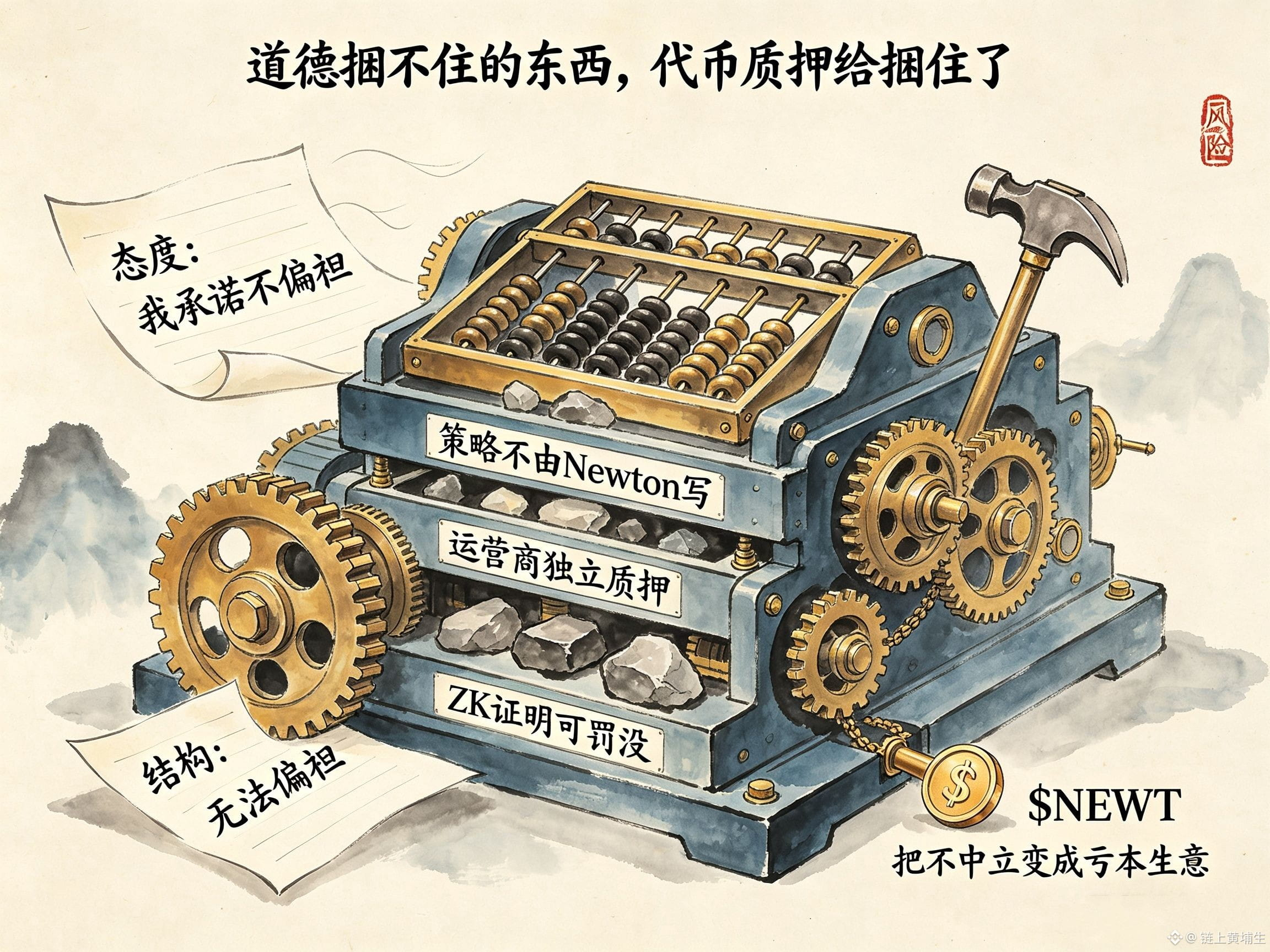
What’s the difference between an attitude and a mechanical structure? An attitude is: “I promise not to favor anyone.” Whether you believe it depends entirely on your trust in me. A mechanical structure is: “I’m simply incapable of favoring anyone.” You don’t have to trust me—you just need to look at how the gears mesh. Newton locks in this distinction with three layers of design. The first layer isn’t written by Newton; it’s decided by the application side itself, and it doesn’t even have permission to change a single punctuation mark. The second layer isn’t executed by the NewtonProtocol team; it’s handled by a group of operators, each independent and not buying each other’s story—and they must first stake real tokens. The third layer is that if this group of operators collectively develop crooked intentions, anyone at any time can post a zero-knowledge proof on-chain and trigger the forfeiture/penalty procedure. Think about it: this isn’t “I believe you will be neutral.” It’s a cold, mechanical statement to you: “If you dare not be neutral, the cost will be so high that even you won’t be able to bring yourself to pay.”#Newt
The role that $NEWT tokens play in this structure is actually quite subtle. They don’t hand anyone a moral medal for “neutrality.” They merely quietly turn “non-neutrality” into a business that is guaranteed to lose money. If morality can’t bind it, token staking will. DYOR.
This incident made me re-read a repeatedly chewed-up term in the @NewtonProtocol whitepaper: “Trusted Neutrality.” In Section 4.2, it’s listed as the “foundation” of the three pillars. I used to think it was just well-packaged public-relations language. But when I stack Section 4.2 together with the economic security mechanisms in Section 9.1 and the dispute resolution process in Section 9.3, I gradually tasted what was really going on—“neutrality” in Newton’s framework isn’t an attitude at all; it’s a precisely engineered mechanical structure.
What’s the difference between an attitude and a mechanical structure? An attitude is: “I promise not to favor anyone.” Whether you believe it depends entirely on your trust in me. A mechanical structure is: “I’m simply incapable of favoring anyone.” You don’t have to trust me—you just need to look at how the gears mesh. Newton locks in this distinction with three layers of design. The first layer isn’t written by Newton; it’s decided by the application side itself, and it doesn’t even have permission to change a single punctuation mark. The second layer isn’t executed by the NewtonProtocol team; it’s handled by a group of operators, each independent and not buying each other’s story—and they must first stake real tokens. The third layer is that if this group of operators collectively develop crooked intentions, anyone at any time can post a zero-knowledge proof on-chain and trigger the forfeiture/penalty procedure. Think about it: this isn’t “I believe you will be neutral.” It’s a cold, mechanical statement to you: “If you dare not be neutral, the cost will be so high that even you won’t be able to bring yourself to pay.”#Newt
The role that $NEWT tokens play in this structure is actually quite subtle. They don’t hand anyone a moral medal for “neutrality.” They merely quietly turn “non-neutrality” into a business that is guaranteed to lose money. If morality can’t bind it, token staking will. DYOR.