
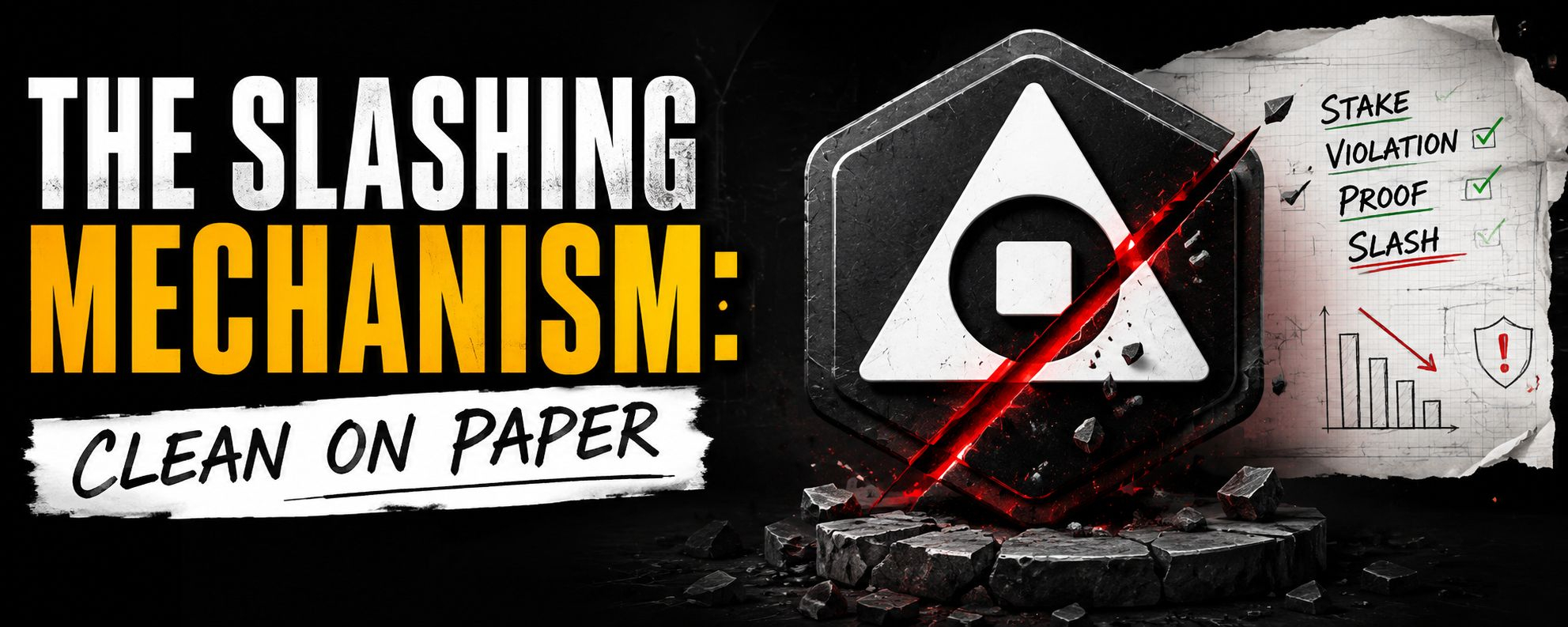

Another cycle, another slashing mechanism. Clean on paper.
Newton's approach is honest about one thing: the parameters are governance-variable, not fixed constants. That admission matters. Because the math only works if punishment reliably exceeds profit. Stake 100 !ETH#, cheat for 200, lose 10 rational actors do the math.
But the real friction isn't the percentage. It's the latency.
Challengers need to submit ZK proofs within a window. No challenge, no slash. That turns effective deterrence into a two-variable equation: severity of punishment and liveness of challengers. Early networks lack both. Limited operators, concentrated stake, unproven challenger incentives. The gap between mechanism design and mechanism effectiveness is widest at launch.
We've seen this pattern before. Every cycle promises a more elegant solution to the same problem: how to make trust optional. The vocabulary shifts from oracles to validity proofs to economic securit but the underlying tension remains. Decentralization requires coordination. Coordination requires incentives. Incentives attract exploiters. The arms race continues.
The token layer complicates everything. When the governance token itself becomes the primary value accrual mechanism, the line between protocol security and market speculation blurs. Governance turns into a game of accumulation. Security becomes a talking point for raising the floor. The actual slashing mechanism becomes background noise.
I'm not dismissing it. I'm watching.
The signal I'm waiting for isn't the whitepaper math. It's the first successful challenge. The type of violation. The time between offense and execution. Whether the record stays empty or starts filling.
There's something else worth observing: the real deterrent isn't the slash itself. It's the credible threat of the slash. That threat decays with every minute of latency. In high-throughput environments, the challenge window becomes a performance bottleneck. Operators optimize for speed, not security. The mechanics say one thing. The incentives whisper another.
Newton's design is more honest than most. It doesn't pretend to have fixed the coordination problem. It acknowledges the governance variable. That's a subtle admission that these systems remain human at their core. Politics and markets still matter. The code just enforces the consequences.
That data will tell us if this is deterrence or theater. Until then, I'm not impressed. Not dismissive. Just quietly attentive.
I'll keep watching the challenge log. When it fills, we'll know the mechanism works. If it stays empty? Either perfect behavior or perfect ineffectiveness.
We won't know until it happens.
