
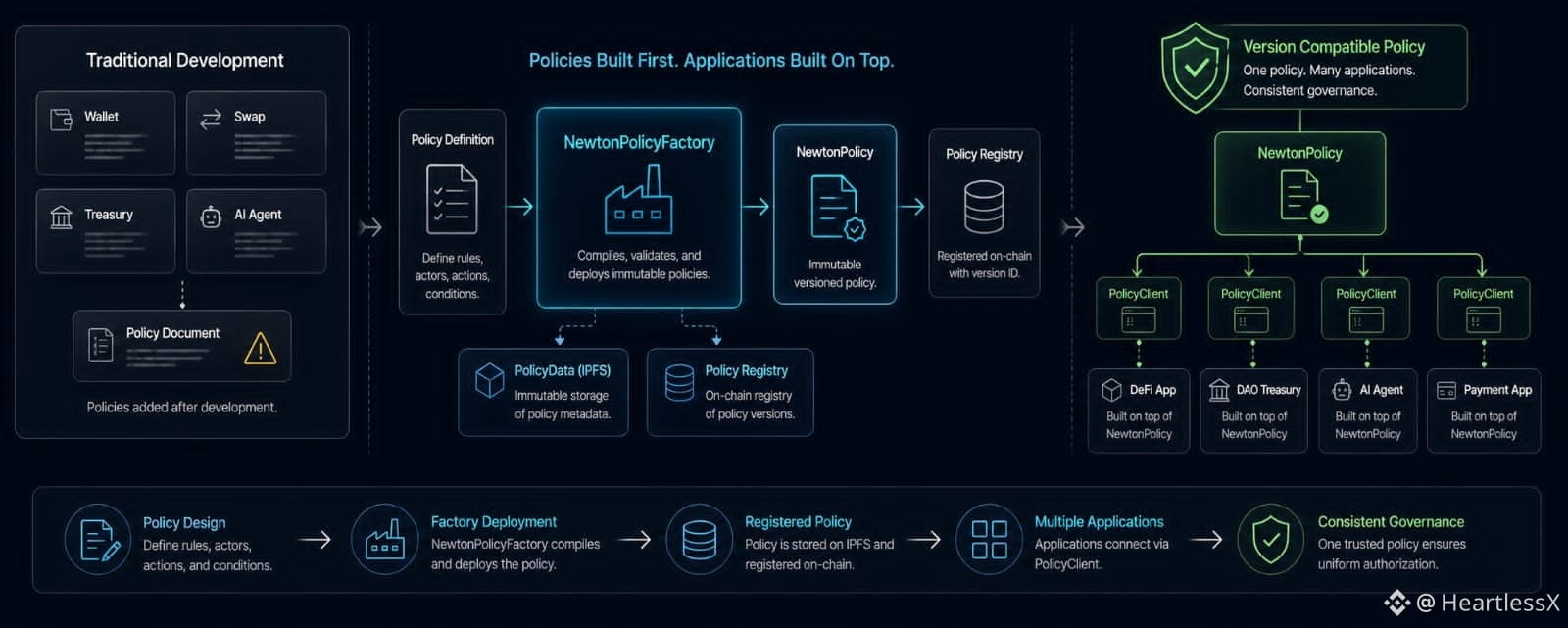

Newton's Policy Factory Makes Policies Feel More Like Infrastructure Than Features
I keep noticing the same pattern whenever I read about new blockchain applications. Development teams usually spend most of their time building wallets, dashboards, trading features, or automation workflows. The discussion about authorization rules often starts much later, after the application is already taking shape. To me, that makes policy design feel like something added to an application instead of something the application is built around.
As I go through Newton's deployment flow, I notice that the order changes. Developers don't begin by connecting an application to a policy. They first create and register a NewtonPolicy through NewtonPolicyFactory, and only then does a PolicyClient start using that policy. The deployment flow quietly treats the authorization policy as an independent component before the application begins processing requests.
The way I see it, that changes the role of policy design. A development team is no longer deciding permission rules after writing application logic. The team is deciding which authorization policy should exist before the application goes live. That small workflow change encourages developers to think about governance while they are designing the application instead of after they finish building it.
I find myself comparing that workflow to constructing a building. Architects don't finish the offices first and then decide where the foundation should go. The foundation is planned before anything else because every floor depends on it. Newton's Policy Factory gives me the same impression. Application features can change over time, but the authorization policy is expected to exist before those features start handling real transactions.
I also notice that this workflow asks development teams to accept more responsibility early in the project. Every deployed policy has to come from a compatible factory version, so a protocol upgrade can require a new policy deployment even when the authorization logic itself hasn't changed. The extra planning happens before deployment instead of becoming a maintenance problem later.
What stays with me isn't the factory contract or the deployment command. To me, the more interesting idea is that Newton's Policy Factory encourages development teams to treat authorization policies like long-term infrastructure instead of temporary application features. Sometimes the biggest architectural decision isn't the feature an application ships. It's the policy that already exists before the first feature ever reaches users.
Source: Newton Protocol Documentation (Architecture Overview & Smart Contract Integration). Personal analysis based on the documented deployment flow.