

Robinhood stock tokens are easy to turn into a smooth storyline: mainstream brokers move U.S. stocks on-chain, and ordinary users can trade stock tokens in their wallets afterward. This entry point is compelling and shareable, but if you only write along that direction, the analysis will stop too early at the four words “stocks on-chain.”
More worth comparing is that within the same category of narratives, there is already more than one path. xStocks / Backed are also turning U.S. stocks and ETFs into on-chain tokens and distributing them across exchanges, wallets, and DeFi scenarios. Robinhood and xStocks both make stock price exposure feel more like an on-chain asset, but they shouldn’t be lumped into the same conclusion: looking like a stock doesn’t mean token holders have received full shareholder rights; being able to circulate through more entry points doesn’t mean the risk boundaries automatically disappear.
The structure disclosed by Robinhood is very clear. Stock Tokens are issued by Robinhood Assets (Jersey) Limited and are described as tokenized debt securities. They provide economic exposure to the underlying stock or ETF, but they do not grant investors any legal or beneficial rights to the issuer of the underlying securities. The page also emphasizes that they are 1:1 backed; the underlying shares are held by a custodian; they can be discovered and exchanged via the Robinhood Wallet, DEX, or CEX; and it lists applicable regional restrictions. In other words, Robinhood’s focus is not “users directly holding on-chain stocks,” but packaging stock-related economic exposure into a tokenized product organized under a Robinhood/RHJ structure.
xStocks / Backed provides a useful adjacent comparison. The xStocks website describes it as 1:1 backed U.S. stock and ETF tokenized representations, emphasizing 24/7 availability, cross-chain functionality, and the ability to be used in exchanges, wallets, and DeFi protocols. Kraken’s xStocks risk disclosure narrows the boundary further: xStocks is issued by Backed Assets (JE) Limited; holders have no ownership of the underlying stocks, no voting rights, no distribution rights, and no legal claims to the underlying stocks. The difference is not that one side is “real stock” and the other is “fake stock,” but that the product paths are different: Robinhood is more like starting from broker and wallet entry points, while xStocks / Backed is more like starting from transferable tokens and a multi-entry distribution network.
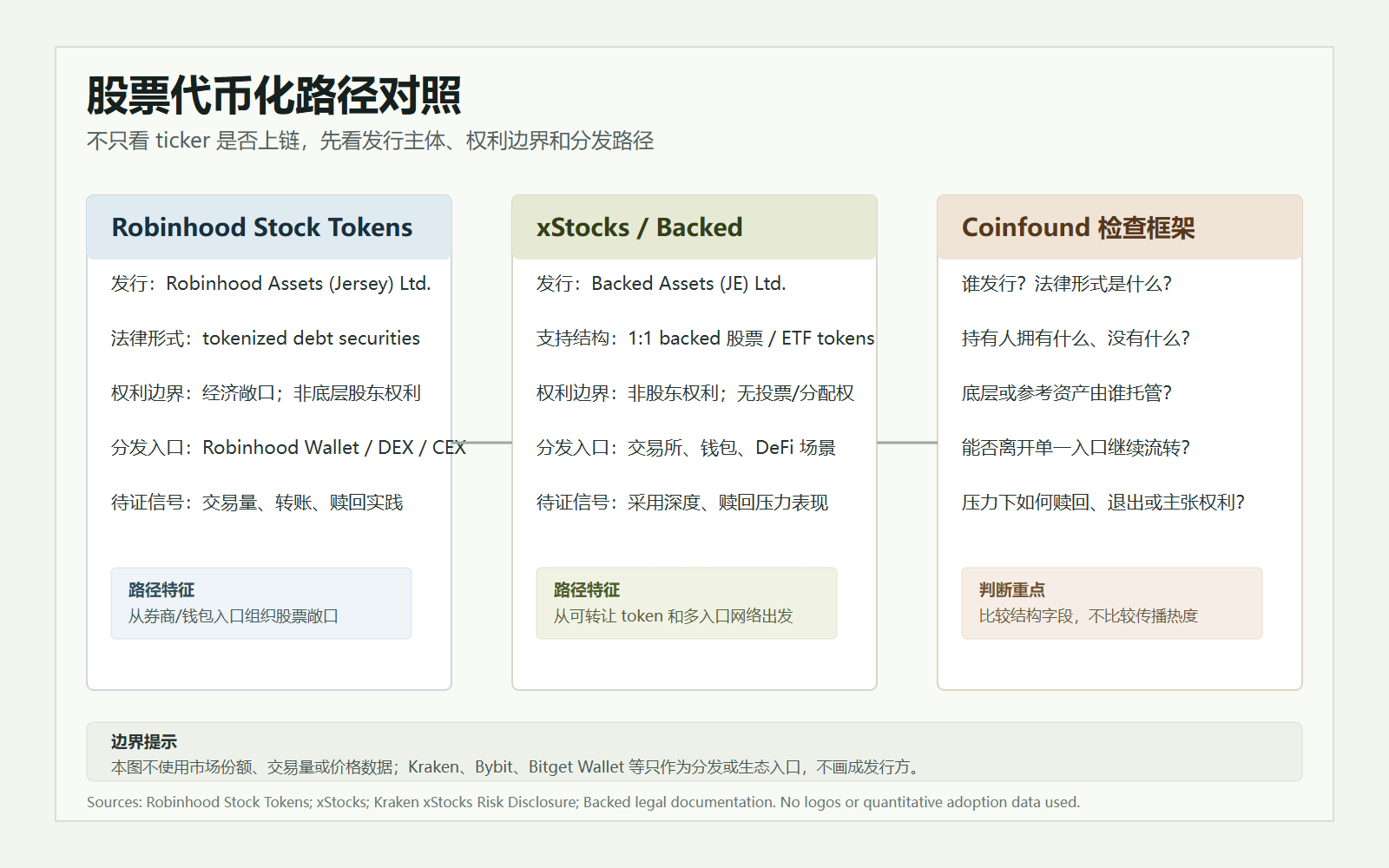
Putting the two together has another benefit: it prevents research from being pulled around by the interface of a single product. If you only look at Robinhood, it’s easy for an article to be written as mainstream broker entry; if you only look at xStocks, it’s also easy for an article to be written as open-network diffusion. The former will underestimate changes in distribution paths, while the latter will overestimate the evidentiary power of the ecosystem list itself. The truly useful comparison is to acknowledge that both are lowering the threshold for stock price exposure to enter an on-chain environment, while also probing whether the rights, custody, and exit mechanisms behind these entry points are sufficiently clear.
That is also why it is necessary to place entry points like Bitget Wallet cautiously. It can indicate that xStocks is trying to enter a broader range of wallet and self-custody scenarios, and it can help readers understand that “stock tokens don’t necessarily only live inside broker interfaces.” But unless legal documents or official disclosures explicitly state otherwise, it cannot be written as the issuer, nor as proof of real adoption that has been validated. For RWA research, the more entry points there are, the more you need to distinguish between “accessible,” “tradable,” “continuously used,” and “with complete rights.”
This comparison makes the Robinhood case more valuable for research. In the past, when the market discussed tokenized equity, it often started by asking whether there are tickers for Apple, Tesla, NVIDIA, and so on. Coinfound should more likely start with another set of questions: who issues the token, what legal form it takes, what holders have and do not have, where the underlying or reference assets are, who is the custodian, who is responsible for redemption or handling stress scenarios, and whether the token can leave a single entry point. Can a distribution list be converted into real usage?
If you look at Robinhood and xStocks through this set of questions, they represent two stock-tokenization paths worth continuing to track. Robinhood’s strengths are its brand, user entry point, and product-packaging capability; its boundary is that holder rights are still defined by the issuing entity, disclosure documents, and an off-chain custody structure. xStocks’ strength is a stronger narrative around open distribution—names like Kraken, Bybit, and Bitget Wallet show that it has a broader imagination of entry points. Its boundary, however, is that these entry points cannot be written as adopting something “with depth,” and cannot be written as being backed or endorsed by the issuer.
Therefore, analysis of tokenized stocks should not stop at the question of whether “stocks are on-chain.” A more precise question is: who issued this token, what assets back it, where it trades, whether it can be redeemed, and what rights holders have in normal and stress scenarios. Only by placing these fields in the same table will the market avoid misreading familiar stock names as complete shareholder rights.
What is most worth observing next is not whose token list is longer, but harder operational signals: actual trading and transfer activity, redemption practices, ongoing disclosures of custody and guarantee arrangements, regulatory feedback, and whether there are stable non-speculative use cases in DeFi or wallet scenarios. Only at that stage can tokenized equity move from “on-chain exposure that looks like a stock” to “on-chain financial products with clearer rights boundaries.”
Reference
Robinhood Stock Tokens: https://robinhood.com/rhj/stocktokens/
Robinhood Chain: https://robinhood.com/us/en/chain/
xStocks: https://xstocks.com/
Kraken xStocks Risk Disclosure: https://www.kraken.com/legal/xstocks
Backed Assets Legal Documentation: https://assets.backed.fi/legal-documentation