
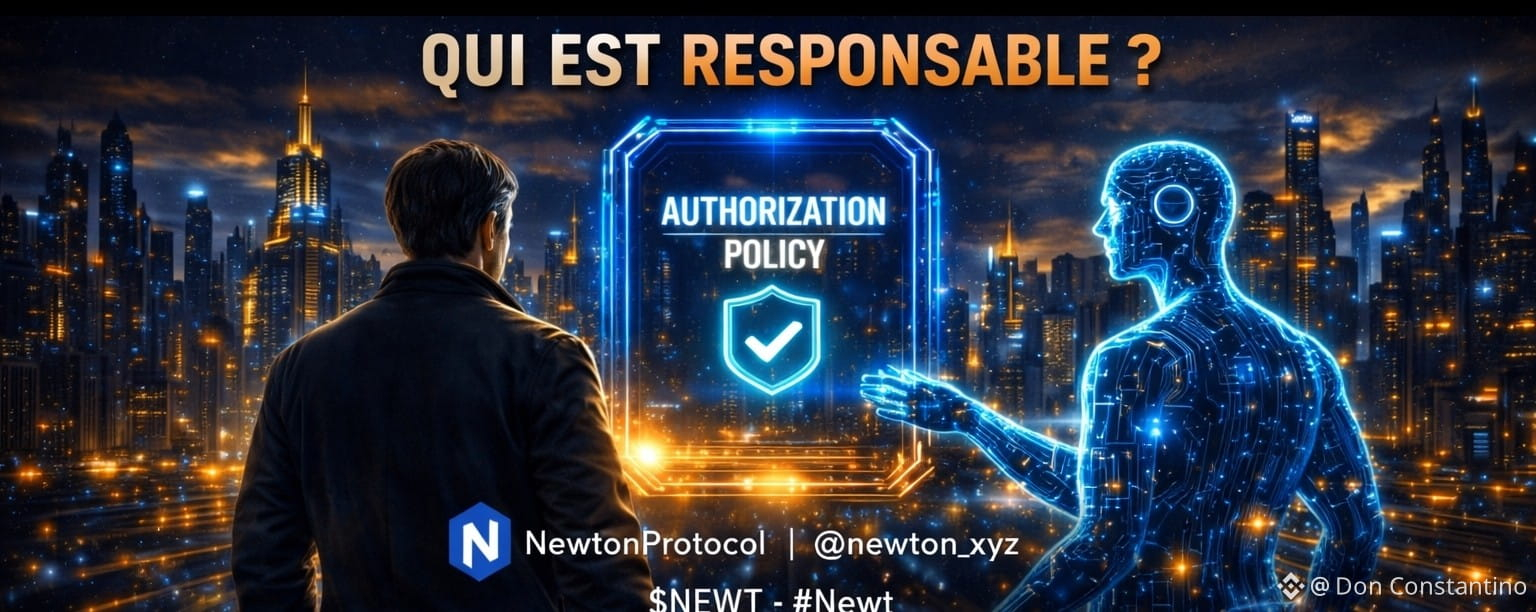

Imagine an AI agent managing your digital assets while you sleep.
It analyzes the markets in a few seconds.
It detects an opportunity.
It carries out a series of transactions.
When you wake up, you find that your portfolio has suffered a significant loss.
The first question that comes to mind is simple:
Who is responsible?
The AI?
The developer who designed it?
The protocol that executed the transactions?
Or you, who entrusted it with this mission?
The more I study the evolution of Web3, the more I’m convinced that this question will become unavoidable.
Today, we often talk about performance, automation, and speed.
But tomorrow, we’ll be talking mostly about responsibility.
An artificial intelligence can make decisions in just a few milliseconds.
Of course, those decisions must also comply with clearly defined rules.
That is precisely what led me to delve deeper into Newton Protocol.
Its approach around an Authorization Layer is not only about automating interactions. It also paves the way for a framework where certain actions may be subject to predefined policies before they’re executed.
In my view, this reflection goes far beyond the technical.
It raises a question of trust.
In a world where AI agents will be increasingly autonomous, should we give them total freedom... or set limits from the start?
I think true innovation will not lie solely in AI capable of acting on its own.
It will reside in our ability to define the rules that will guide their decisions.
And it’s this vision that makes Newton Protocol particularly interesting to follow.
Because, ultimately, a technology doesn’t inspire trust when it can do anything.
It inspires trust when it also knows what it must not do.
And you, do you think an AI agent should always have the final say, or should some decisions require human approval?
I’d really like to hear your opinion.
$NEWT #Newt