

Vetrii develops the Digital Vehicle Passport on a level L1 blockchain infrastructure provided by Tanssi, facing a structural challenge in the Brazilian automotive market.
When it comes to blockchain in Brazil, the debate is still often limited to crypto assets, investments, or financial speculation. However, there is a concrete challenge, outside of social media and online discussions, that directly impacts real life: the fragmentation and complexity of information in the Brazilian automotive market.
The country has one of the largest vehicle markets in the world, but operates on historically disconnected systems, with scattered records, low interoperability, and difficulties in verifying history and provenance. Solving this type of problem does not depend solely on digital applications, but on a base of infrastructure capable of operating on a national scale, with predictability, security, and regulatory compliance.
It is in this context that Vetrii develops the Digital Vehicle Passport, supported by a level L1 blockchain infrastructure provided by Tanssi, designed to support regulated flows, high transaction volumes, and long-term operations. The combination of Vetrii's application and Tanssi's infrastructure allows transforming fragmented data into verifiable, interoperable, and reliable records for the entire Brazilian automotive ecosystem.
The real challenge: fragmented data, fraud, and lack of trust
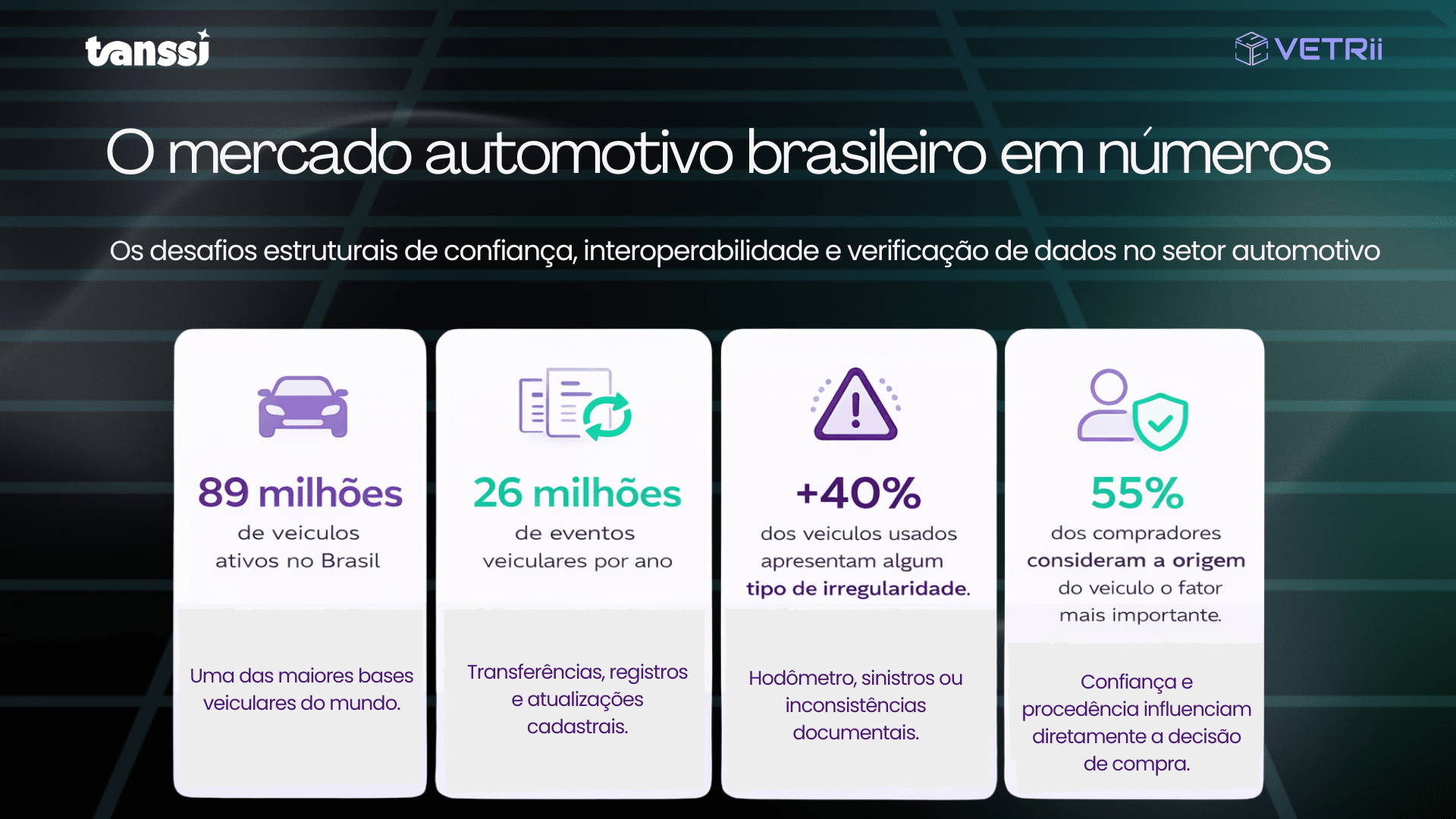
Some facts help to understand the size of the problem:
Brazil has more than 89 million active vehicles.
The country records more than 26 million vehicle events per year, including transfers, registrations, and updates.
More than 40% of used vehicles have some type of irregularity or hidden risk, such as odometer tampering, history of accidents, or documentation issues.
For more than 55% of buyers, the origin of the vehicle is the most important factor in the purchasing decision.
Today, this information is scattered among:
state DETRANs
insurers
banks
workshops
manufacturers
dealerships
Systems that do not communicate with each other rely on manual processes and create opportunities for error, fraud, and information asymmetry.
Vetrii's proposal: Digital Vehicle Passport
Vetrii emerges with a clear proposal: to transform each vehicle into a verifiable digital asset.
With the Digital Vehicle Passport, each car comes to have:
maintenance history
mileage records
ownership events
information on batteries and components
environmental and recycling data
All of this is recorded on-chain, in an immutable, auditable, and interoperable manner.
This is not about car NFTs. It is about trust, traceability, and regulatory efficiency applied to the infrastructure of the automotive sector.
Tanssi's role as infrastructure
For this model to work on a national scale, it is not enough to 'use blockchain.'
Control, predictability, and performance are necessary, especially when dealing with regulated data, high transactional volume, and institutional integration.
Vetrii chose to run its sovereign L1 on Tanssi because it needs:
dedicated blockspace
total control of execution logic
high predictability of performance
integration with regulated institutions
security aligned with Ethereum
The @Tanssi provides the infrastructure for Vetrii to operate its own blockchain without needing to manage all the technical complexity behind it.
In practice, this allows Vetrii to focus on what matters: digital public infrastructure for mobility.
Regulation is already knocking at the door
This movement does not happen in a vacuum.
The European Union already requires digital passports for electric vehicle batteries.
In Brazil, PL 2132 is moving forward to make digital passports for electric vehicles mandatory.
The federal MOVER program requires traceability of components and carbon measurement throughout the lifecycle.
Without a reliable digital base, meeting these requirements becomes costly, slow, and inefficient.
With blockchain, this ceases to be a patch and becomes native infrastructure.
Far beyond the sale of the car
Vetrii's L1 does not only solve buying and selling.
It opens up space for:
tokenized vehicle financing
insurance with automatic onboarding
property transfer with Delivery vs Payment
battery tracking and recycling
structural reduction of fraud
In practice, what we see here is economic coordination functioning outside of discourse and within reality.
What this case shows about Web3 in Brazil
The Vetrii + Tanssi case leaves a clear message:
Web3 in Brazil does not need to start with DeFi.
It can start with the public infrastructure.
When blockchain solves a problem that:
already exists
affects millions of people
involves regulation and critical data
It stops being a promise and becomes the execution layer of real life.