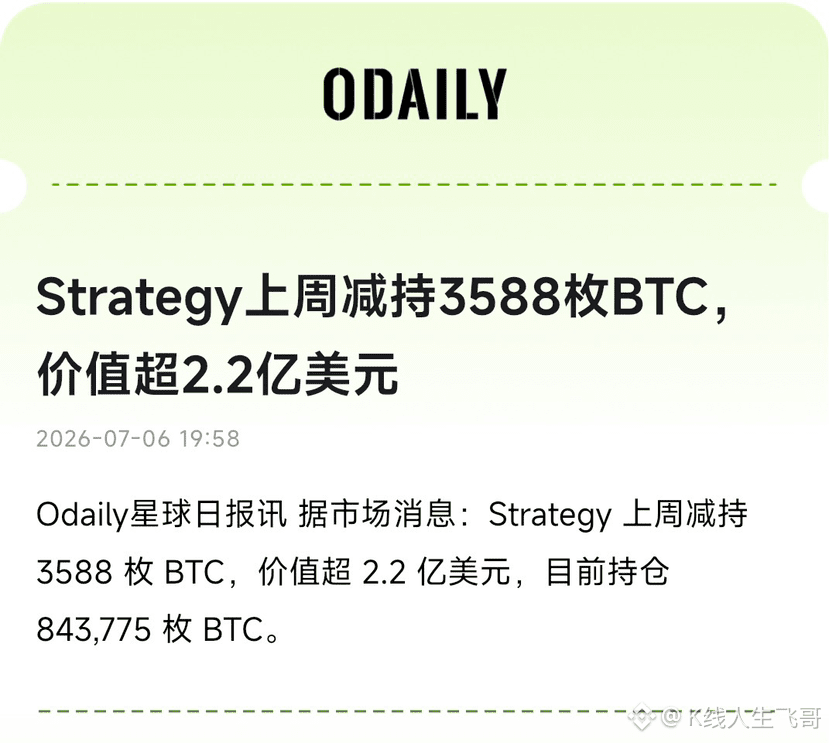
From the perspective of industry development, MicroStrategy selling Bitcoin is not necessarily a bad thing.
MSTR’s first large-scale selloff of BTC may spark controversy in the short term, but in the long run it can actually help reduce the company’s systemic risk—signaling a shift in the “only buy, never sell” treasury narrative.
In the past, MSTR has relied on continually increasing its BTC holdings to reinforce the value-reserve logic. However, as the size of its holdings grows, making moderate adjustments to its position and optimizing cash flow can improve the company’s resilience to risk, rather than simply depending on BTC price increases.
The development of the crypto industry is also entering a new phase. If Crypto is to truly go mainstream, it can’t remain only at the value-reserve narrative of “digital gold”; it needs to move toward large-scale applications, building a financial system on the chain—what’s often referred to as “Wall Street on-chain.”
This means that in the future, market attention will not be limited to BTC. Increasingly, it will also focus on public-chain assets that support applications—such as ETH and SOL—along with payments, RWA, stablecoins, and on-chain financial ecosystem assets. Their share of the total market capitalization across the crypto market is also expected to rise further.
BTC is still the core anchor of the entire crypto market. Without it, Crypto will struggle to build trust. But if the future remains only BTC standing out while there’s a lack of truly large-scale application scenarios, the industry’s development potential will inevitably be constrained.
A truly mature crypto market should have BTC responsible for value storage, while ETH, SOL, and others drive application innovation—together pushing the industry from “storing value” to “delivering applications.”
MSTR’s first large-scale selloff of BTC may spark controversy in the short term, but in the long run it can actually help reduce the company’s systemic risk—signaling a shift in the “only buy, never sell” treasury narrative.
In the past, MSTR has relied on continually increasing its BTC holdings to reinforce the value-reserve logic. However, as the size of its holdings grows, making moderate adjustments to its position and optimizing cash flow can improve the company’s resilience to risk, rather than simply depending on BTC price increases.
The development of the crypto industry is also entering a new phase. If Crypto is to truly go mainstream, it can’t remain only at the value-reserve narrative of “digital gold”; it needs to move toward large-scale applications, building a financial system on the chain—what’s often referred to as “Wall Street on-chain.”
This means that in the future, market attention will not be limited to BTC. Increasingly, it will also focus on public-chain assets that support applications—such as ETH and SOL—along with payments, RWA, stablecoins, and on-chain financial ecosystem assets. Their share of the total market capitalization across the crypto market is also expected to rise further.
BTC is still the core anchor of the entire crypto market. Without it, Crypto will struggle to build trust. But if the future remains only BTC standing out while there’s a lack of truly large-scale application scenarios, the industry’s development potential will inevitably be constrained.
A truly mature crypto market should have BTC responsible for value storage, while ETH, SOL, and others drive application innovation—together pushing the industry from “storing value” to “delivering applications.”