



Key metrics: (Hong Kong time June 29 16:00 -> July 6 16:00)
BTC/USD +4.8%($60,000 -> $62,900),ETH/USD +11.7%($1,580 -> $1,765) BTC/USD spot technical outlook:
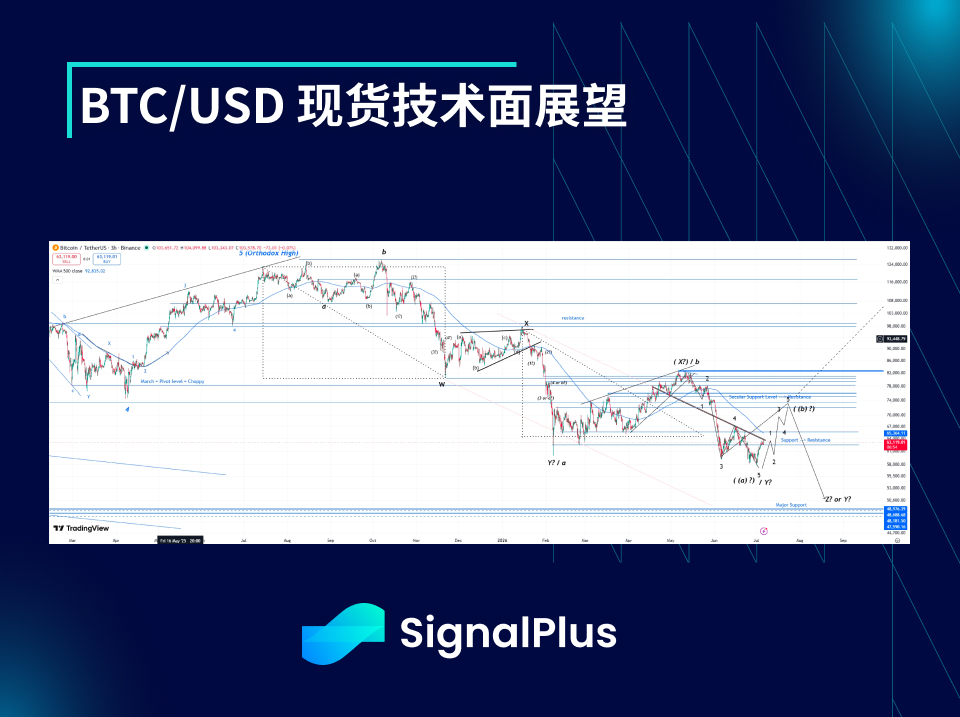
Last week’s overall spot price action felt relatively restrained. Although it briefly dipped to a local low of around $58k, it did not trigger panic-driven put option buying as a hedge. This makes us feel even more strongly that, at this point, the market has much less spot positioning. While MSTR’s ability as a “buyer of last resort” has declined, at the same time this also reduces the likelihood that the market will spiral into a terror-style downward move and disrupt the entire BTC narrative in the medium term.
From a technical pattern perspective, the last leg of the decline most clearly appears as a five-sub-wave structure, which suggests that this round of downtrend since mid-May may be nearing completion. The next question is whether this is the “A-wave” within the final “ABC” structure of a “WXYXZ triple correction,” or instead an extended “Y-wave” within a “WXY double correction” from the very beginning. Trading action over roughly the next month should gradually make this clearer. On the “future” dimension, we remain bullish, because overall the market is not far from the February lows and has since been moving sideways but in a corrective manner. Technically, this sets up the conditions for the market to restart an upward move into the trough area about 10–12 months after the peak, whether that peak is a “proper” peak or an “improper” peak.
Market theme
Last week, after the stock market went through the chaos of month-end/quarter-end rebalancing, it started to release pressure. The subsequent U.S. non-farm data came in a bit soft. Meanwhile, Waller acknowledged that recent inflation data has eased somewhat, although he still said inflation is “still too high.” U.S. rates pulled back from recent highs, and the dollar also partially gave back its strong June gains. Gold found support below $4,000 per ounce and rebounded by nearly 5% from the lows within 48 hours. Overall, the market seems to be entering a wait-and-see mode ahead of summer. The interest-rate/dollar “shock” that appeared after Waller’s first FOMC meeting is fading, while stocks are ultimately still supported by strong earnings and a moderately supportive macro backdrop. However, the sharp pullback after an overly euphoric period recently, along with concerns that valuations are too high, may temporarily limit upside.
The crypto market seems to have found a bottom in the short term. After heavy ETF outflows at month-end/quarter-end, that outflow has finally started to ease. BTC around the $58k area, in particular, is showing decent demand. MSTR has formally confirmed it will sell $1.2 billion worth of Bitcoin at “some point” over the next few months to replenish funds for share repurchases (it previously sold $1.2 billion of stock to raise cash to cover STRC dividend obligations). Overall, the market views this as positive for MSTR and STRC, but for BTC it still represents structural pressure. After short-covering early this week pushed the price up to around $64k, we expect the price is likely to fall back to the $60k–$62k range. Then, if the macro backdrop remains supportive, it may gradually move higher in a more controlled way, with the first target pointing to the $66k–$68k resistance zone. Tonight, the market will closely watch MSTR’s filings to confirm whether it sold any BTC last week.
Implied volatility
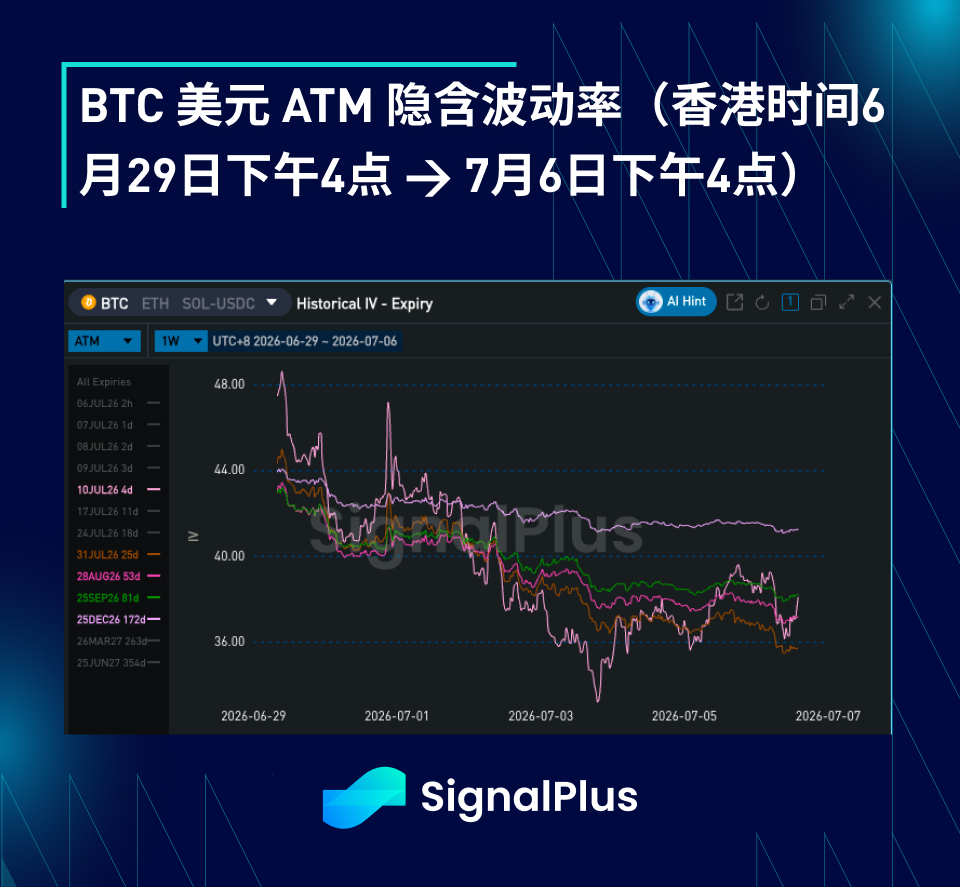
Implied volatility overall fell last week. Even though spot repeatedly tried to break the $58k low, the market digested that selling pressure very well; on the other hand, even with sensitivity in both fund flows and spot levels, realized volatility remained comparatively mild overall. In general, the market has not seen fresh options demand—especially not demand for downside options—which suggests that current spot positioning is cleaner and relatively quiet around current levels. The upside sell pressure stemming from hedging strategies is still being released, especially when spot rebounds. The market seems to be gradually accepting the view that the next few months will likely trade roughly in the $55k–$70k range: MSTR’s potential overhang limits upside rebound potential, while players who need to—or want to—exit the BTC market are likely already fully sold. This is also reflected in the persistent and heavy ETF outflows since May.
As the market enters the seasonal summer months and spot starts looking for a new equilibrium range, the term-structure curve has begun to steepen again. We still expect realized volatility to pick up starting in September, especially considering the midterm elections and the macro backdrop. Also, the potential timing for the Fed’s first rate cut has shifted from July/August to September/October.
BTC skewness/kurtosis
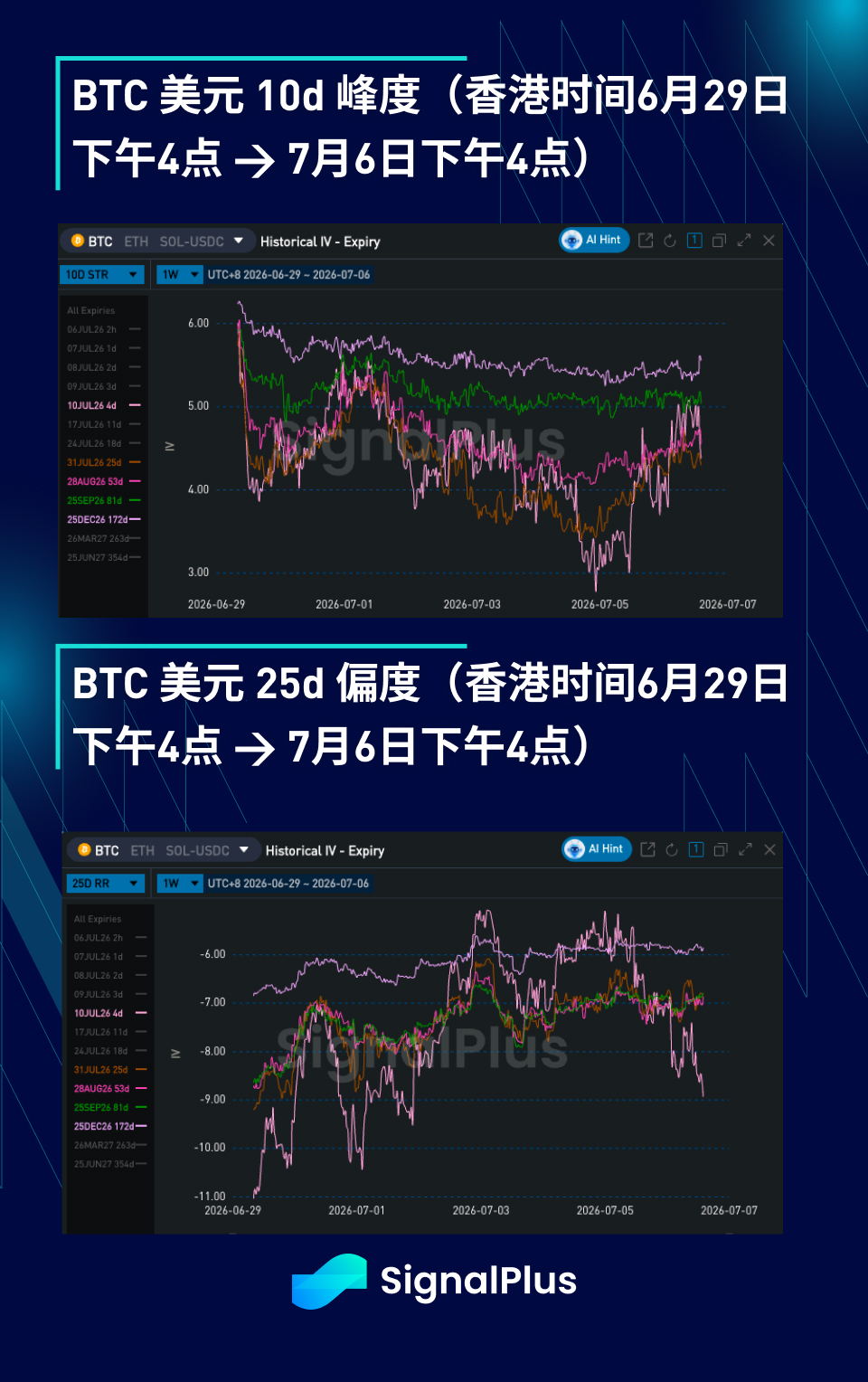
Skewness has started to normalize from extreme levels. Although the spot price has probed lower—at one point even briefly breaking below $58k to make a new local low—the overall realized volatility is still kept under control, and there has not been the kind of implied-volatility spike that is usually seen. This is because demand for options in the market has not truly materialized. In addition, MSTR’s news can be said to have reduced tail variance to the downside at least in the short term. Given its existing cash reserves, the market has clearly concluded that there will not be forced panic selling of BTC in the near term. Meanwhile, upward moves continue to face indiscriminate sell pressure from hedging strategies. As a result, due to the one-way fund flows on that side, the market is not willing to price higher volatility for the upside. Overall, we expect skewness prices to stabilize around current levels. However, it’s important to note that the cost of holding single-leg put options at these levels is very high, especially as the market moves into summer consolidation.
Kurtosis overall continues to trend lower because the market is digesting the ongoing supply of upside wings brought by hedging strategies. At the same time, given the relatively high carrying cost and a more supportive macro backdrop, the pricing of downside fat tails has started to ease. Wishing you a smooth trade next week!
