#newt This afternoon I was reviewing how different companies handle internal approvals, and one thing kept bothering me.
Almost none of them rely on rules that stay exactly the same forever. Every few months, someone updates permissions, adjusts compliance requirements, or changes who can approve what.
Nobody sees those updates as a weakness—they're simply part of keeping the business aligned with reality.
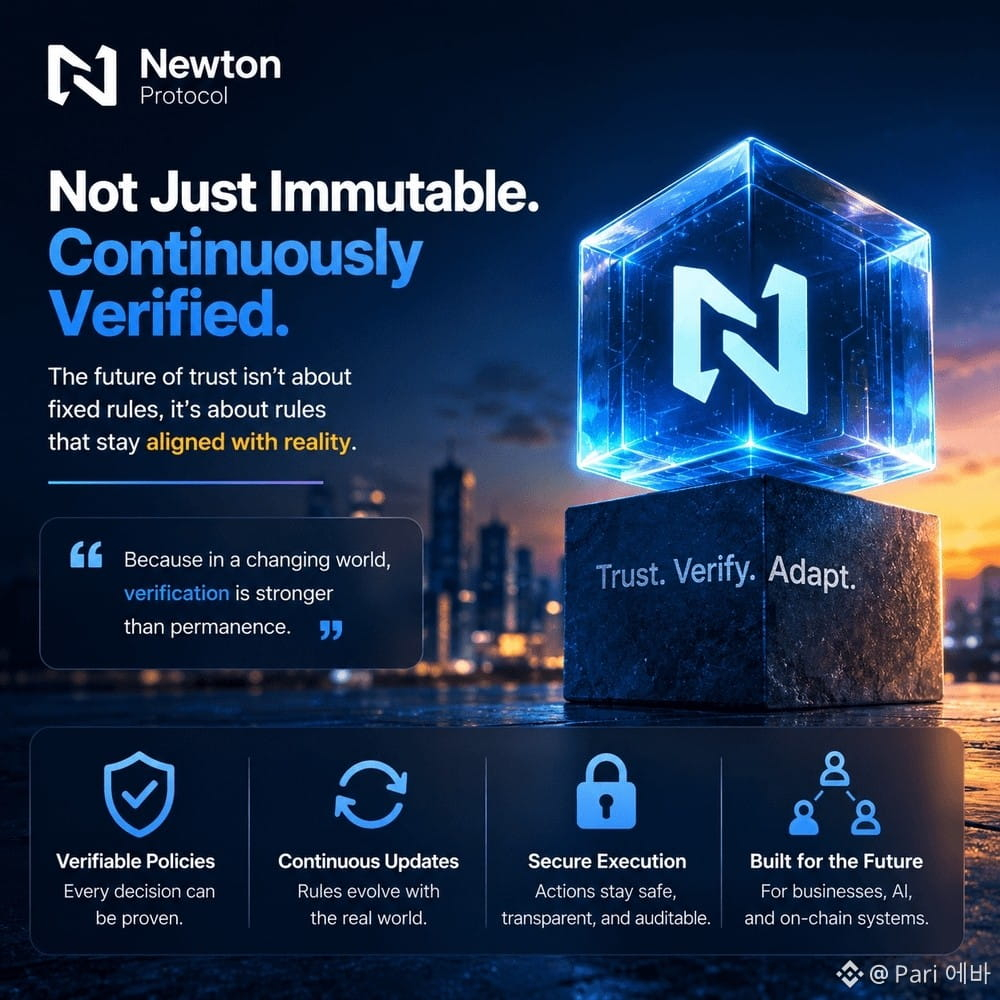
That made me look at Newton Protocol from a different angle.What caught my attention isn't the idea of making rules permanent. It's the idea of making every important decision continuously verifiable.
There is a big difference between those two things.
A rule written two years ago may still exist, but does it still reflect today's regulations, risks, or organizational structure? That's a much harder question.
In many cases, the real challenge isn't executing an action on-chain—it's proving that the authorization behind that action is still the correct one.
That's why I find Newton's approach interesting. It shifts part of the conversation away from transaction speed and toward decision integrity.
As software, institutions, and AI systems begin making more autonomous decisions, continuously verifying why an action is allowed may become just as important as recording that it happened.
The more I think about it, the more I feel that the next evolution of blockchain may not be about building systems that never change. It may be about building systems that can adapt without asking people to stop trusting them.
That's a question I'll probably keep coming back to.
$TLM $CAP $NEWT #Newt @NewtonProtocol
Almost none of them rely on rules that stay exactly the same forever. Every few months, someone updates permissions, adjusts compliance requirements, or changes who can approve what.
Nobody sees those updates as a weakness—they're simply part of keeping the business aligned with reality.
That made me look at Newton Protocol from a different angle.What caught my attention isn't the idea of making rules permanent. It's the idea of making every important decision continuously verifiable.
There is a big difference between those two things.
A rule written two years ago may still exist, but does it still reflect today's regulations, risks, or organizational structure? That's a much harder question.
In many cases, the real challenge isn't executing an action on-chain—it's proving that the authorization behind that action is still the correct one.
That's why I find Newton's approach interesting. It shifts part of the conversation away from transaction speed and toward decision integrity.
As software, institutions, and AI systems begin making more autonomous decisions, continuously verifying why an action is allowed may become just as important as recording that it happened.
The more I think about it, the more I feel that the next evolution of blockchain may not be about building systems that never change. It may be about building systems that can adapt without asking people to stop trusting them.
That's a question I'll probably keep coming back to.
$TLM $CAP $NEWT #Newt @NewtonProtocol