


In discussions about the future of blockchain, AI Agents have already become the focus of attention across the entire industry. Everyone is imagining a future: in the digital world, advanced artificial intelligence can autonomously move through the network like an untiring “digital worker,” executing transactions for us, managing assets, and handling complex financial services.
To make this vision a reality, AI Agents must solve two most fundamental survival problems. First, they need a legitimate “identity and wallet” to store money and handle settlement. Second, they need vast and continuously replenished “computing power” to sustain their thinking.
In the real-world traditional financial system, no bank would open an account for a piece of virtual code. Auvin Chain has keenly identified this structural pain point. By bridging native account abstraction and the x402 machine payment standard at the bottom layer of the network, Auvin Chain successfully grants these intelligent agents lawful on-chain identities, giving them the right to freely settle anytime, anywhere (7×24 hours).
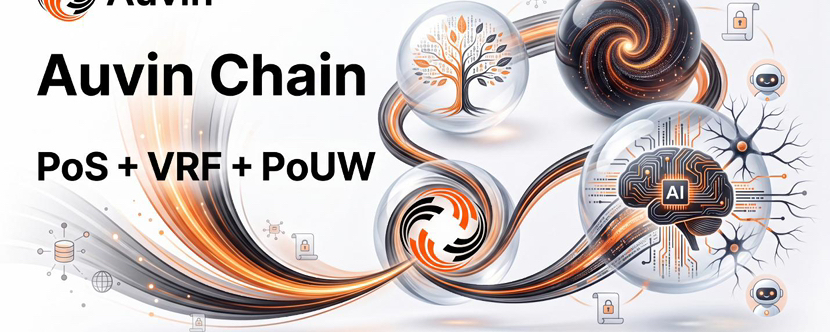
Once the “wallet” problem is solved, the real challenge comes next: where will the massive computing power to keep these agents running come from? Auvin Chain’s answer is hidden in its highly disruptive three-part consensus engine: “PoS + VRF + PoUW.”
Say goodbye to wasted computing power: evolution from a consumption network to a production network
Any decentralized blockchain network needs a “consensus mechanism” to decide who records the ledger and to ensure the safety of the ledger.
Early networks used a PoW (Proof of Work) mechanism, letting computers worldwide go all out solving difficult math problems to compete for the right to record transactions. This directly led to an electricity consumption level that was simply unbearable. Later, mainstream public chains moved fully to pure PoS (Proof of Stake), effectively solving the energy-consumption problem, but bringing a new regret: the high-performance chips installed on node servers spend most of their time sitting idle with nothing to do.
Auvin Chain innovatively deeply integrates three top mechanisms to build a ground-layer engine that perfectly combines “security, fairness, and productivity.” Their operating logics interlock—none can be missing.
First pillar: PoS (Proof of Stake) — building an unbreakable foundation of trust
For AI Agents to handle on-chain assets worth millions of dollars with peace of mind, the network itself must be absolutely secure. Auvin Chain still retains PoS as the security foundation.
In Auvin Chain’s network, any computer (node) that wants to participate in record-keeping and processing data must first stake a certain amount of AUV tokens to the system. This staked deposit is like a “performance guarantee deposit” in the real world. Only nodes that hold a stake are eligible for the system to assign block-producing tasks.
Paired with a strict Slashing (penalty) mechanism, once the system detects that a node is acting maliciously or attempting to tamper with data, its deposit will be ruthlessly deducted. This line of defense built through economic incentives and game theory, with extremely low energy costs, constructs a solid trust barrier for the operation of AI Agents.
Second pillar: VRF (Verifiable Random Function) — an absolutely fair “invisible shield”
With the security deposit mechanism in place, the system also needs to decide which node will execute the task every second in practice. In many traditional networks, due to the algorithm’s predictability, hackers can determine in advance which node is responsible for producing the next block, and then launch precise network attacks (DDoS attacks), causing the network to collapse.
To thoroughly eliminate this kind of security risk, Auvin Chain has introduced cutting-edge VRF (Verifiable Random Function) cryptographic technology.
You can think of VRF as an absolute fairness “super lottery machine” that exists in the cryptographic world. Each time it selects a work node, the VRF generates a random number that cannot be predicted before the result is derived, thereby determining which node accepts the job. Hackers can’t know the next target, so targeted attacks are out of the question. After the lottery ends, everyone across the network can also use publicly verifiable cryptographic proofs to check that the process has not been tampered with by anyone. VRF puts an invisible fairness shield over the entire scheduling system.
Third pillar: PoUW (Proof of Useful Work) — the ultimate engine that activates idle computing power
This is the most industry-transformative link in the Auvin Chain architecture—one that completely sets it apart from other public chains.
After PoS ensures node honesty and VRF ensures scheduling security, what exactly does the selected node need to do? Auvin Chain discards the mode of letting nodes idle and wait, requiring nodes to put their powerful computing capabilities directly into real computational tasks.
When an AI Agent needs to run a complex market prediction model, or when it needs to perform high-frequency data valuation of real-world assets (RWA) on-chain, these massive computing demands are packaged and sent to nodes in the network. Nodes must consume real computing power (FLOPs) to complete these AI inference and valuation model computations.
To prevent any node from “slacking” or forging computation results, the system is designed with a rigorous multi-node cross-verification mechanism. The same task is distributed to multiple nodes for independent execution. Only when everyone’s computed results match completely and the verification quality meets the standard will the system officially confirm task completion and issue generous AUV tokens as a computing-power reward.
Rebuilding the infrastructure foundation of the digital world
By linking these three concepts together, Auvin Chain’s grand blueprint becomes clear.
This three-part consensus engine successfully transforms the operating cost of a blockchain into a computational power source with immense commercial value. Countless high-performance nodes across the entire network converge under rigorous mechanisms into a decentralized supercomputer that is absolutely secure, absolutely fair, and always online.
Here, the AI Agents obtain the living environment they’ve longed for. They have legitimate on-chain identities to interact, while also being able to call the idle computing power of the entire public chain network for free or at extremely low cost at the underlying layer to keep “thinking.” With its extremely deep underlying technological innovations, Auvin Chain lays a broad, solid foundation high-speed highway for the incoming agent economy.