
Today is December 24th. If it were in North America, Europe, or some places in Asia, companies would be close to the holiday break. For example, the Hong Kong stock market will close for two and a half days starting this afternoon and reopen next Monday.
At this time, it would be good to review what I have done in 2025, what summaries I have, and look forward to next year.
I found a template for an annual summary online and adapted it to try to analyze my gains and losses over the year.
1. What important work or projects did I complete this year?
This year, my company's operations have been relatively smooth, with performance steadily improving. Since its establishment in 2020, the company has maintained profitability, adhering to a light asset operation model, and has never relied on kickbacks or gifts to acquire business, instead emphasizing the cost-effectiveness of services and striving to improve professionalism.
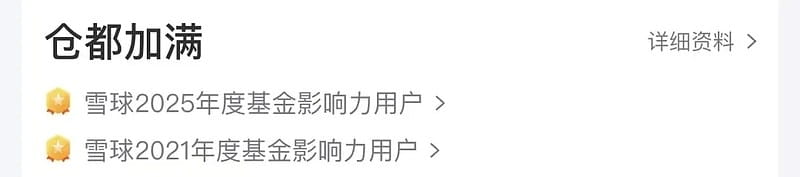
In terms of public accounts, although many people say that traffic is declining, my follower count has continued to grow, consistently reaching new highs, with an increase of about 15% compared to the end of last year. In terms of Xueqiu, I have been recognized as a Fund Influencer User for 2025.
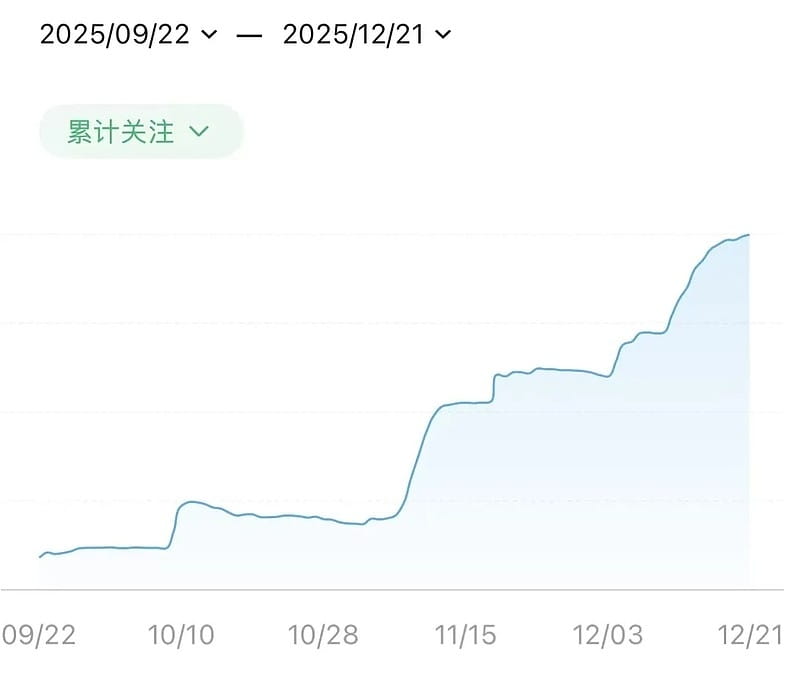
I think there is still room for growth for professional, forward-looking, and valuable industry vertical media, which is also quite scarce.
Of course, in many aspects, I am lacking and may have a significant gap from the level I want to achieve.
2. Which comfort zone have I broken through?
This year should be about weight loss. In the past, I thought losing weight was very difficult and could only be achieved through intense exercise or hiring professional coaches.
But after practicing, it's very easy. I basically completed my goals in less than 3 months just by eating less and moving more, giving up snacks, hot pot, and takeout.
In the first month, which is October this year, I reduced my weight from 83KG at the beginning of the month to 73KG by the end of the month, losing 10KG in one month, which can be said to be extreme.
November is a plateau period, with no significant changes around 73KG.
In December, my weight started to go down to 71KG, and I estimate that by the end of the month or early January, I can reach my ideal weight—69KG.
Why must it be 69KG? Because I checked the data, a BMI of 22 is the healthiest and promotes longevity.
3. What was the question I spent the most time thinking about this year?
I think it is a weakness of human nature. For example, looking at my personal characteristics, I prefer investing in growth stocks, and my stock selection is relatively precise.
But in terms of risk tolerance, I am relatively conservative. Once the net value retreats by more than 10%, I get quite anxious and often sell quality stocks too early due to excessive fluctuations, and even sell at a loss.
This year, I sold a bunch of stocks that doubled, for example, a certain star chip company that surged this year has increased dozens of times since I sold it two years ago.
So my conclusion is that in the future,
One is to diversify investments to avoid the psychological distress brought about by concentrated investments.
The second is to give up leverage to avoid selling too early due to a big drop;
The third is to improve research accuracy, selecting the strongest companies in growing industries for long-term holding, with a bit more professionalism.
4. What new skills or knowledge have I learned?
This year, I have utilized AI tools, which can significantly improve work and investment efficiency.
5. How has my self-awareness changed compared to before?
I have realized that many of my experiences are caused by my personality.
For example, I like to delve into business rather than networking, I don't like to socialize upwards, dislike parties, and I'm indifferent towards others. I don't like meeting new friends, my emotional intelligence isn't very high, but now that I'm in middle age, many things cannot be changed.
But in terms of diligence, I am relatively laid-back, simply put, a bit 'lazy', and this point can be improved.
6. Have I neglected my health? If so, how do I plan to improve?
In the past few years, I neglected my health. Earlier this year, I had a cough due to a viral infection that affected my sleep. After adjusting my diet and lifestyle, I have greatly improved. Now I walk over 10 km a day, no longer cough, and my physical strength has improved.
7. What is the most worthwhile effort this year?
I think it is about the control of life. Now I have the freedom to manage my time running my own company, I can also precisely control my weight, have zero personal debt, improved investment levels, and my family's living conditions are healthy, all pursuing their respective life values.
Of course, what new problems will we face in the future? It is currently unknown. But as Munger said, life is a series of problems, and we spend our lives solving problems until the last problem cannot be solved.
8. In terms of fund investment, what reflections and outlook do I have in 2025?
In 2025, I analyzed quite a few good investment opportunities, such as the gold and technology innovation I wrote about at the beginning of the year, the non-ferrous metals I wrote about mid-year, and the AI industry chain changes I wrote about in October. The reference value is still quite high.
Looking ahead to next year, I personally feel that it may be necessary to pay attention to the allocation value of the CSI A500 Fund.
In the middle of the month, when the market experienced significant fluctuations and market confidence was somewhat shaken, it was noticeable that last week, the main funds significantly flowed into the CSI A500 Fund exceeding 30 billion yuan. Compared to other traditional broad-based indices, the CSI A500 Index has more than 50% of its companies in emerging industries, aligning with the trend of new productive forces, and its long-term value is quite obvious.
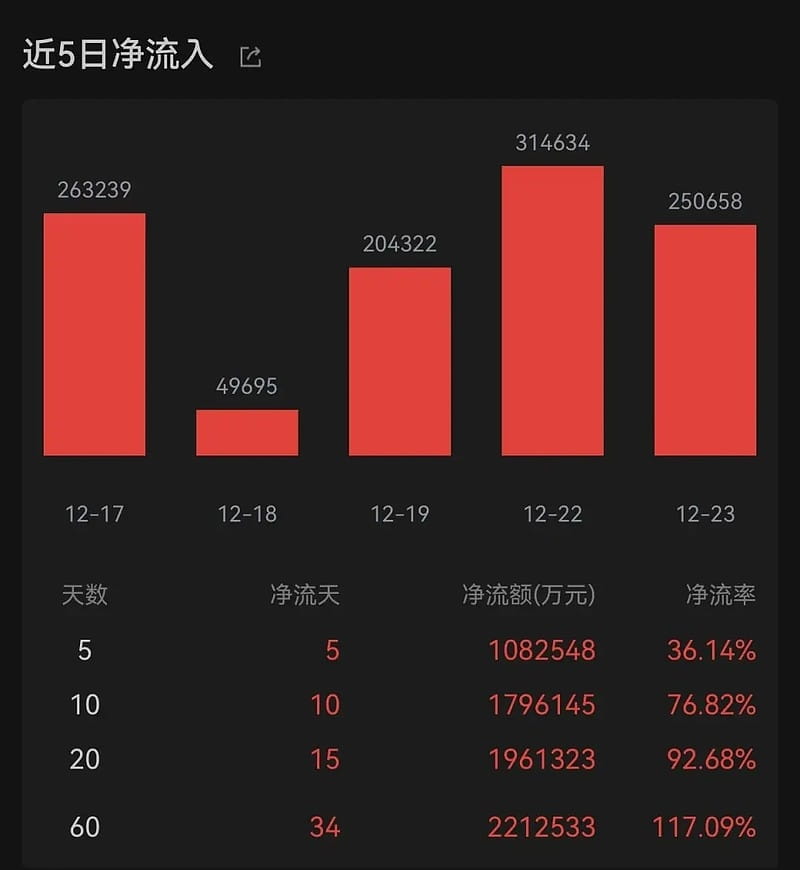
Data source: Wind, as of 2025.12.23
Among them, the A500ETF Southern (159352) has seen impressive growth, with a net capital flow of over 22.1 billion yuan in 60 trading days; in the past 10 trading days, all net inflows, with a net capital flow of over 17.9 billion yuan.
The fund's scale has reached 41.838 billion yuan, ranking among the top in its category.
Relatively speaking, there are still quite a few A500 index funds, which track the same index, and the differentiation seems to be not very significant. However, why is there so much new capital optimistic about A500ETF Southern (159352) and its connect (A: 022434/C: 022435/Y: 022918)?
Personally, I believe that from foreign experience, whether it is the NASDAQ or the S&P index, only a few products lead in scale.
From the perspective of the domestic market, it is also following a similar path. Wind data shows that as of the end of November 2025, the top ten ETF managers managed a total ETF scale of 4.3 trillion yuan, accounting for 75% of the total market ETF scale.
The real competition for index funds has elevated to occupying brand perception, the breadth and warmth of ecological services, as well as a deep understanding and forward-looking layout of national strategies and industrial changes.
As of the third quarter report of 2025, the index products managed by Southern Fund exceeded 430 billion yuan, not only an important market participant but also a proactive builder of the industry as it transitions from the 'tool era' to the 'solution era'.
From the clear brand proposition of 'Invest in ETFs, choose Southern' to the forward-looking product matrix that aligns with national strategies; from maintaining industry-leading operational precision under a super large scale to building a warm, companion-like ecosystem empowered by technology—Southern Fund's path reveals that true leading advantages do not lie in the temporary expansion of scale. In the new stage of high-quality development, only by deeply integrating professional capabilities, customer companionship, and national strategies can we build a sustainable value creation system and truly stand at the forefront and win the future.