

On June 19, Aave founder Kulechov positioned the upcoming Aave V4 as an on-chain alternative to Wall Street securities financing, targeting the US daily average of about $126 billion in repos, $46 billion in lendable securities for securities lending, and the margin financing market. He proposed three product types: securities-backed loans, repos (atomic settlement), and securities lending. The institutional RWA lending market Horizon, since going live in August 2025, has accumulated roughly $440 million to $550 million in deposits, with a goal to exceed $1 billion in 2026. This turns “RWA as collateral” from a product into a narrative of “on-chain securities financing infrastructure.”
Using the three-layer framework, the nature of this issue lies in the third layer—composability. V4 does not change the credit of any underlying asset, nor does it directly create liquidity mismatches. What it does is connect the problems from the first two layers to on-chain leverage and liquidations in a unified way. In other words, it turns the composability layer we have emphasized into the system’s backbone, from a single risk point.
Aave is qualified to do this. By the end of 2025, it holds about 61.5% share of the active lending market, and more than half of the lending segment’s TVL. Its engineering is also more cautious than typical DeFi—Horizon uses Chainlink’s NAV oracle to price at net value, risk parameters are handled by LlamaRisk and Chaos Labs, aTokens are non-transferable, and the contracts are non-custodial. These should be acknowledged; they should not be outright dismissed across the board.
But there is one design choice worth unpacking. V4’s “centralized liquidity Hub + multi Spoke” architecture, and Horizon’s shared-liquidity pool, share the same orientation—capital efficiency first. A shared pool is an advantage: once a new asset goes live, it immediately taps depth and has steadier interest rates. The cost, however, is that risk is no longer isolated: if one category of collateral runs into trouble during a stress period, what gets used is the same stablecoin pool shared across all other collateral types. While improving efficiency, it expands the risk exposure of the composability layer from a single asset to the entire market. This is another side of the trillion-TAM narrative that is often overlooked.
This risk is not hypothetical. In April 2026, a third-party cross-chain bridge was attacked, causing about 116,500 unbacked rsETH tokens to be deposited into Aave as collateral, resulting in bad debt—this is exactly the template of “collateral integrity fails → bad debt,” and it is unrelated to whether the underlying assets themselves default.
In scale terms, Horizon is currently about $500 million and targets $1 billion; relative to the $12.6 trillion repo market it targets, it’s still just starting out (see the chart below). That is precisely why this mechanism that unifies leverage for various RWAs has not yet been tested in any real instance of credit or liquidity stress. Combined with our prior-period estimate for a 5%–10% net value drift during stress periods for CLO-like tokens, the looped leverage positions could be “blown through” before NAV is re-priced. We tend to believe the first large-scale bad debt or forced liquidation on RWA collateral will be triggered by a misalignment in token price/net value during stress periods—not by default of the underlying assets. This shows up as liquidations or loss-sharing in some institutional RWA lending markets, while the underlying credit does not actually default.
To all parties, the meaning differs: for institutions providing collateral to this type of market, they should price according to the pressure-period “net value vs. on-chain price” gap—not just apply a discount based on credit. For lenders supplying stablecoins to them, they need to understand they are taking on a shared pool, exposed to every category of collateral within it, not merely the category they personally favor. For the risk service side and in the contract design, the tradeoff between choosing an isolated pool versus a shared pool is exactly the tradeoff between risk isolation and capital efficiency. In our three-layer framework, this paper and the contemporaneous stablecoin (the borrowed asset) and the previous-period CLO (the pledged asset) all point to the same main storyline: the market still mainly watches the credit layer, while tokenization repeatedly creates new risk in the latter two layers. Pricing liquidity and composability risk of collateralized tokens independently—this is where Coinfound fits.
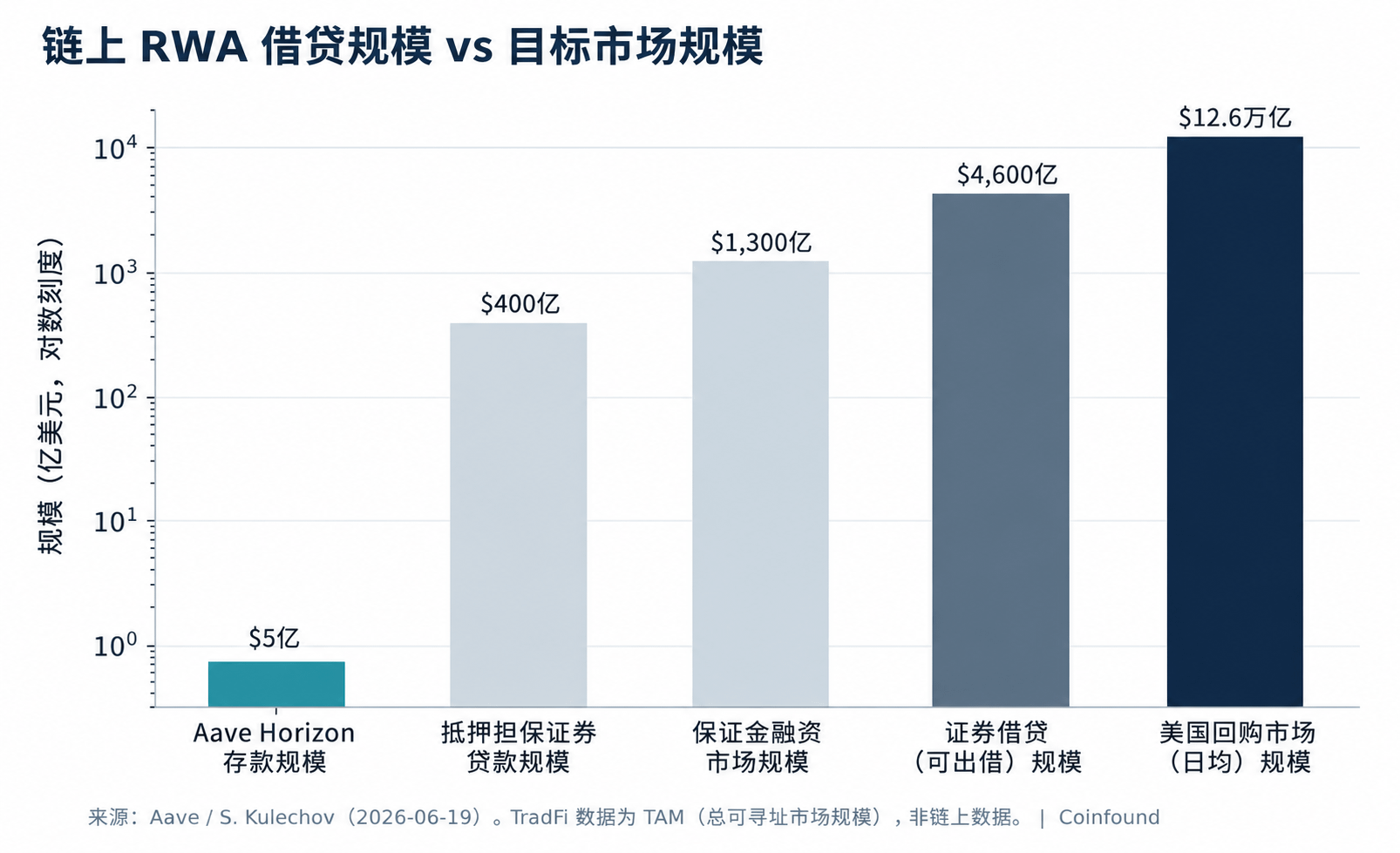
Caption: On-chain RWA lending is still tiny compared with the traditional securities-financing market it targets (source: Aave / Kulechov, 2026-06).
Disclaimer: This article is for informational purposes only and does not constitute any investment advice; data may be delayed or contain errors—please refer to official disclosures.