


I like infrastructure more when I can see what it becomes in the hands of builders.
Big ideas are easy to admire from a distance. Crypto has never had a shortage of them. Every cycle brings new language, new diagrams, new promises, and new versions of the same sentence: this will change everything.
Maybe it will.
But I have learned to pay closer attention to the quieter question.
Can builders actually use it?
That is the reason Newton Vault SDK interests me.
Not because every SDK becomes important. Most do not. Many developer tools look useful in theory but never become part of real workflows. Some are too complex. Some arrive too early. Some solve a problem that teams do not feel strongly enough.
But Newton Vault SDK is interesting because it touches a very real problem inside DeFi vaults: turning policy into action.
Newton Protocol is built around onchain authorization. In simple terms, it checks whether a transaction matches a set of rules before that transaction settles. For vaults, that matters because vaults are not just yield machines. They are systems that manage risk, capital, data, permissions, and trust.
A vault may have a strategy that looks clean from the outside. The APY may look attractive. The dashboard may look calm. But underneath that surface, there can be many moving parts.
Is the oracle healthy?
Is the counterparty safe?
Is the asset behaving normally?
Is the wallet allowed?
Is the vault taking on more risk than the curator intended?
Is there a security signal that should stop the action before it goes through?
These are not abstract questions. They are the kinds of questions that become expensive when they are answered too late.
And that is where the builder problem begins.
Most vault teams already know they need better controls. They understand sanctions risk. They understand oracle failure. They understand that APY can hide ugly details. They understand that risk management cannot live only in a document or a dashboard.
But knowing the problem is not the same as building the solution.
Building authorization logic from scratch takes time. It takes integrations. It takes testing. It takes maintenance. It takes engineering focus that many teams simply do not have.
And honestly, I do not think every vault team should have to rebuild the same risk-control stack alone.
That is what makes Newton Vault SDK feel practical to me.
It is not only saying that policies should exist. It is trying to give builders a way to connect those policies with actual vault actions.
That difference matters.
A policy that sits outside execution is useful, but limited. If a sanctions check happens after the transaction, it may already be too late. If an oracle health rule exists somewhere but is not enforced during the action, then it is more like a warning sign than a guardrail.
Newton Vault SDK tries to move these checks closer to the action path.
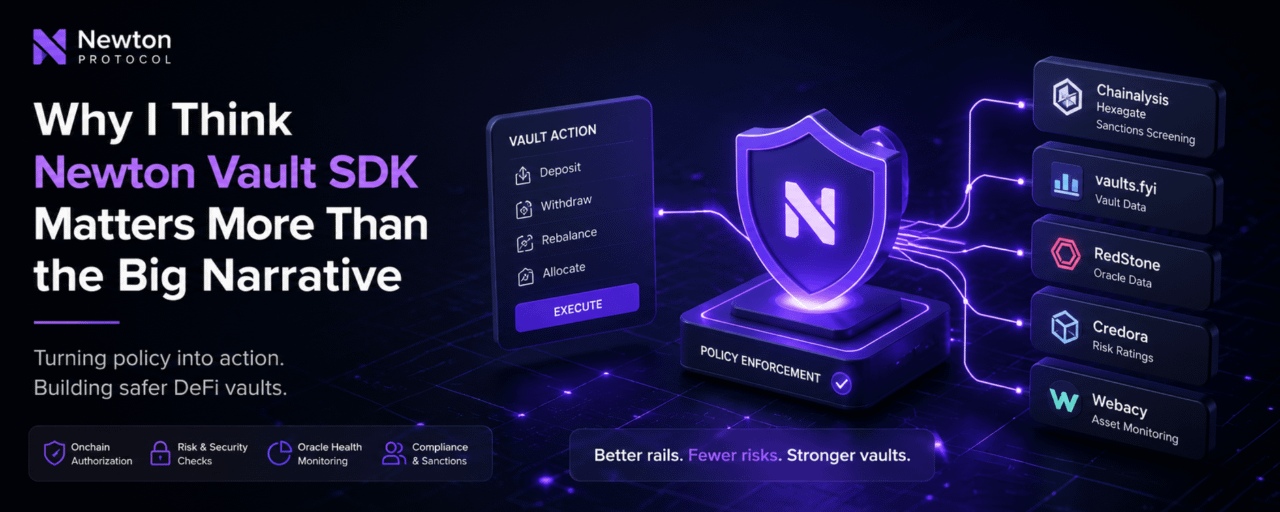
Before a vault rebalances, allocates, deposits, withdraws, or interacts with a strategy, the system can ask whether the action fits the vault’s policy. If the checks pass, the action can continue. If they fail, the action can stop.
That sounds simple.
But simple is often where good infrastructure wins.
The best tools do not always feel dramatic. Sometimes they just remove a painful step. They reduce repeated work. They help teams do something important without building every piece themselves.
That is why the integrations mentioned around VaultKit are important. Tools from Chainalysis Hexagate, Vaults.fyi, RedStone, Credora, and Webacy can bring different types of checks into one enforcement flow. Sanctions screening, vault data, oracle health, risk ratings, asset monitoring, and security signals can become part of how a vault decides what is allowed.
To me, that is more useful than another dashboard.
A dashboard tells you what happened.
A policy enforcement layer can help decide what is allowed to happen.
That is a very different thing.
The bigger DeFi gets, the more this matters. Growth without better controls creates hidden pressure. When vaults manage more capital, small mistakes are no longer small. A bad data input can affect real money. A weak rule can become a loss. A missed risk signal can move faster than a team can react.
So I see Newton Vault SDK as more than a developer tool.
I see it as a shortcut from intention to execution.
A vault curator may already know what rules they want. The hard part is making those rules live inside the product. The SDK gives them a way to bring risk, security, compliance, and data checks closer to the place where decisions actually happen.
Still, I do not think this is guaranteed.
An SDK can look strong on paper and still fail to get adopted. Developers care about the boring things: documentation, examples, setup time, cost, latency, support, and how much code they need to change.
If the SDK feels heavy, it may stay limited to a small group of advanced vault teams.
That is the risk I would watch.
Another important point is that tools do not replace judgment. If a curator creates weak rules, the system may simply enforce weak rules faster. Policy infrastructure can help teams act with more discipline, but it cannot decide what good risk management means on their behalf.
That balance matters.
My takeaway is simple: Newton Vault SDK matters because it makes Newton’s idea more usable.
It turns onchain authorization from a concept into something builders can place inside real vault actions. It gives Newton Mainnet Beta a more practical story. Not just a protocol with a big vision, but a product layer that can help teams build safer vaults with less repeated work.
For anyone watching $NEWT, I would not only watch price action or campaign noise.
I would watch usage.
Which vault teams test it?
Which policy checks become common?
Does the SDK make risk control easier, or does it add more complexity?
Do builders keep using it after the first experiment?
That is the real test.
Because in the end, infrastructure proves itself quietly. Not through the loudest narrative, but through the number of builders who start depending on it.
And maybe that is why Newton Vault SDK interests me.
It is not trying to make risk disappear.
It is trying to make better risk controls easier to use.
In DeFi, that may be exactly the kind of progress that matters most.