

Sober Options Studio × Derive.XYZ Co-produced

Written by Sober Options Studio Analyst Jenna @Jenna_w5
1. Macro Economic Barometer: Will the Policy Divergence Between the U.S. and Japan Reshape Global Liquidity?
This week, the global financial markets have entered a rare moment of 'policy scissors difference.' On one side, the world's largest economy, the United States, has shown unexpected signals of slowing inflation, indicating a faster pace of interest rate cuts; on the other side, Japan, which has been in a state of extreme easing for a long time, has officially entered the peak of interest rate normalization. The changes in interest rate differentials between the U.S. and Japan are profoundly reshaping the logic of global capital flows.
U.S. inflation falls below expectations: A 'technical' acceleration of the Federal Reserve's rate cut path
The U.S. Department of Labor reported on Thursday that the unadjusted annual CPI for November recorded 2.7%, far below the market expectation of 3.1%; core CPI rose 2.6% year-on-year, reaching the lowest level since March 2021.
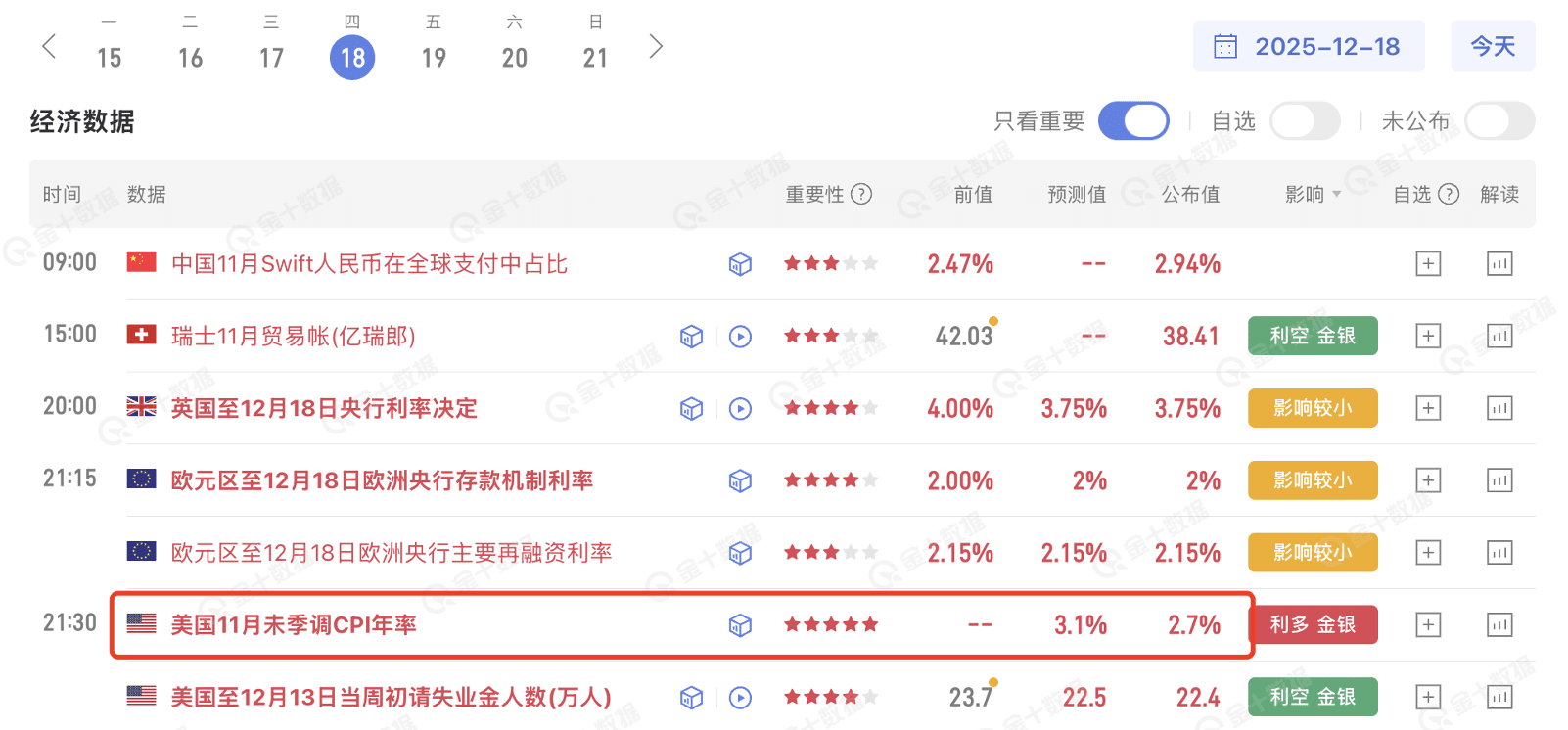
Re-anchoring of rate cut pricing: Despite strong data, Goldman Sachs points out that the unexpected decline in core CPI in the November report was mainly due to technical and time-related factors, rather than a general easing of overall inflation pressures. Federal Reserve decision-makers are still in an 'observation window,' and December data will be key to assessing the true level of U.S. inflation.
Liquidity spillover effect: Lower inflation levels provide the Federal Reserve with greater flexibility, especially as signs of slowing in the labor market emerge. This expectation directly leads to a decline in U.S. Treasury yields, theoretically benefiting risk-on assets like cryptocurrencies.
Market speculation focus: The market is currently in a 'marginal easing period under volatility.' The Federal Reserve releases liquidity through rate cut expectations and balance sheet expansion, but this easing is being countered in the short term by the inertia tightening of liquidity at the end of December, leading BTC and ETH to exhibit wide oscillations at high levels.
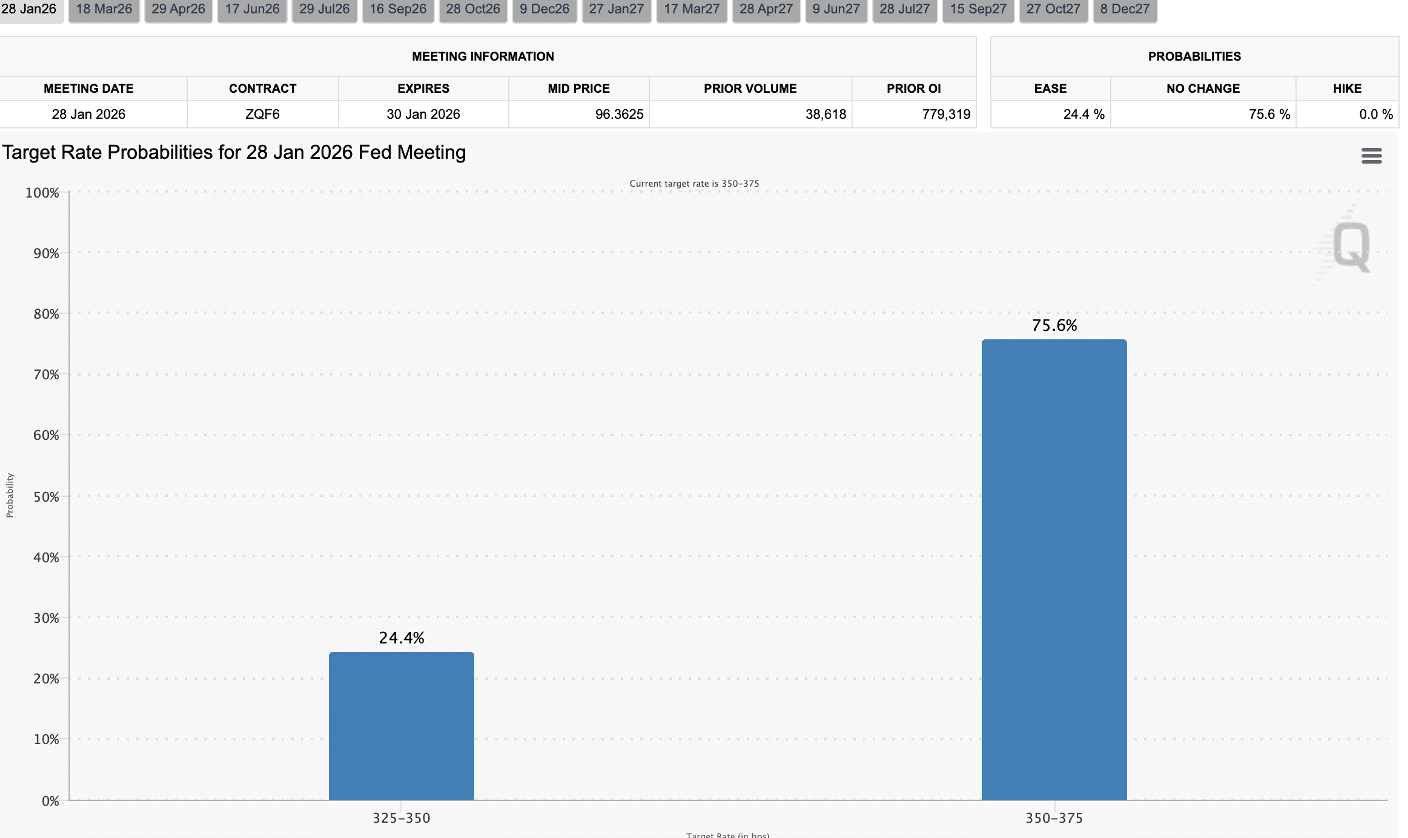
The Bank of Japan's (BoJ) interest rate reset: The 'valve' for global carry trade tightening
On December 19 at noon, the Bank of Japan announced that it would raise the benchmark interest rate to 0.75%, marking the highest level in 30 years and signifying Japan's official farewell to the ultra-low interest rate era.
The transmission mechanism of Carry Trade: For a long time, the yen has been the most important low-cost financing currency globally. Investors borrow nearly zero-interest yen and turn to high-yield U.S. treasuries, U.S. stocks, or crypto assets. When yen rates rise, financing costs increase, forcing investors to close overseas assets to repay yen debts, which often leads to liquidity withdrawal from global risk assets. This capital repatriation triggered by narrowing interest differentials is the core driving force behind the market's current state of 'not rising, not falling' amidst favorable rate cut news.
Why was there no shock this time? Last July, the BoJ's rate hike triggered severe volatility, mainly due to a 'expectation gap' caused by insufficient communication. Before this rate hike, Governor Ueda had communicated extremely adequately, and the market had essentially completed its pricing. Moreover, the currently active arbitrage positions have been largely closed in the past six months, weakening the physical foundation of liquidity shocks.
Global liquidity reshaping: The path evolution of narrowing U.S.-Japan interest differentials
The divergence in monetary policy between the U.S. and Japan essentially redefines the 'water level' of global liquidity. With the coexistence of anticipated rate cuts by the Federal Reserve and actual rate hikes by the Bank of Japan, the interest rate differential corridor between the dollar and yen is narrowing.
Impact Path A: Funds flow from high-yield dollar assets to yen assets, causing marginal tightening of dollar liquidity.
Impact Path B: Increased yen volatility raises the risk premium for cross-border arbitrage, suppressing the leverage of global speculative funds.
This spread has placed the global market in a 'tight balance' period. On one hand, the U.S. is using monetary means to prevent recession and release liquidity; on the other hand, Japan is reclaiming cheap funds through interest rate normalization.
The year-end 'triple squeeze': liquidity constraints and legal uncertainties
In addition to central bank games, the market also faces two short-term variables that cannot be ignored:
Year-end liquidity trap: Entering late December, institutions are entering the year-end settlement period, and market depth significantly decreases. Low liquidity will amplify any volatility caused by yen arbitrage closings or macro noise, making prices more prone to irrational gaps.
The 'legal boot' of Trump's tariffs: The U.S. Supreme Court is expected to announce a ruling on the legality of Trump's large-scale imposition of reciprocal tariffs in December. Although the conservative 6:3 majority appears solid, recent questions from several justices regarding the expansion of executive power have raised market concerns about trade policy risks in 2026. If the ruling supports the tariffs, it will raise long-term inflation expectations and could disrupt the Federal Reserve's rate-cutting rhythm. If the ruling questions the tariffs, it will greatly alleviate market inflation worries, providing medium- to long-term liquidity benefits for the crypto market.
This is a window period of 'seeking support amidst volatility.' The Federal Reserve's rate cut commitment provides a liquidity safety net, but yen rate hikes and trade war concerns constitute a short-term ceiling. Strategically, we maintain the judgment of 'buying on dips amidst oscillation while focusing on downside defense,' utilizing options tools to hedge against year-end uncertainty.
2. In-depth analysis of BTC & ETH options market data
Combining chart data provided by Amberdata&Derive.XYZ, this week the BTC and ETH options market is gradually returning from previous macro games, but structural preferences still show investors' deep caution toward 'black swans.'
Skew: Forward confidence restoration, ETH shows resilience
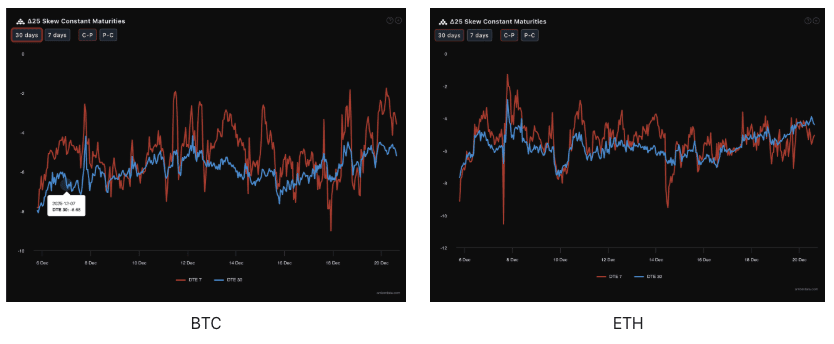
Observing Delta 25 Skew (implied volatility of call options - implied volatility of put options), the negative magnitude of this indicator reflects the market's hedge demand against downside tail risks.
Data performance: Last week, the 7D DTE data for BTC and ETH basically oscillated around -5, showing that short-term bearish hedging still dominates. However, the 30D DTE data has significantly rebounded from about -7 last week to -5 this week, with ETH's 30D curve even rarely exceeding the 7D curve.
In-depth interpretation: The recent narrowing of the forward and near-term Skew indicates that market expectations for the long term (January and beyond) are recovering from fear. The repair slope of ETH is better than that of BTC, reflecting the market's structural catch-up on ETH, or in other words, investors believe the downside protection of ETH has become sufficiently expensive, starting to shift towards bullish positioning in the long term.
Term Structure: Farewell to inversion, entering a 'reverse L' oscillation period
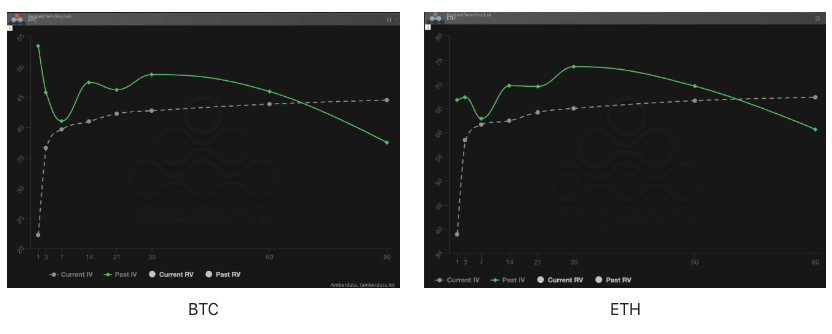
Term Structure displays the distribution of Implied Volatility (IV) across different expiration times.
Morphological evolution: Last week, influenced by the Bank of Japan's monetary policy meeting, Past IV (green solid line) showed a significant near-term high and long-term low inverted state, reflecting a sharp outbreak of immediate risk. This week, Current IV (gray dashed line) has returned to a structure resembling a 'reverse L': short-term IV falls, but medium- and long-term IV remains flat at high levels.
Market logic: This non-standard Contango (near low, far high) structure suggests that the market believes liquidity risks between December and January (tariff rulings, subsequent yen rate hikes) are not a fleeting issue. The premium increase in medium- to long-term IV indicates that large funds are paying 'insurance premiums' for potential severe volatility during the year-end period.
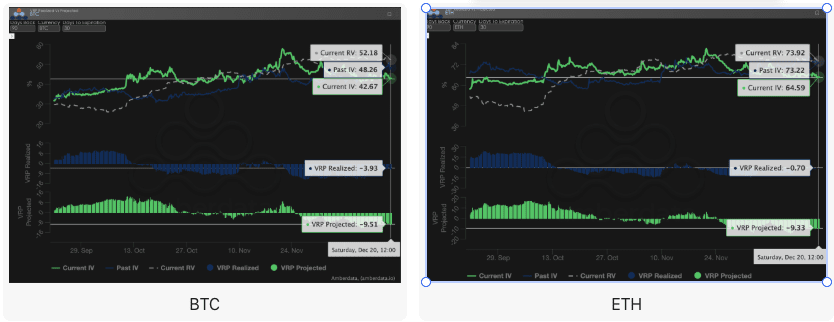
Volatility Risk Premium (VRP): Excess fear premium, is there a window for sellers?
VRP (Volatility Risk Premium = Implied Volatility IV - Realized Volatility RV) is an important indicator for assessing whether option pricing is reasonable. The current market is in a correction phase.
Data divergence: This week has seen a fascinating phenomenon—the deeply negative value of VRP Projected (approximately -10) is much larger than VRP Realized (realized VRP, close to 0).
Comparative analysis: The week before last saw Projected slightly negative and Realized deeply negative (indicating that volatility was really large, options could not be sold); this week, Projected remains deeply negative, but Realized has returned to calm.
Core viewpoint: This indicates that the market is too afraid of volatility. Investors are overestimating the volatility potential over the next 30 days, and this 'over-defense' leads to a serious divergence between IV and RV reality. For option holders, the current Gamma return is extremely low because the actual volatility has not kept up with the expensive pricing, which is usually a good opportunity for laying out low premium defensive strategies.
3. Options strategy recommendation: Lock in downside risk with a Bear Put Spread.
Given the current complex intertwining of macro factors, the dovish signals from the Federal Reserve contrast with potential hawkish actions from Japan, coupled with year-end liquidity tightening and the uncertainty of tariff rulings, as well as continuously deep negative option market data, we believe the market may still face potential downside risks. Therefore, we continue to recommend using Bear Put Spreads for defensive positioning.
Strategy objective:
Defend against potential downside risks triggered by year-end liquidity constraints.
Fully utilize the high premium of put options brought by deep negative Skew to achieve low-cost entry.
Strategy construction (using BTC/ETH as an example):
Buy a higher strike, slightly out-of-the-money (Slightly OTM) put option (Long Put).
Sell a lower strike put option with the same expiration date (Short Put).
Expiration date selection:
Considering the impact of the Supreme Court ruling in December and year-end liquidity tightening, it is recommended to choose mid-term contracts with DTE of 30 days or DTE of 60 days to cover the entire uncertainty window.
Core advantage:
By selling low strike puts to collect premiums, the cost of buying puts is significantly reduced, while locking in the maximum loss to be the net premium expenditure. This is more cost-effective than directly buying put options (Long Put).
The current Skew remains deeply negative, selling puts can yield higher premiums, further optimizing the risk-reward ratio of the spread.
4. Disclaimer
This report is based on publicly available market data and options theoretical models, aimed at providing investors with market information and professional analytical perspectives. All content is for reference and communication purposes only and does not constitute any form of investment advice. Cryptocurrency and options trading carry extremely high volatility and risk, which may lead to the loss of the entire principal. Before adopting any trading strategy, investors should fully understand the characteristics, risk attributes of options products, and their own risk tolerance, and must consult a professional financial advisor. The analysts of this report are not responsible for any direct or indirect losses arising from the use of this report's content. Past market performance does not predict future results; please make rational decisions.
Co-produced: Sober Options Studio × Derive.XYZ