



Original author: Long Yue
Original source: Wall Street News
A report about Meta selling off excess computing power puts several of the most sensitive questions in AI trading on the table at once: Is computing power truly scarce? Will Meta cut or lower its capital expenditures? And how long can Neocloud continue to profit?
Wall Street News notes that Meta is drawing up a cloud business plan and may offer two types of services externally: one is managed model/API access, similar to AWS Bedrock; the other is the “raw computing power” rental, akin to Neocloud.
The moment the news broke, the share price of CoreWeave, a new-generation GPU cloud star provider, plunged 13%, Nebius fell 15%, and AI hardware sectors such as chips were hit hard as well. If Meta starts selling computing power, investors will naturally ask three questions:
First, is Meta buying too much compute?
Second, is Meta no longer putting that much effort into models and AI products?
Third, does the demand curve for AI hardware and Neocloud need to change?
According to a Bloomberg-style “chasing the wind” trading desk, on July 1, UBS, Morgan Stanley, Bernstein, and other Wall Street banks quickly broke down this event. Perhaps this isn’t a collapse of AI fundamentals, but a pragmatic move by large players to find balance between compute constraints and financial returns. This also can’t simply be equated with “Meta doesn’t need compute anymore.” But the implications differ for different asset classes.
For Meta, renting out compute capacity could be a bridge for revenue and EPS. UBS judged: “Selling cloud compute or model-access rights would, in theory, bring in faster near-term revenue than waiting for Meta Business Agents and Meta AI chatbot scaling, while easing concerns that 2027 EPS will stay flat or contract.”
For CoreWeave-like Neocloud companies, this is potential competitive pressure.
For the chip and server chain, what the market cares about more is whether the timing of future capital expenditures will change.
“There’s extra capacity to rent out” doesn’t equal “industry-wide compute oversupply”
What the market is trading on the shortest chain is: renting out compute equals compute oversupply equals capex cut.
Meta might have compute capacity it can rent out on a temporary basis, but that doesn’t automatically mean oversupply across the entire industry. Capacity definitions vary across different institutions, so they can’t simply be added up.
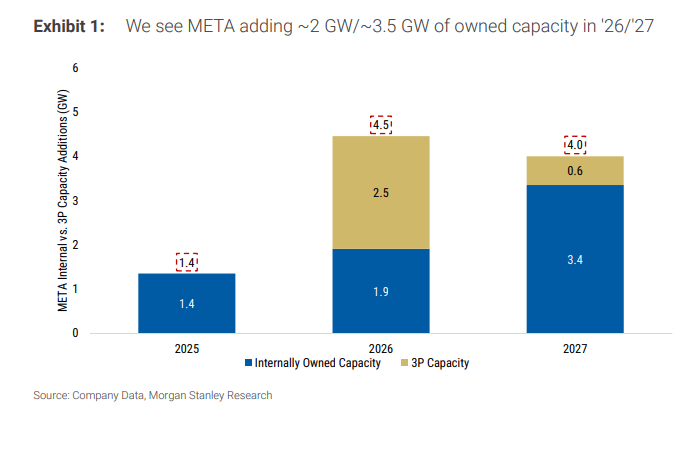
In the Morgan Stanley model, Meta is expected to add about 2GW and 3.5GW of owned, operated IT capacity in 2026 and 2027, respectively, with a baseline of about 3GW at the end of 2025. For comparison, the incremental IT capacity that mega cloud vendors like Amazon and Google could add in 2027 is on the order of 5GW and 9GW, respectively. In other words, even if Meta puts some owned capacity up for rental, it would be difficult to change the overall cloud-vendor construction “big picture” over the next three years by itself.
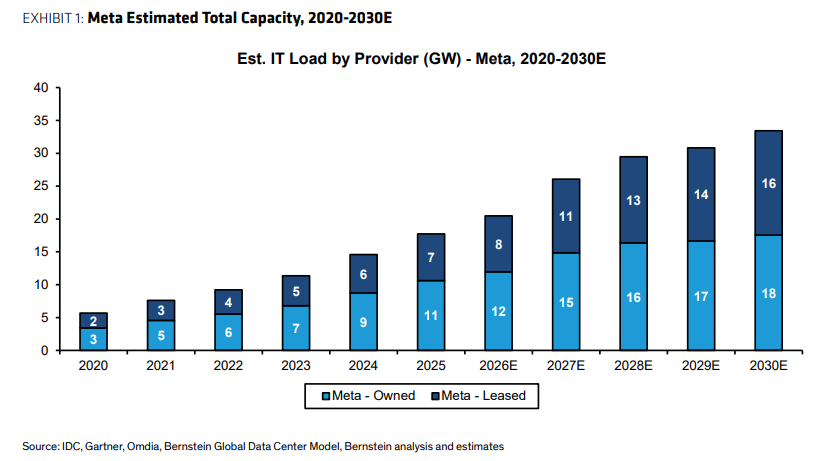
Bernstein uses a broader total data center footprint metric: Meta currently estimates global capacity at about 20GW, and in the coming years it will bring online another ~14GW, including both owned and leased combinations. The number looks large, but it isn’t “all AI compute capacity that can be rented,” nor does it mean the same generation of GPUs, the same type of workload, or the same pricing curve.
In addition, there’s a more aggressive reverse-implied calculation in market estimates: using contracts and capacity planning as anchors—Google with Anthropic, AWS with Anthropic/OpenAI, Microsoft with OpenAI, etc.—the total AI compute capacity of future cloud vendors could be around 20GW or even higher. OpenAI’s own Stargate and the roughly 10GW-scale arrangements associated with Nvidia and Broadcom are also included in the demand-side observation. The purpose of this metric isn’t to produce precise predictions, but to show one thing: partial external renting by Meta is insufficient to prove that global AI buildout has entered oversupply.
More counterintuitively, Bernstein also mentioned weekend reports that Google has restricted Meta’s compute usage due to its own capacity constraints. If that’s true, Meta is simultaneously trying to secure external compute while preparing to sell a portion of compute externally in the future. This looks more like redistribution across “different generations, different purposes, different time windows,” rather than simple “we can’t use it.”
This is not Meta’s first time putting “selling compute capacity” on the table
On May 27, 2026, shareholders asked Meta whether it would build a cloud business to compete with AWS, Azure, etc. Zuckerberg responded:
“Of course, that’s definitely on our radar… we haven’t done that yet, because we think we can use that compute ourselves. But clearly, if we reach a certain stage and think we’ve built too much, then this becomes an option we have—and that’s also part of the reason we’re confident in continuing to invest in building.”
Earlier, on October 29, 2025, Zuckerberg also discussed similar logic:
“Any compute we don’t need, we’re quite confident we can absorb a very large portion of it… Of course, it’s possible we build too much. If we really do… we see a lot of new demand both internally and externally. Almost every week, companies come to us from the outside asking us to build API services, or asking whether they can get different types of compute from us. We haven’t done that yet. But obviously, if you’re at a stage where you’ve built in excess, that can become an option.”
This explains why UBS calls it “not a new development.”
For Meta shareholders, selling compute is more like an “EPS bridge,” not a new main business.
For Meta, the most direct benefit of renting out compute capacity is turning future AI investment into near-term revenue.
In UBS’s table, Meta’s diluted EPS in 2026 and 2027 is about $32.6 and $33.0, respectively. What the market worries about is whether 2027 EPS will be roughly flat versus 2026, or even compressed. Renting out compute or selling model-access rights could provide a period of revenue and profit buffering at least before Meta Business Agents and the Meta AI chatbot achieve true-scale rollout.
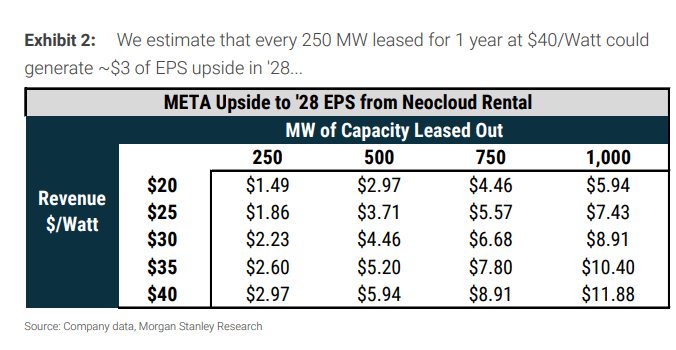
Morgan Stanley’s sensitivity analysis is more intuitive: for every 250MW of compute rented out, with a one-year lease and a price of $40 per watt, Meta’s 2028 EPS could increase by about $0.297, roughly equivalent to 8% upside room. If capacity expands to 500MW, 750MW, or 1000MW, or if the price differs, EPS sensitivity would continue to be amplified or dampened.
That’s also why the market hasn’t interpreted it as purely a negative. From Meta shareholders’ perspective, Zuckerberg et al. effectively have an additional escape route: if internal AI products can’t consume all the compute in the short term, they can first sell to external AI labs and recoup part of the investment.
The market also draws a comparison to xAI renting compute capacity to Anthropic: 500MW corresponds to $1.25 billion per month, or about $30 billion/GW/year. If this pricing holds, the implied return is extremely high—actually suggesting that high-quality compute is still tight in certain scenarios. This isn’t evidence that “no one wants compute,” but evidence that “idle capacity can be swept up at high prices.”
But this can only be called a bridge, not the main line. Morgan Stanley still places the key to Meta’s valuation on innovation in first-party products: whether Meta AI, business agents, messaging businesses, diffusion offerings, subscriptions, and so on can drive more persistent engagement and revenue growth. Selling compute can support EPS, but it can’t automatically lift valuation multiples.
Capex might not be cut; going all-in on a full cloud offering could burn more money
What the market worries most is that Meta cuts capex in 2027, and then the entire AI hardware supply chain follows with lower expectations.
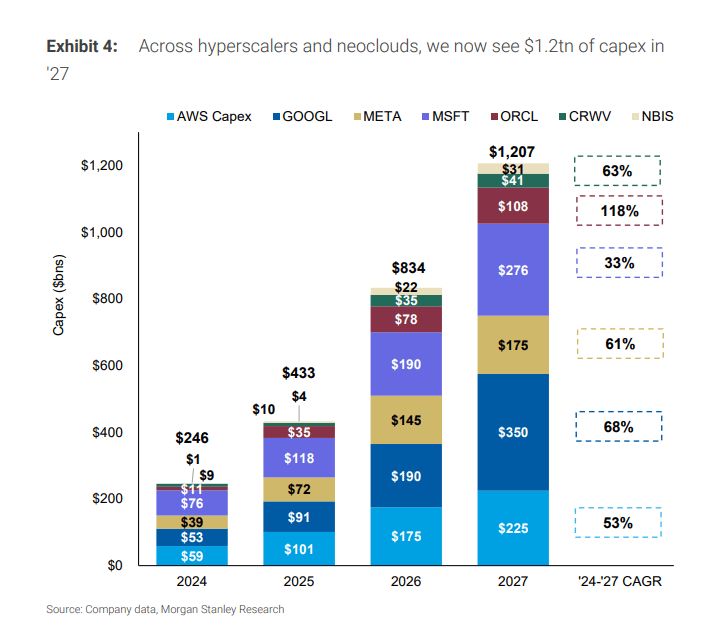
But in the Morgan Stanley model, current assumptions are that Meta’s capital expenditures rise from $145 billion in 2026 to $175 billion in 2027 and $205 billion in 2028. The model’s premise is that Meta mainly builds capacity for its own first-party line of products, rather than creating a full-scale hyper-large cloud service provider.
If Meta truly grows external cloud services—especially building a model/API platform rather than temporarily renting out bare compute—capex could face upward pressure instead. Because a full cloud business requires longer-term data-center capacity, more complex software platforms, and enterprise delivery capabilities.
Bernstein also looks at this question beyond 2027. Meta is one of the most important “checkbooks” in the AI market, so any change in buildout cadence affects the supply chain. But a “temporary external rental” approach has different capex implications from a “permanent expansion of cloud business,” and they can’t be mixed together.
The bigger demand driver is still inference and agent applications. HY Computer & AI’s market digest treats OpenAI’s weekend articles about Codex/agentic AI as a demand signal: the number of individual non-developer users grew 137x, the number of organizational users grew 189x, and OpenAI’s internal user count grew 12x. This perspective emphasizes that continued expansion of new scenarios could further drive inference compute demand.
So the key to this round of disagreement is not whether “Meta will sell compute capacity,” but whether the AI demand curve is still becoming steeper. If overseas ARR accelerates, inference application growth continues, and cloud vendors keep raising capex forecasts, then renting out compute becomes more like step-by-step monetizing assets. If, in the subsequent earnings seasons, capex forecasts get collectively cut, then this would become an industry turning-point signal.
Selling bare compute is easy; building a complete AI cloud is hard
Meta has two potential business routes, with very different levels of difficulty.
The first is selling “bare compute” or raw chip capacity, similar to neocloud. The customer buys GPU/compute resources, so Meta doesn’t need to immediately fill in the full enterprise software, developer tools, model platform, and sales system.
The second approach is offering hosted models/API access, like AWS Bedrock or Google Vertex AI. This isn’t a business you can do just because you have “a data center and chips.” It requires model capability, software stack, developer experience, enterprise customer sales, and service support to all keep up.
The Morgan Stanley model is more cautious about the second path. It notes that Meta’s Muse model family does not stand out on TerminalBench and SWE Bench Verified, and these tests are related to coding abilities and third-party usage scenarios. If Meta wants to compete with frontier models like Gemini, subsequent models need a significant improvement.
This is also where the scenario “Meta sells compute capacity equals Meta exits the model business” doesn’t hold up. The potential solution set already includes model/API access: Meta AI, business agents, messengers, diffusion offerings, subscription revenue, and other first-party products remain the core of long-term valuation. The issue isn’t whether Meta will do models, but whether it can turn model capabilities into cloud services that are sufficient for external customers to pay for.
In market discussions, some people also treat Muse Spark, the closed-source strategy, and management adjustments as evidence that Meta is still at the model-table. But these are better suited as tracking items for what comes next. At least across three frameworks, the more certain conclusion right now is: the execution threshold for selling raw compute is low, while the threshold for building a full-stack AI cloud is high.
Is CoreWeave the biggest “victim”? Customers become potential competitors
This latest shock hits most directly on new-cloud/GPUaaS companies like CoreWeave.
Bernstein’s rating for CoreWeave is Underperform with a target price of $67; Meta is Outperform with a target price of $850. The logic is straightforward: if Meta offers cloud infrastructure externally, it may end up directly competing with CoreWeave.
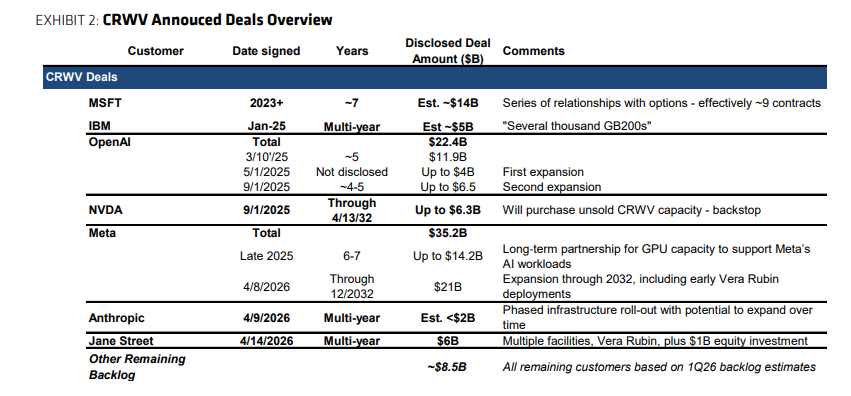
What’s more troublesome is that Meta itself is a major customer of CoreWeave. Under Bernstein’s metric, Meta currently has $35.2 billion in CoreWeave contracts, accounting for more than one-third of CoreWeave’s order backlog. Add Microsoft’s roughly $14 billion contract, and CoreWeave is approaching the point where nearly half of its orders come from customers who could become competitors when future renewals occur.
Near-term risk isn’t that direct. Existing contract constraints are strong, so it’s unlikely they can exit immediately; therefore, CoreWeave’s near-term revenue and debt pressure may not deteriorate right away.
The long-term problem is harder to deal with. If customers build their own clouds and sell compute themselves, a new cloud company’s bargaining power will decline. Especially at renewal time, CoreWeave is no longer just facing demand-side customers—it faces potential supply-side players with money, technology, and data-center experience.
In the JPMorgan trading desk’s view, the market’s reaction to CRWV down 13% and NBIS down 15% is relatively easy to understand: Meta went from customer to potential competitor overnight. For chip hardware, the impact is more indirect; for GPUaaS, it feels more like a stress test of the business model.
Why hardware falls first: besides fundamentals, there’s also crowded positioning
On the short-term trading level, the market isn’t just trading fundamentals.
The JPMorgan trading desk broke the debate into two sides: one is whether the Meta news represents a shift in the narrative for CSP capex and AI computing demand; the other is that crowded positioning, deleveraging, and profit-taking have amplified the selloff. Their view is that the latter has a higher weight, and the real way to judge whether fundamentals have turned is to look at how the upcoming earnings season is described.
The positioning backdrop isn’t light. The main indices’ rebalancing has just happened, and both total flow and leverage are starting from relatively high levels. Over the past four weeks, increases in both longs and shorts have been at about +2 standard deviations; over the past five years, July has often seen deleveraging by hedge funds, with changes typically in the range of -1 to -3 standard deviations. Semiconductor and memory holdings are close to the 100th percentile.
This explains why a single Meta headline could knock down the entire AI hardware supply chain. In a crowded trade that meets a narrative like “compute may not be scarce,” it’s easy to sell first and ask questions later. The same day, the software names, crowded shorts, and China ADRs all rose by more than 1.4 standard deviations, which also fits the characteristics of short-covering during deleveraging.
As for the signals that would reverse the narrative, the market mainly looks at a few things: whether Meta clarifies; whether overseas AI application ARR accelerates; whether cloud vendors keep raising capex; and whether the second-quarter performance beats expectations. The timing is concentrated between July and August. Right now it feels more like an observation period rather than a conclusion the market has already agreed on.
There’s also a tail risk: the higher the stock price, the harder it is for equity financing rumors to be ignored.
If Meta’s stock price is boosted by this “compute can be monetized” narrative, it could even increase the probability of equity financing rumors.
The logic is: when the market is at below 17x FY2027 EPS, Meta is unwilling to do dilutive financing. But if this news and a strong second-quarter performance push the valuation above 20x, the market shouldn’t be surprised by potential equity financing.
This isn’t the main line in the three foreign-institution frameworks, and no company has confirmed it. But it explains why the reaction in Meta’s stock price may not be purely straightforward. Selling compute can ease worries about investment returns, while equity financing rumors create dilution concerns. These two forces can both affect trading.
The three valuation frameworks didn’t price Meta as a “compute-selling company”
UBS reiterates a Buy rating on Meta with a target price of $865. The valuation is based on full-year diluted GAAP EPS of $33.26 through Q1 2028 and a 26x P/E multiple. Since the company has not confirmed any potential compute-sale news, UBS has not adjusted its forecast yet.
Morgan Stanley maintains an Overweight rating and Top Pick on Meta with a target price of $775. The implied base case includes roughly a 23x P/E multiple on FY2027 earnings. The core drivers remain advertising revenue, Reels monetization, improved engagement from AI, efficiency improvements, and the option value of new products.
Bernstein maintains Meta Outperform with a target price of $850, and also maintains CoreWeave Underperform with a target price of $67. This pairing reflects the market’s disagreement well: Meta’s set of options increases, while CoreWeave’s competitive pressure increases.
But the risk hasn’t disappeared either. Downside factors include: a pullback in the advertising cycle, regulatory pressure, uncertainty around the return on investment for Reality Labs, and execution mistakes in data-center construction that could lead to higher long-term capital intensity, among others.