

Reporter from Daily Economic News|Zhao Wenqi???? Editor at Daily Economic News|Zhang Yiming????
From being a co-founder of “Beyond the Year,” which was acquired by Meituan, to leading the establishment of a new company and launching an attempt to approach the Hong Kong Stock Exchange in less than three years—Silicon Flow founder Yuan Jinhui’s entrepreneurial story is now entering another key turning point.
As disclosed by the Hong Kong Exchanges and Clearing Limited on June 30, Beijing Silicon Flow Technology Co., Ltd. (hereinafter “Silicon Flow”) submitted a listing application to the Hong Kong Stock Exchange’s Main Board. Huatai International and Haitong International serve as joint sponsors. This AI (artificial intelligence) infrastructure company, founded by Yuan Jinhui only in August 2023, stepped onto the IPO (initial public offering) track just 34 months after its establishment—so fast that the market took notice.
Silicon Flow is doing a business of “selling tokens.” Tokens are the smallest unit for AI models to process information. For each answer the large model generates, behind it are thousands of tokens consumed. What Silicon Flow does is to package complex engineering capabilities—such as chip adaptation, model deployment, inference engine optimization, and heterogeneous computing scheduling—into standardized API (application programming interface) interfaces, allowing developers to call on demand and pay per usage, just like using water and electricity. Industry insiders therefore describe it vividly as a “token factory.”
According to the prospectus, based on annual token throughput, in 2025 Silicon Flow ranked as the fourth-largest token supply platform in China, with a market share of 1.5%, and it ranked first among all independent token supply platforms with ecosystems in China.
However, another side of high-speed growth is the continued expansion of losses. The prospectus shows that in 2024 and 2025, Silicon Flow’s revenue was RMB 7.35 million and RMB 55.33 million, respectively, representing year-on-year growth of up to 653%. But in the same periods, annual losses were RMB 81.92 million and RMB 345 million, respectively; after adjustments, net losses were RMB 54.01 million and RMB 187 million, respectively. Revenue growing by tens of times while losses also expand in parallel—“increasing revenue without increasing profit”—is the most talked-about issue when this star start-up lines up for its IPO.
Alibaba and Huawei as heavy backers—Yuan Jinhui’s “roller-coaster” entrepreneurial journey
Silicon Flow’s story is inseparable from founder Yuan Jinhui’s dramatic entrepreneurial experience.
As early as 2016, Yuan Jinhui led the OneFlow team to enter the large-model infrastructure track. At that time, the team was the world’s only start-up building a general deep learning framework. In 2023, standing on the large-model boom, OneFlow was acquired by a large-model company “Beyond the Year” founded by Wang Huiwen, a former Meituan co-founder. Shortly afterward, “Beyond the Year” was acquired by Meituan. After declining Meituan’s invitation to stay on, in August 2023 Yuan Jinhui led the team again to start fresh and founded Silicon Flow.
Yuan Jinhui once publicly described 2023 as “like a roller coaster.” Within a few months, the start-up went through multiple mergers and acquisitions—turning from a company worth $100 million into one worth $1 billion and then $10 billion—before being spun off again to start anew.
What truly brought Silicon Flow into the public eye was DeepSeek’s global breakout in the Spring Festival of 2025. At the time, DeepSeek repeatedly ran into issues such as server attacks and the official website being unable to open. Silicon Flow’s large-model cloud service platform, SiliconCloud, was the first to roll out a full-powered version of the DeepSeek R1/V3 model based on Huawei Cloud Ascend cloud computing. It became the industry’s first company to successfully clear the deployment path for DeepSeek models on domestically made chips. This “mainstreaming” event drove a surge in Silicon Flow’s user growth. Its public cloud platform quickly accumulated more than 7 million users and over 10,000 enterprise users.
What is particularly dramatic is that Yuan Jinhui once recalled on social media that in the second half of 2023, when he was initially setting up Silicon Flow, he discussed investment matters with DeepSeek’s founder Liang Wenfeng, but they were unable to work together for multiple reasons. After the fact, he lamented in his朋友圈 that “he regretted not having foresight back then.”
From the perspective of the financing timeline, Silicon Flow is almost a “funding harvesting machine” in the primary market. From the angel round launched in December 2023 to the present, the company has completed seven rounds of financing in total. On June 16, 2026, the company officially announced that it had completed more than RMB 2 billion in a B round, setting a record for the largest single financing in the third-party MaaS (model as a service) track in China since 2026. By this point, the company’s post-investment valuation has reached RMB 7.74 billion.
According to the prospectus, Silicon Flow’s shareholder roster is nothing short of “luxurious.” Alibaba holds 7.42% through its holding in Hangzhou Multi Network Technology Co., Ltd., making it the largest external shareholder; HUAWEI’s Hubble Technology holds 4.07%; and Meituan holds 1.05% through Tianjin San Kuai Technology. In addition, industrial investors and financial investment institutions such as Innovation Workshop, Yaotou Capital, Purview Capital, Gênesis Capital, JinkoEnergy, SenseTime, and Biren Technology are also listed among the shareholders. The controlling shareholders are founder Yuan Jinhui and four employee incentive platforms, which together control about 44.48% of voting rights.
However, this company was registered and established in August 2023, and its commercialization is still at an early stage. In terms of its commercialization path, Silicon Flow adopts a “dual-engine” model driven by both public-cloud services and on-premises deployment solutions. The prospectus discloses that in 2025, the share of revenue from the company’s public-cloud services jumped from 14.6% in 2024 to 52.9%, becoming its largest revenue source. The company expects to meet the revenue requirements for “a commercialized company” as defined in Chapter 18C of the Hong Kong Listing Rules by the end of 2026.
Public information shows that only when the profit for the most recent financial year reaches HKD 250 million will it meet the listing rules’ definition of “a commercialized company.”
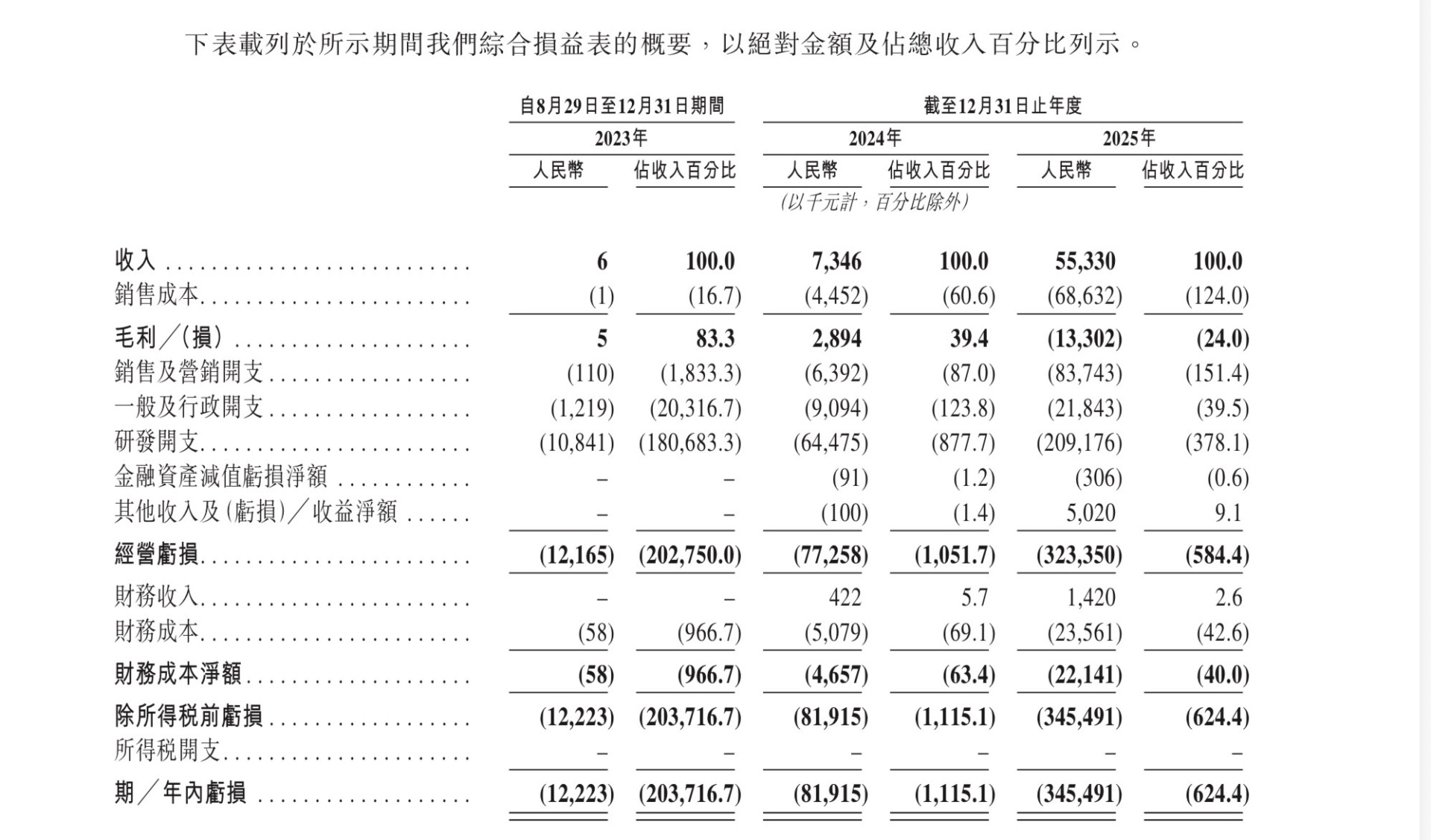
Image source: prospectus
Net losses are expected to continue in the near term: high R&D spending and price compression from big vendors?
With revenue growth exceeding 650% and annual losses exceeding RMB 300 million, Silicon Flow’s high growth coexisting with high losses reflects structural contradictions across the entire “token factory” track.
On the one hand, the market space for this business is expanding at an astonishing speed. The prospectus notes that, measured by token throughput, China’s token supply market size grew by 1,602.6% from 2024 to 2025, and is expected to have a compound annual growth rate of 638.3% from 2025 to 2030. IDC data shows that in 2025 the size of China’s public-cloud MaaS market reached RMB 3.07 billion, and it is expected that the token consumption volume in 2026 will reach 40,000 trillion—about 20 times higher than in 2025.
But the most direct pressure on profitability comes from ongoing R&D spending and the increasingly intense API price war.
In the prospectus, Silicon Flow states that as the company expands its commercial scale in the future, it expects that its absolute R&D expenditures and recent net losses will continue. The company plans to achieve long-term profitability through measures including capturing the industry’s explosive growth; deepening the involvement of domestic customers; accelerating overseas revenue growth; maximizing the utilization rate of computing resources; and improving operational efficiency.
Since 2023, leading large-model vendors have cumulatively cut API prices more than ten times. For some mainstream models, the per-thousand-token price has fallen from the original few tenths of a yuan to just a few cents, with cumulative reductions exceeding 90%. In May 2026, DeepSeek announced a permanent 75% cut in the V4-Pro model’s API pricing. Subsequently, Xiaomi and Tencent Cloud also followed suit, with the highest reductions reaching 99% and 97.5%, respectively. For Silicon Flow, which charges based on tokens, the continuous decline in downstream pricing directly squeezes profit margins.
At the same time, internet giants are getting directly involved. Leading companies such as Alibaba, Tencent, and ByteDance have fully rolled out their own inference computing power and MaaS services. These not only support their own business with AI capabilities, but also output MaaS services to the outside. With cost advantages from self-built computing clusters and technical ecosystem strengths, big tech firms are reshaping the competitive landscape.
In this regard, angel investor and AI expert Guo Tao analyzed to a (Daily Economic News) reporter that while big tech firms have technical and ecosystem advantages, market demand is diverse and complex and it is difficult for them to cover all scenarios. Independent third parties still have room to survive, and they can focus on vertical sectors to provide tailored services.
In its prospectus, Silicon Flow also candidly admits that the company is currently facing multiple risks and challenges. On the financial front, the company is still loss-making, with operating cash flow remaining negative; if it fails to effectively improve profitability or obtain external financing in a timely manner in the future, its ability to sustain operations may be affected. On the technical front, AI industry technology evolves extremely fast. The company must continue to make heavy investments in R&D to maintain competitiveness, while pressures to adapt new models and new chips, as well as potential changes in the open-source model ecosystem, could all shake the foundation of its business. On the market front, competition in the global token supply pipeline is getting increasingly intense, and the industry’s price war continues to squeeze profit margins.
The prospectus also mentioned that on the regulatory side, China’s regulatory framework for the AI industry is still evolving rapidly, and compliance costs and uncertainty continue to rise. In addition, international chip export controls and trade sanctions could at any time affect upstream supply chains, further heightening operational risks. Overall, Silicon Flow is in a critical stage of “rapid expansion coexisting with large losses.” Whether it can stabilize its technological moat while burning money to gain scale, and whether it can meet the dual tests of capital and supply chain pressures—are the most closely watched questions after its IPO.
Judging from the financial data, Silicon Flow’s gross margin dropped sharply from 39.4% in 2024 to -24% in 2025, recording a gross loss of RMB 13.3 million. Sales and marketing expenses surged from RMB 6.39 million in 2024 to RMB 83.74 million in 2025, an increase of 1,210%. Among them, the share of promotional computing resource costs—i.e., free token vouchers—was as high as 64.7%, reflecting the company’s massive investment in the user acquisition stage.
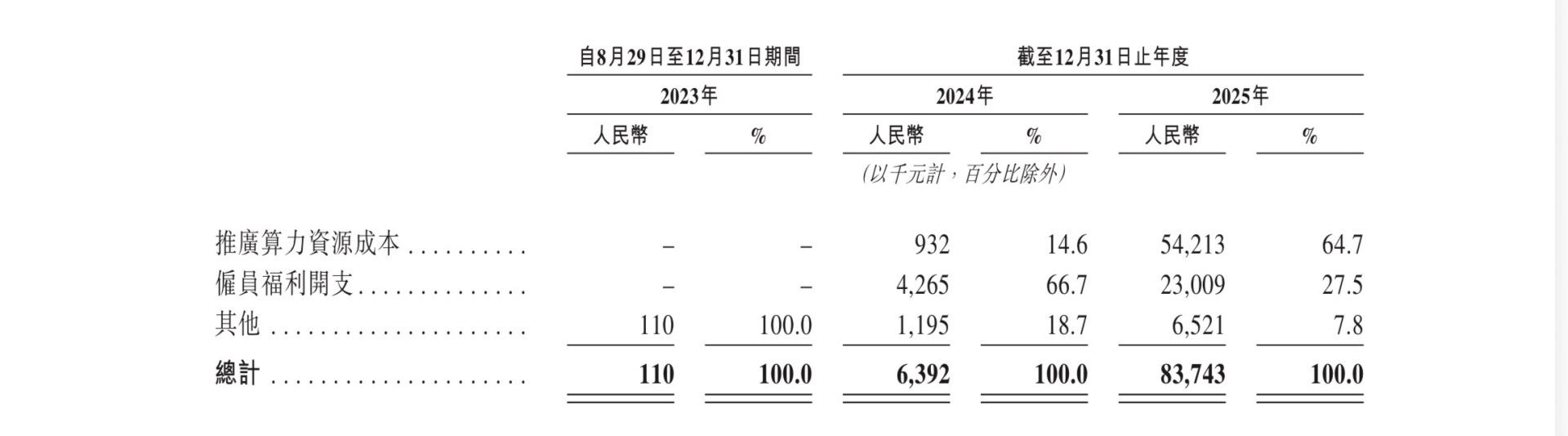
Image source: prospectus
It is worth noting that Silicon Flow’s co-founder, Hu Jian, previously said in an interview with a (Daily Economic News) reporter that the trend of “turning large models into utilities like hydropower, coal, and gas”—or “water, electricity, coal, gas, and models”—is irreversible. In the future, model costs will become increasingly cheaper, just like electricity bills. However, the real value will be reflected in various applications built on top of the models. In his view, finding a balance between adapting heterogeneous computing power, cost control, and security assurance will be the key to determining whether an enterprise’s AI applications succeed or fail.
Having been founded for less than three years and rushing to target the Hong Kong Exchanges and Clearing before a listing—Silicon Flow’s IPO is both a test of the “token economy” business model and a re-examination by the market of valuation logic for the AI infrastructure track. Under the twin narrative of a sprinting scale and mounting pressure on profitability, whether this “token factory” can tell a sustainable growth story to the capital markets remains to be answered by time.
Cover image source: Every-day Economic News Media Resource Database