
This node proposed the '23-hour system', not out of consideration for Asian traders, but to pave the way for seizing global liquidity high ground.
Written by: Frank, MSX Research Institute
In the past, trading U.S. stocks meant sleepless nights; will there be no sleep during the day in the future?
As the Crypto market has become accustomed to a 7×24 never-sleeping rhythm, Nasdaq, standing at the core hub of TradFi, finally couldn't sit still.
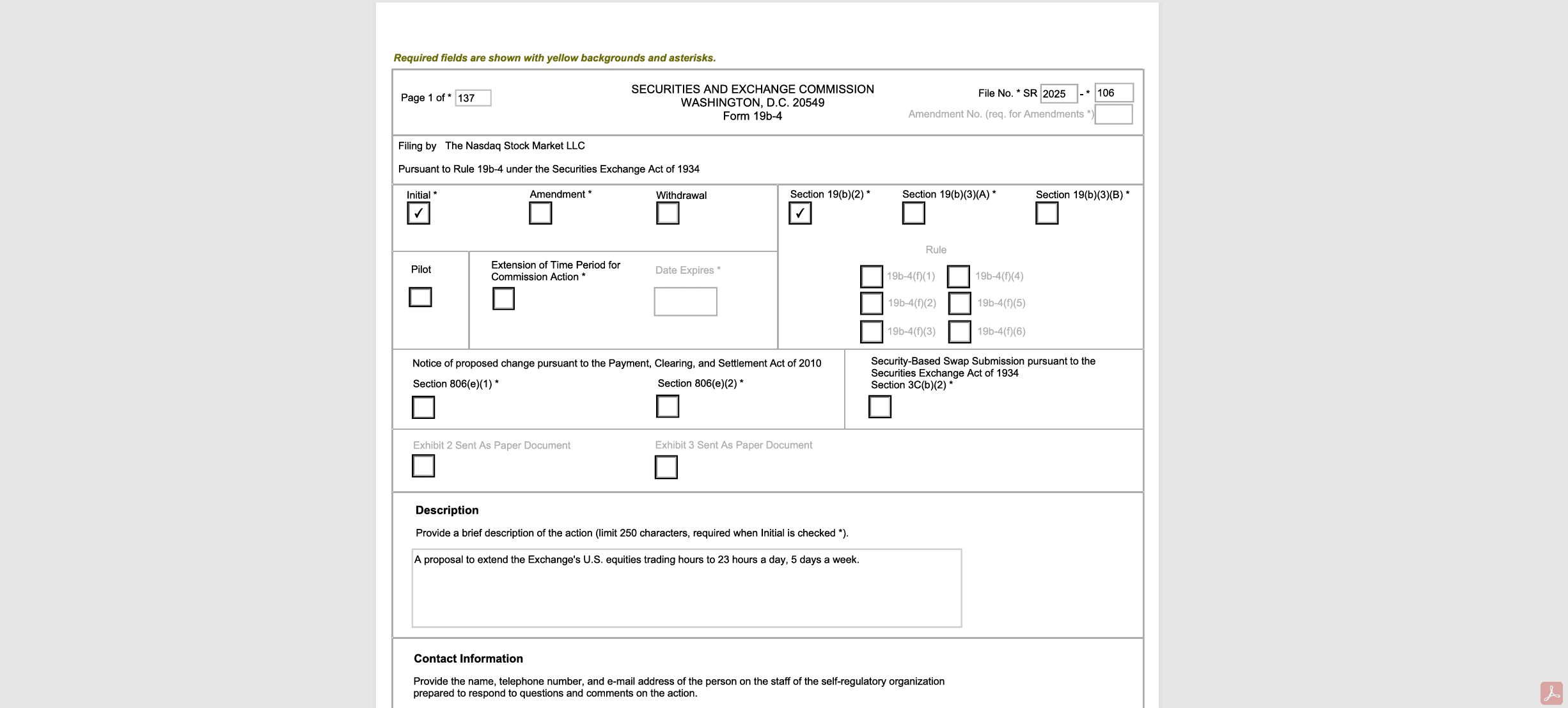
On December 15, Nasdaq officially submitted documents to the U.S. Securities and Exchange Commission (SEC), planning to extend trading hours from the current 5 days a week, 16 hours a day (pre-market / intraday / post-market), to 5 days a week, 23 hours a day (daytime / nighttime).
Once approved, U.S. stocks will trade continuously from Sunday evening 21:00 until Friday evening 20:00, leaving only a 1-hour (20:00-21:00) market closure window each day, and the official reason is also quite decent, namely "to meet the growing demand of Asian and European investors, allowing them to trade during non-traditional hours."
However, if we peel back the layers, we will find that the logic behind this goes far beyond that. Nasdaq is clearly conducting extreme stress tests for the future of stock tokenization, and we are gradually piecing together a continuously advancing timeline:
Nasdaq and the U.S. financial market are preparing for a "non-closing financial system."
1. From 5×16 to 5×23: approaching the "last hour" limit of TradFi
On the surface, this is just an extension of trading hours, but from the perspective of all participants in TradFi, this step has almost pushed the technical capacity and collaborative ability of the existing financial infrastructure system to its physical limit.
It is well known that stock trading under the TradFi system is a precisely meshed gear system. Besides Nasdaq, stakeholders also include brokerages, clearing institutions, regulatory bodies, and even the listed companies themselves. This means that to support the 23-hour trading system, all market participants need to communicate fully and undergo deep modifications around all aspects of clearing, settlement, and collaboration systems:
Brokerages and dealers must extend customer service, risk control, and trading maintenance systems to operate around the clock, leading to a sharp rise in operational and labor costs;
Clearing institutions (DTCC) need to simultaneously upgrade trading coverage times and clearing settlement systems, extending service hours to 4 AM to match the new rules for "night trading next-day settlement" (trades from 21:00 to 24:00 are counted for the next day);
Listed companies must also recalibrate the rhythm of disclosing financial reports or major announcements, and investor relations and market participants must gradually adapt to the new reality of "significant information being priced in real time during non-traditional hours";
Of course, for those of us in the East 8 zone, U.S. stock trading has previously concentrated in the deep night or early morning. The future 5 days × 23 hours model means there is no need to stay up late to participate in real-time, which is undoubtedly a great benefit, but it also raises a soul-searching question—since a reform has been decided, why can’t we realize 7×24 all at once, instead of leaving this awkward 1 hour?
According to Nasdaq's public disclosures, the 1 hour left in between is mainly used for system maintenance, testing, and trading settlement. This also exposes the "Achilles' heel" of traditional financial architecture, namely that under the current centralized clearing and settlement system (based on DTCC and brokerage/bank systems), there must be a period of physical downtime for data batch processing, end-of-day reconciliation, and margin settlement.
Just like banks still need to reconcile accounts after work every day, from another perspective, this 1 hour can also be seen as a "fault tolerance window" in the real world. Although it requires a huge investment in labor shift costs and system maintenance costs, it also provides necessary buffers for the upgrade of various systems under the current financial infrastructure, synchronization of clearing and settlement, fault isolation, and risk disposal.
However, compared to the past, the remaining 1 hour in the future demands an almost harsh requirement for the cross-role collaboration capability of the entire TradFi industry, akin to an extreme stress test.
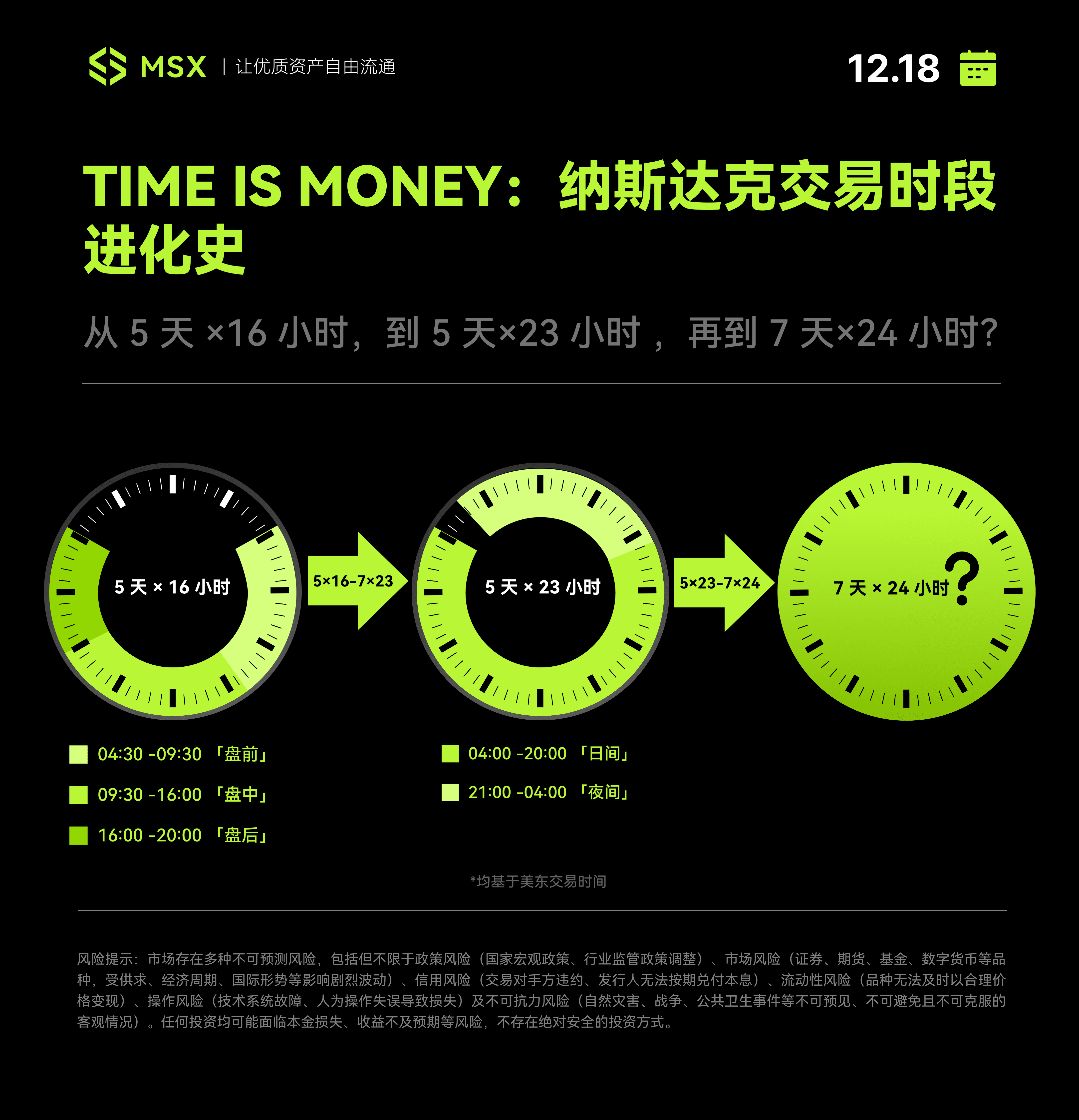
In contrast, blockchain-based crypto and tokenized assets rely on distributed ledgers and smart contracts for atomic settlement, inherently possessing the gene for 7×24×365 around-the-clock trading, with no closing hours, no need for market breaks, and no need to squeeze critical processes into a fixed end-of-day window.
This explains why Nasdaq is challenging the limits with such effort. It is not suddenly realizing the need to "consider" Asian users, but rather a necessity— as the lines between the 7×24 Crypto market and traditional financial markets become increasingly blurred, the incremental trading demand for traditional exchanges increasingly comes from cross-timezone global capital and longer periods of liquidity coverage.
It can be said that entering 2025, tokenization is already an arrow on the string, and players like Nasdaq have long set up positions in the background; therefore, from this perspective, the 23-hour trading system is not an isolated rule change of "opening a few more hours", but rather a systemic transitional step paving the way for stock tokenization, on-chain settlement, and a 7×24 global asset network:
Without overturning existing securities laws and the National Market System (NMS), first pull the trading system, infrastructure, and participant behavior towards a rhythm that "approaches on-chain"—to test and lay the groundwork for more aggressive goals (more continuous trading, shorter settlement cycles, and even on-chain clearing and tokenized delivery).
Imagine, once the SEC's approval is obtained, and the 23-hour trading system starts running and gradually becomes the norm, the market's patience threshold and reliance on "trading at any time, instant pricing" will be raised. How far away can we be from that truly 7×24 endgame?
By then, with the formal launch of tokenized U.S. stocks, the global financial system will smoothly transition to that truly "never closes" future.
2. What far-reaching impacts will this have on the market?
Objectively speaking, the "5×23" model could lead to a structural shock affecting the global TradFi ecosystem.
In terms of time breadth, it significantly expands the time boundaries of trading, which is undoubtedly a substantial benefit for cross-timezone investors, especially in the Asian market; however, from the perspective of market microstructure, it also introduces new uncertainties in liquidity distribution, risk transmission, and pricing power, making it easy to provoke a "sustainable depletion of global liquidity."
In fact, in recent years, the activity of U.S. stocks during non-traditional trading hours (pre-market and after-hours) has indeed shown explosive growth.
Data from the New York Stock Exchange shows that in the second quarter of 2025, trading volume during non-trading hours exceeded 2 billion shares, with a transaction value of 62 billion dollars, accounting for 11.5% of U.S. stock trading in that quarter, a historical high. Meanwhile, transaction volumes on night trading platforms such as Blue Ocean and OTC Moon have also continued to rise, making night trading no longer a marginal phenomenon but a new battlefield that mainstream capital cannot ignore.
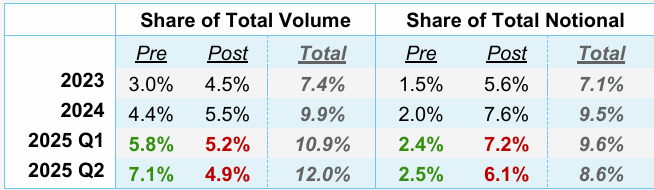
Behind this is essentially the concentrated release of the real demand of global traders, especially Asian retail investors, to "trade U.S. stocks in their own time zones". From this perspective, Nasdaq's attempt is not to create demand, but to reintroduce night trading, which was originally scattered in low transparency environments and outside the market, back into a centralized and regulated exchange system with a compliant identity, reclaiming the pricing power lost in the dark.
But the problem is that "5×23" trading does not necessarily lead to higher quality price discovery; it is more likely to present a paradoxical double-edged sword state:
First, there is the "fragmentation" and "dilution" risk of liquidity: although extending trading hours theoretically can attract more cross-timezone capital, in reality, it also means limited trading demand being fragmented and diluted over a longer time axis, especially during the "night" period under the "5×23" model, where the corresponding trading volume of U.S. stocks is inherently lower than during regular hours, and an extension may lead to wider spreads, insufficient liquidity, increased trading costs and volatility, and even make it easier to manipulate prices during thin liquidity periods;
Secondly, there is the potential change in the structure of pricing power: as mentioned earlier, Nasdaq's "5×23" model is expected to absorb the scattered orders that have been diverted to off-market platforms such as Blue Ocean and OTC Moon, but for institutions, liquidity fragmentation has not disappeared; it has merely shifted from "off-market dispersion" to "on-market time-sharing", raising higher demands on risk control and execution models. This fragmented liquidity environment also significantly increases the friction costs of executing large orders;
Finally, there is the possibility that black swan risks are amplified due to "0 latency": under the 23-hour trading framework, significant unexpected events (whether performance crashes, regulatory statements, or geopolitical conflicts) could be instantly converted into trading instructions, and the market no longer has the buffer period of "sleeping through the night" to digest, making such immediate reactions more likely to trigger gaps, violent fluctuations, and even irrational chain liquidation reactions in the relatively thin liquidity of the night trading environment, exponentially amplifying the destructive power of black swans without counterparties;
That is why the author pointed out above that trading under the "5×23" model is by no means as simple as "just opening a few more hours of trading", nor is it merely a question of "risk being smaller or larger"; rather, it is a systematic extreme stress test of the TradFi price discovery mechanism, liquidity structure, and distribution of pricing power.
Everything is paving the way for that "never closing" tokenized future.
3. Nasdaq's entire chess game: all preparations point to On-Chain
If we extend our view and connect Nasdaq's recent intensive actions, we will be more convinced that this is a strategic puzzle, step by step, aimed at enabling stocks to ultimately possess the ability to circulate, settle, and price like tokens.
To this end, Nasdaq has chosen a moderate reform path with a strong traditional financial style, and the evolution logic of the roadmap is extremely clear, advancing step by step.
The first step occurred in May 2024, when the U.S. stock settlement system was officially shortened from T+2 to T+1, which was a seemingly conservative but actually crucial infrastructure upgrade. Soon after, at the beginning of 2025, Nasdaq began to release signals of its intention for "around-the-clock trading," hinting at plans to launch uninterrupted trading services five days a week in the second half of 2026.
Subsequently, Nasdaq shifted the focus of reform to a more hidden but crucial backend system—the Calypso system integrating blockchain technology to achieve 7×24 hours of automated margin and collateral management. This step has almost no visible changes for ordinary investors, but it is a very clear signal for institutions.
By the second half of 2025, Nasdaq began to advance on institutional and regulatory fronts.
First, in September, a formal application for stock "tokenization" trading was submitted to the U.S. SEC, and in November, the primary strategy was to clearly indicate that tokenizing U.S. stocks would be advanced "as quickly as possible."
Almost simultaneously, U.S. SEC Chairman Paul Atkins expressed in an interview with Fox Business that tokenization is the future direction of capital markets. By placing securities assets on-chain, clearer ownership rights can be realized, and he expects that "within about the next 2 years, all U.S. markets will migrate to operate on-chain, achieving on-chain settlement."
It is against this backdrop that Nasdaq submitted its application for the 5×23 hour trading system to the SEC in December 2025.
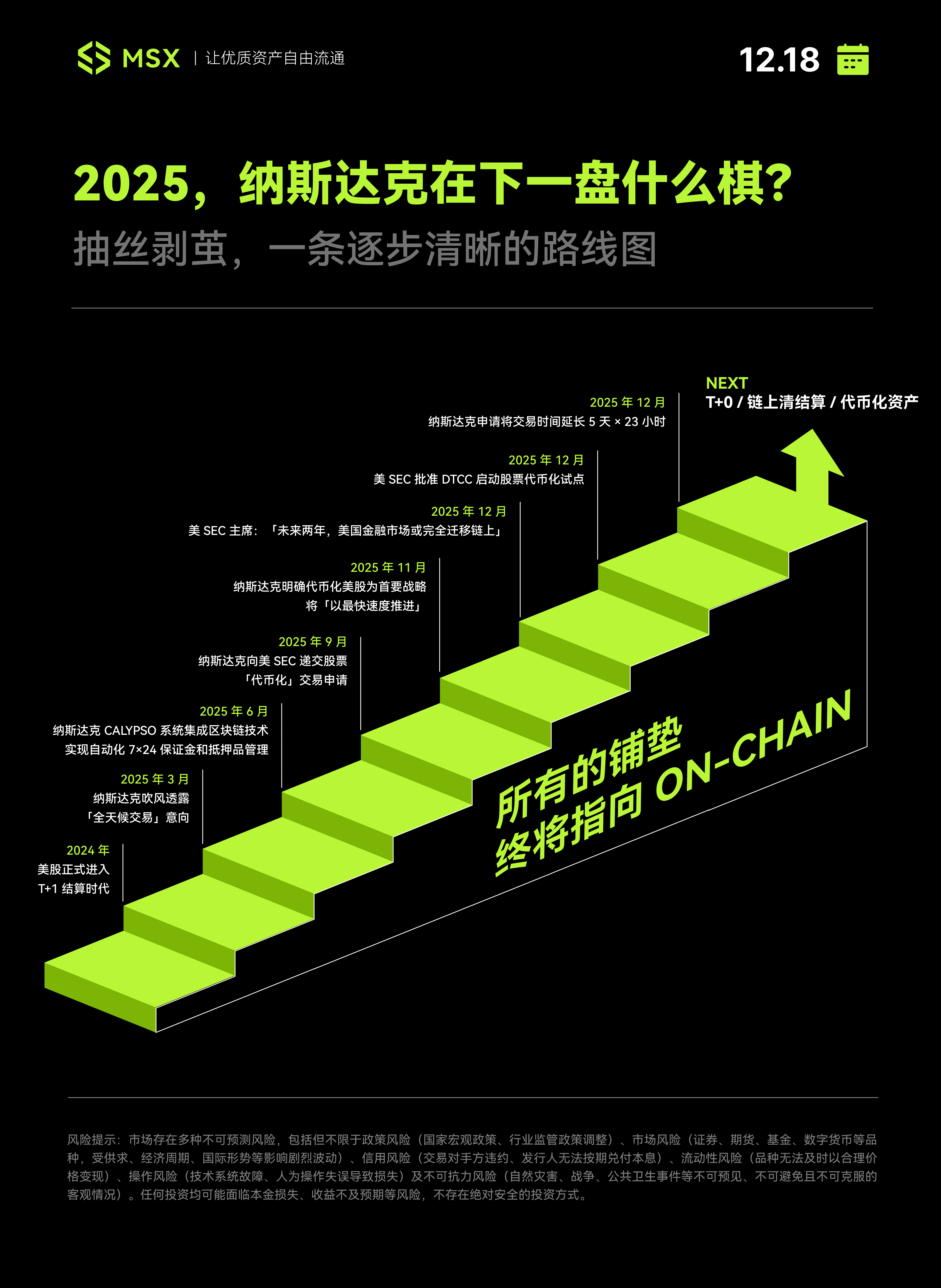
From this perspective, Nasdaq's extension of trading hours with the "23-hour trading system" is not a singular reform but a necessary step in its roadmap for stock tokenization. Because the future tokenized assets will inevitably pursue 7×24 hours of around-the-clock liquidity, and the current 23 hours is the "transitional state" closest to on-chain rhythm.
Most intriguingly, the regulators (U.S. SEC), infrastructure (DTCC), and trading venues (Nasdaq) showed a high level of coordinated rhythm in 2025:
The U.S. SEC is loosening regulations and setting the tone: on one hand, it continues to relax regulations, and on the other hand, it releases expectations for "full on-chain" through high-level interviews, injecting certainty into the market;
DTCC solid foundation: On December 12, DTCC's subsidiary, the Depository Trust Company (DTC), received a no-objection letter from the U.S. SEC, approving its provision of tokenization services for real-world assets in a controlled production environment, with plans to officially launch in the second half of 2026 to address the most core issues of clearing and custody compliance;
Nasdaq charges ahead: officially announces the tokenization stock plan, prioritizing it highly, and submits the 23-hour trading application to attract global liquidity;
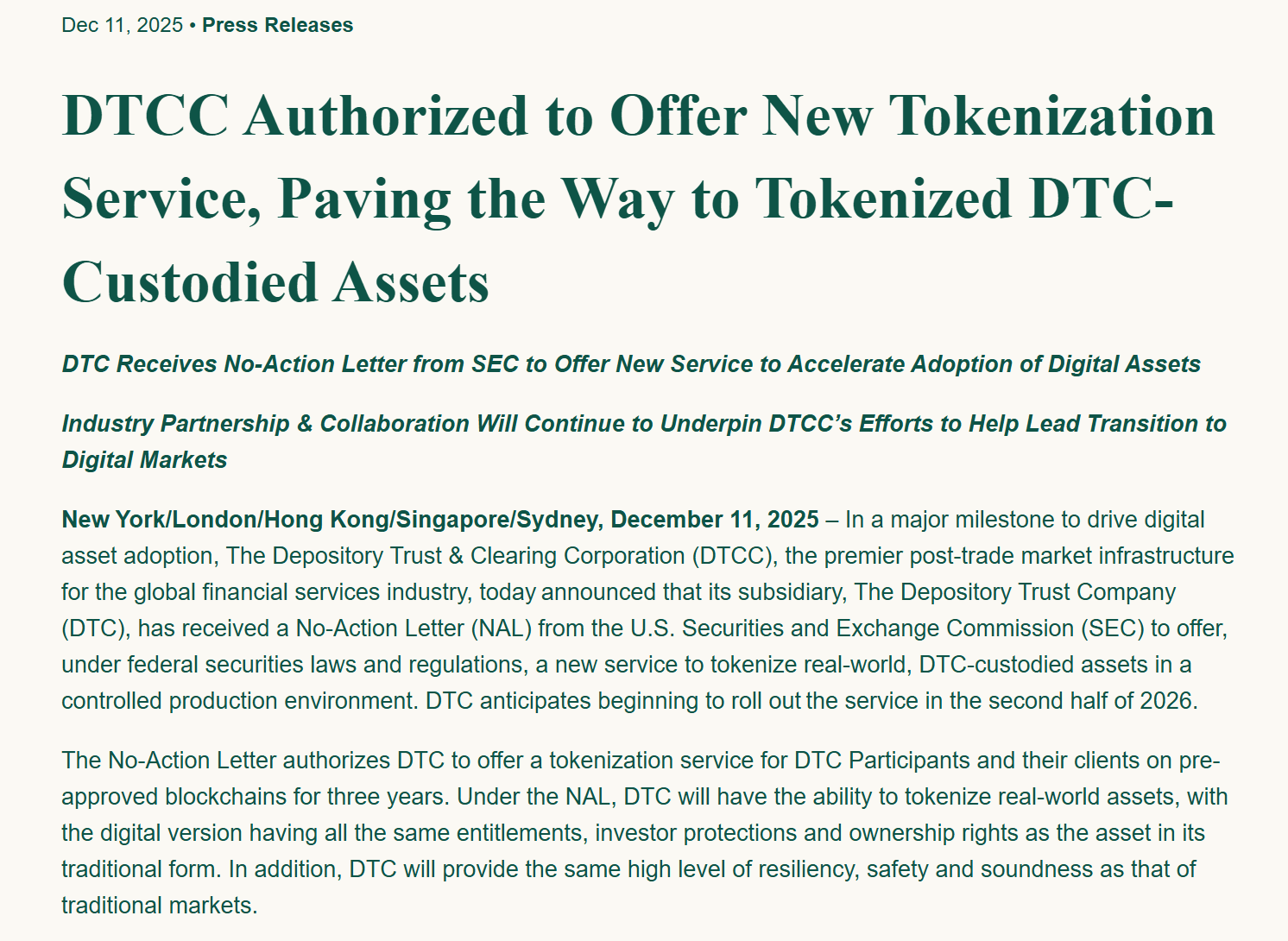
When these three lines are placed on the same timeline, the tacit understanding of this staging is hard not to lead to a conclusion:
This is not a coincidence or a sudden inspiration from Nasdaq, but a highly coordinated and continuously advancing institutional project. Nasdaq and the U.S. financial market are making the final sprint for a "non-closing financial system."
Written at last
Of course, once Pandora's box is opened, the "5×23 hours" is just the first step.
After all, once the demand of human nature is released, it becomes irreversible. Therefore, since U.S. stocks can be traded at midnight, users will inevitably question: why should I still endure that 1-hour interruption? Why can't I trade on weekends? Why can't I use U to settle in real time?
When the appetite of global investors is thoroughly whetted by the "5×23 hours", the existing fragmented architecture of TradFi will face its final blow. Only 7×24 native tokenized assets can fill the last hour's gap, which is why, besides Nasdaq, players such as Coinbase, Ondo, Robinhood, and MSX are also racing frantically—those who run slowly will inevitably be swallowed by the on-chain tide.
The future is still far off, but the time left for the "old clock" is already running out.