

@KITE AI A session timeout looks like a tiny problem until you’re the one trying to explain an outage with incomplete evidence. A user says “it logged me out,” a gateway reports “unauthorized,” a service owner sees retries, and the graphs refuse to form a neat spike. In agent-driven systems, where a single intent can fan out into multiple API calls and payment steps, that timeout is often the moment the narrative fractures. You can restore service and still spend days arguing about what actually happened.
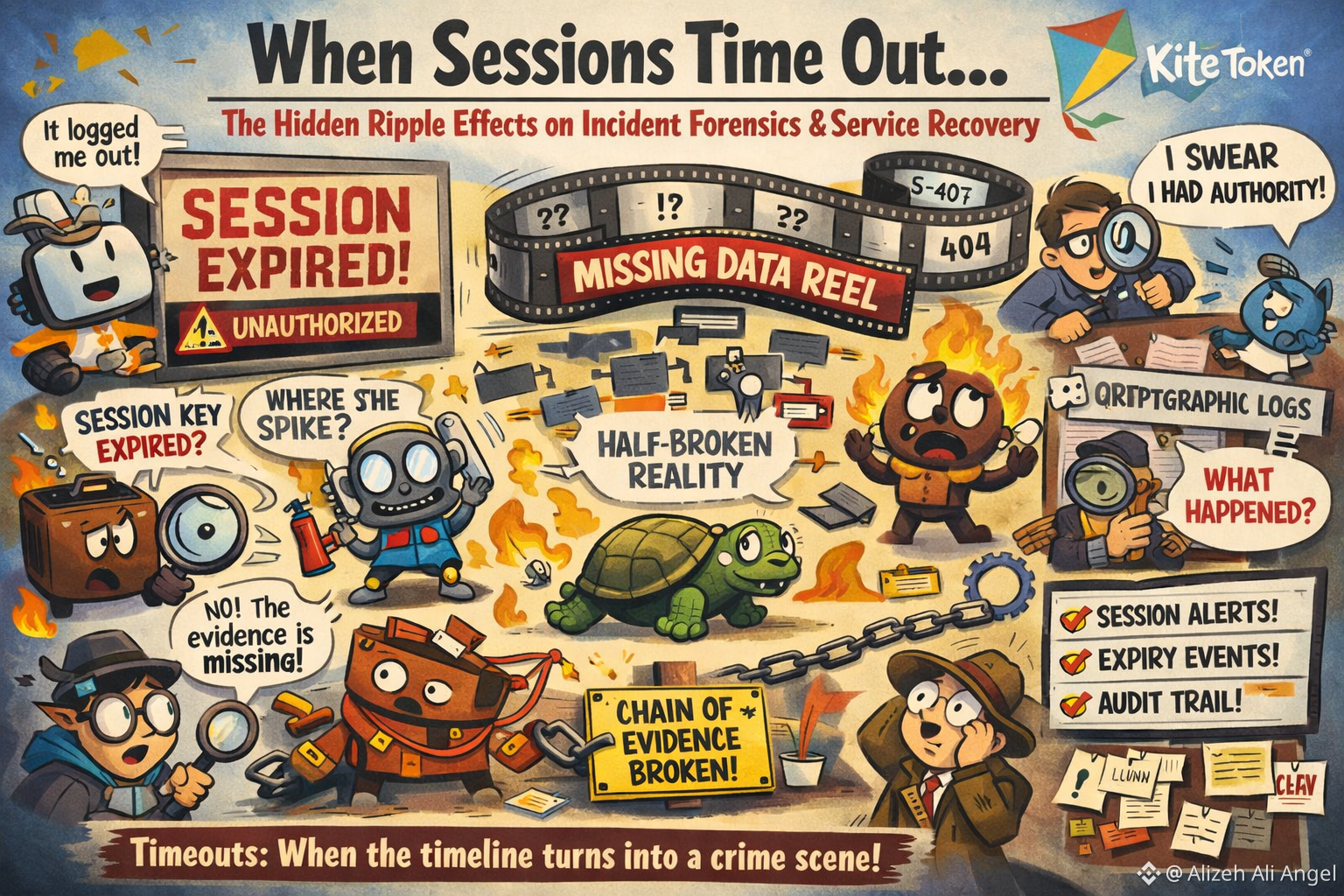
This feels especially current in the GoKiteAI orbit because identity is no longer a background detail; it is part of the product. Kite frames itself as infrastructure that lets autonomous agents operate and transact with identity, payment, governance, and verification. When you build on that promise, a session expiring isn’t just “log in again.” It’s a reliability event that can interrupt delegated authority, payments, and the audit trail you’ll later need.
Kite’s documentation describes a three-layer identity model: user as root authority, agent as delegated authority, and session as ephemeral authority, with session keys that expire after use. That design limits the blast radius. But it also means identity changes are constant, even when everything is healthy. If you don’t treat those changes as first-class signals, you end up with incident timelines that look like a missing reel of film: the action continues, but the continuity is gone.
In real incidents, the failure rarely announces itself as “session expired.” What you actually see is a spray of 401s, client retries, and backoffs that create latency and pressure in strange places. Some flows continue because their tokens refresh cleanly. Others fail because a renewal request races, or a cache stores an unauthenticated response, or a client has a brittle refresh loop. The result is a half-broken reality: no single red bar, just drift toward pain, and a recovery that feels like guesswork.
The forensic damage usually shows up after the fire is out. Kite’s agent network materials emphasize that interactions can be recorded automatically under pre-authorized spending rules, and that cryptographic logs (with optional privacy techniques) can provide an audit trail without exposing sensitive details. That’s the right direction, especially for systems where agents may transact. But a timeout still hurts if your observability collapses every auth problem into the same “unauthorized” bucket. You lose the ability to answer basic questions quickly: did an agent exceed a policy, did a session key expire mid-step, did a dependency reject it, or did a client fail to renew?
This topic is also trending because the ecosystem is accelerating. High-visibility listings and platform launches pull in new builders fast, and that surge changes what “normal load” looks like overnight. Integrations are where session expiry becomes operational: cron jobs, agent orchestrators, wallet signers, data providers, and UI bridges, all with different assumptions about when identity should rotate and what “expired” should mean.
There’s a parallel in a completely different “Kite token” ecosystem: Zerodha’s Kite Connect access tokens. Their developer community has long treated token timing as a practical constraint because automation depends on staying within the session window. Whether or not you trade, the lesson transfers cleanly: predictable expiration should be treated like scheduled risk. You plan for it, you test it, and you watch it as calmly as you watch a nightly batch job.
Security guidance is pushing everyone toward more frequent renewal, not less. That’s good security hygiene, but it increases normal identity churn. More churn means more chances for correlation to break unless you intentionally preserve it.
So what does preservation look like in a GoKiteAI context? It starts with naming session events as normal, structured telemetry. Session creation, rotation, expiry, and refresh failure should be observable in the same way database latency is observable: consistent fields, stable identifiers, and clear error categories. It also means designing workflows to be restartable without being duplicative. If a payment step is retried after a timeout, the system should be able to prove “this intent was already settled” and avoid double execution, even when retries overlap with rotation.
None of this requires hype. It requires discipline. Measure the auth path separately from business logic. Alert on “identity plane unhealthy” before it becomes ten downstream pages. Practice failure modes where the refresh endpoint is slow, or where session keys expire mid-orchestration, and make sure your dashboards tell a single story rather than five competing ones. The emotional relief, when it works, is real: your team stops arguing about what the system “probably” did and starts reading what it actually recorded.
I keep coming back to a simple question: when a session expires at the worst possible moment, what story will your system tell tomorrow? If it’s a complete, stitched-together story, timeouts become manageable and boring. If it’s a confusing one, the timeout wasn’t a minor nuisance at all; it was the point where your evidence chain broke.



