




When I look at RWA projects recently, I find the RE Protocol @ReProtocol direction quite special.
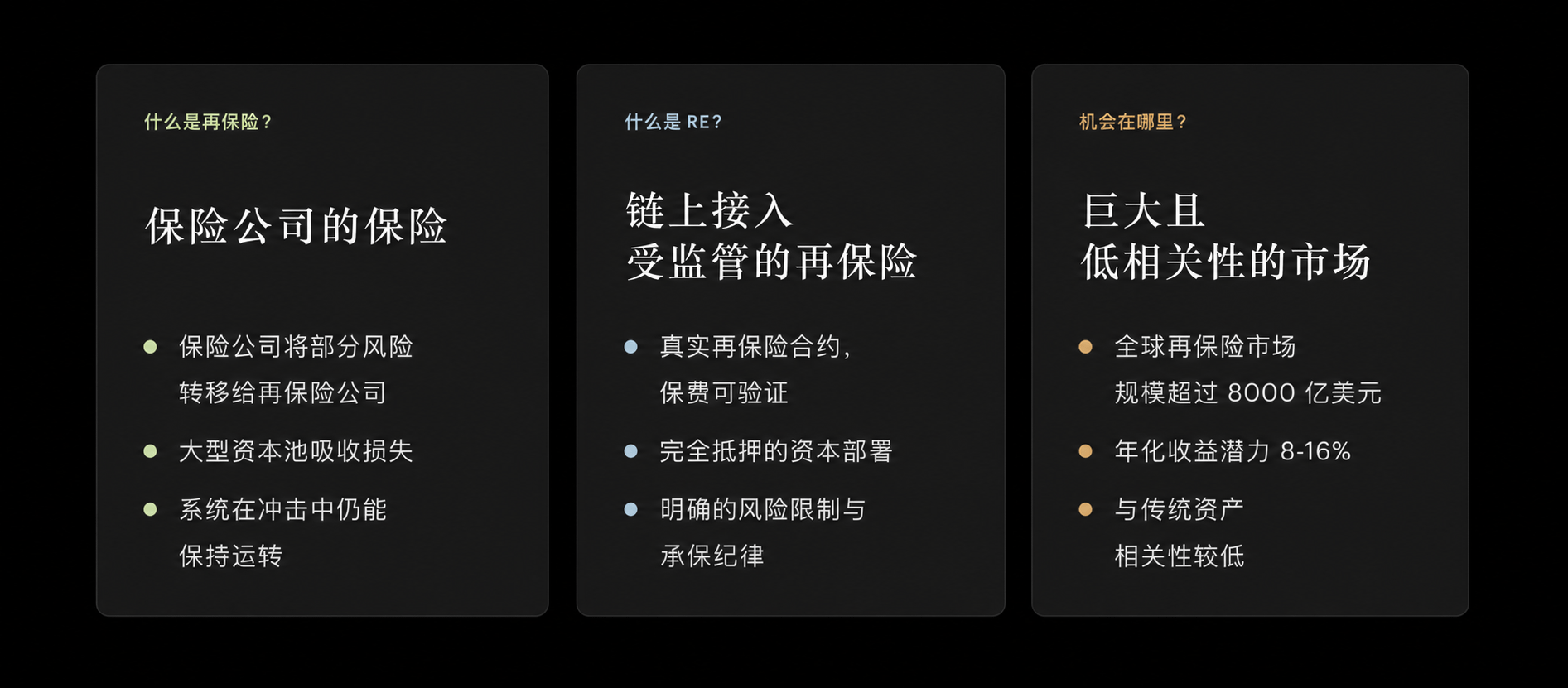
Many RWA projects deal with assets like U.S. Treasuries, bills, and credit. RE Protocol focuses on the reinsurance market. The term sounds a bit technical, but it can be simply understood as “insurance for insurance companies.”
When ordinary people buy insurance, they transfer risk to the insurance company. Insurance companies themselves also face the risk of large payouts—for example, natural disasters or concentrated incidents. So they also need to pass part of that risk on to others, and that’s reinsurance.
This market is very large—over a trillion dollars globally. But in the past, it was basically a market for institutional players, making it difficult for ordinary users to participate.
What RE Protocol wants to do is connect stablecoin funds to the reinsurance business, giving on-chain users the opportunity to earn returns from real-world insurance business.
Users deposit stablecoins into its insurance capital layer, ICL. The funds then flow through licensed insurance companies into fully collateralized reinsurance contracts. The yield source isn’t simply token subsidies; it comes from a combination of on-chain yield, off-chain yield, and the spread from the product itself.
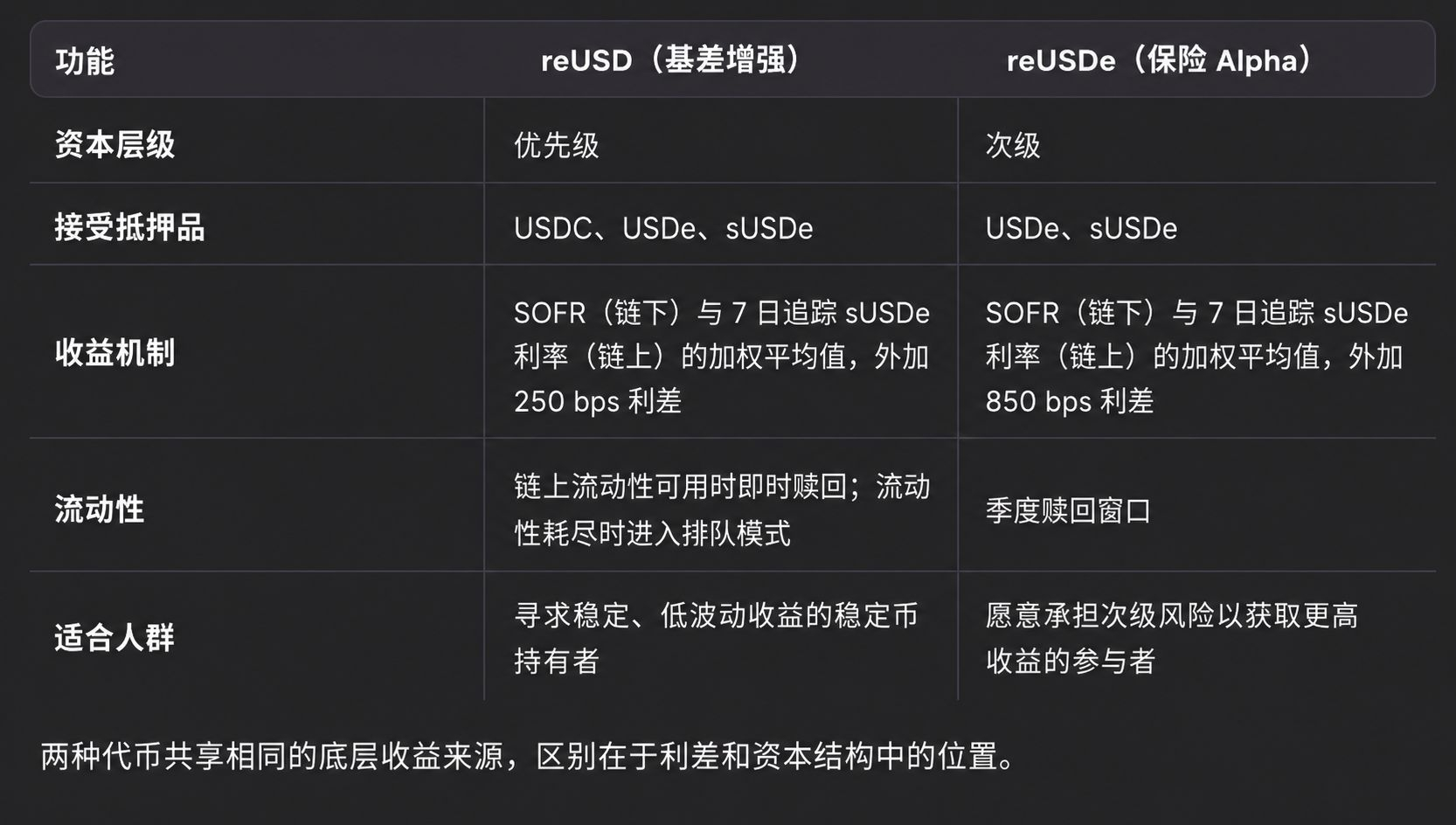
It currently has two main products: reUSD and reUSDe.
reUSD is more conservative and belongs to the priority product, with a spread of about +250 bps. With sufficient buffered funds, it can be redeemed immediately, making it more suitable for users who value liquidity.
reUSDe offers higher returns, with a spread of about +850 bps, but it’s a higher-risk structure. Redemptions aren’t available at any time; they are handled through quarterly windows.
In simple terms, reUSD is more stable, while reUSDe is more aggressive. The two products share the same underlying yield sources, but they differ in how risks and returns are layered.
One thing I think is especially worth关注 about RE Protocol is that it isn’t just competing in DeFi by churning out subsidies; instead, it tries to bring on-chain stablecoins into the real-world insurance market.
In theory, the correlation between this kind of yield and token price fluctuations or on-chain trading activity isn’t that strong, so it functions more like a new source of RWA yield.
Of course, the most crucial aspect of the RWA project is transparency. According to the official documentation, the ICL funds are transferred daily into Fireblocks custody vaults, off-chain bank balances are proven daily by The Network Firm, and then published on-chain via Chainlink. The contracts have also been audited by Certora and Hacken, and they use multisig and a 48-hour timelock.
Additionally, both reUSD and reUSDe are ERC-20 tokens. They’ve been integrated with DeFi protocols such as Curve, Pendle, and Morpho, and have been deployed across multiple chains including Ethereum, Avalanche, Arbitrum, Base, BNB Chain, Katana, and Ink.
So it’s not just a yield instrument—there’s also a chance to enter more DeFi combination strategies later, such as LP, collateral, and yield strategies.
Overall, RE Protocol’s narrative is quite clear.
It’s not just moving U.S. Treasuries on-chain; it aims to turn the traditional institutional reinsurance market into an RWA yield product that on-chain users can also participate in.
Of course, this doesn’t mean there’s no risk. Reinsurance itself carries payout risk, and RWA also depends on off-chain custody, auditing, and compliance structures. Before participating, you still need to clearly understand the risk layering of reUSD and reUSDe.
But from a track/sector perspective, on-chain reinsurance is indeed a relatively new direction.
If this model can work, RE Protocol could become a project in RWA worth continued observation.
The above is only a review of the project’s mechanics and narrative and does not constitute investment advice.