
Stop! Think of a vast dark ocean, where each drop of water is a datum generated by an artificial intelligence, an infinite cacophony of information that expands faster than the human mind is capable of processing or verifying. In this scenario of digital entropy, truth is not something that simply exists; it must be constructed, architected, and, above all, traced. We are on the brink of an epistemological collapse, where the distinction between the real and the simulated dissolves, and it is precisely in this fissure of reality that the Kite protocol inserts itself, not just as a financial tool, but as a necessary temporal anchor for the survival of information integrity. Most market observers look at charts and see green or red candles, but this is a two-dimensional view of a four-dimensional problem; to understand what Kite proposes, one must look at the underlying structure of human collaboration in a world dominated by algorithms.
The architecture of the Kite is not about transactions; it is about memory. Think of the blockchain not as a ledger, but as a decentralized nervous system that reacts to stimuli in real time. The problem we face with the rise of large AIs is not the lack of intelligence, but the lack of attribution, the forgetting of origin. When an AI creates, it hallucinates based on data whose trail it has lost. The Kite emerges as the technical solution to this paradox, introducing a layer of data attribution that works like a totem spinning on a table: the proof that we are in the real world. By rewarding collaborators who provide structured and verifiable data, the token ceases to be currency and becomes fuel for truth. It is an inversion of traditional economic logic; instead of paying for the final product, the protocol monetizes the very structure of reality that allows the product to exist.
Here we find the unusual connection that few would dare to make: the relationship between thermodynamics and token economics. The second law of thermodynamics tells us that the universe tends toward disorder, toward chaos. Uncurated data is chaos. The computational and human effort to organize this data, to validate it through the subnets of the Kite ecosystem, is a work of reversing entropy. The token, therefore, is the thermodynamic representation of order. Each transaction, each reward distributed to developers and data curators, is an act of resistance against the white noise that threatens to engulf the internet. The technicality of the project, with its low-latency APIs and agnostic chain integration, allows this 'order' to be exported to any other system, creating a federation of intelligence where collaboration is not just encouraged, it is mathematically inevitable.
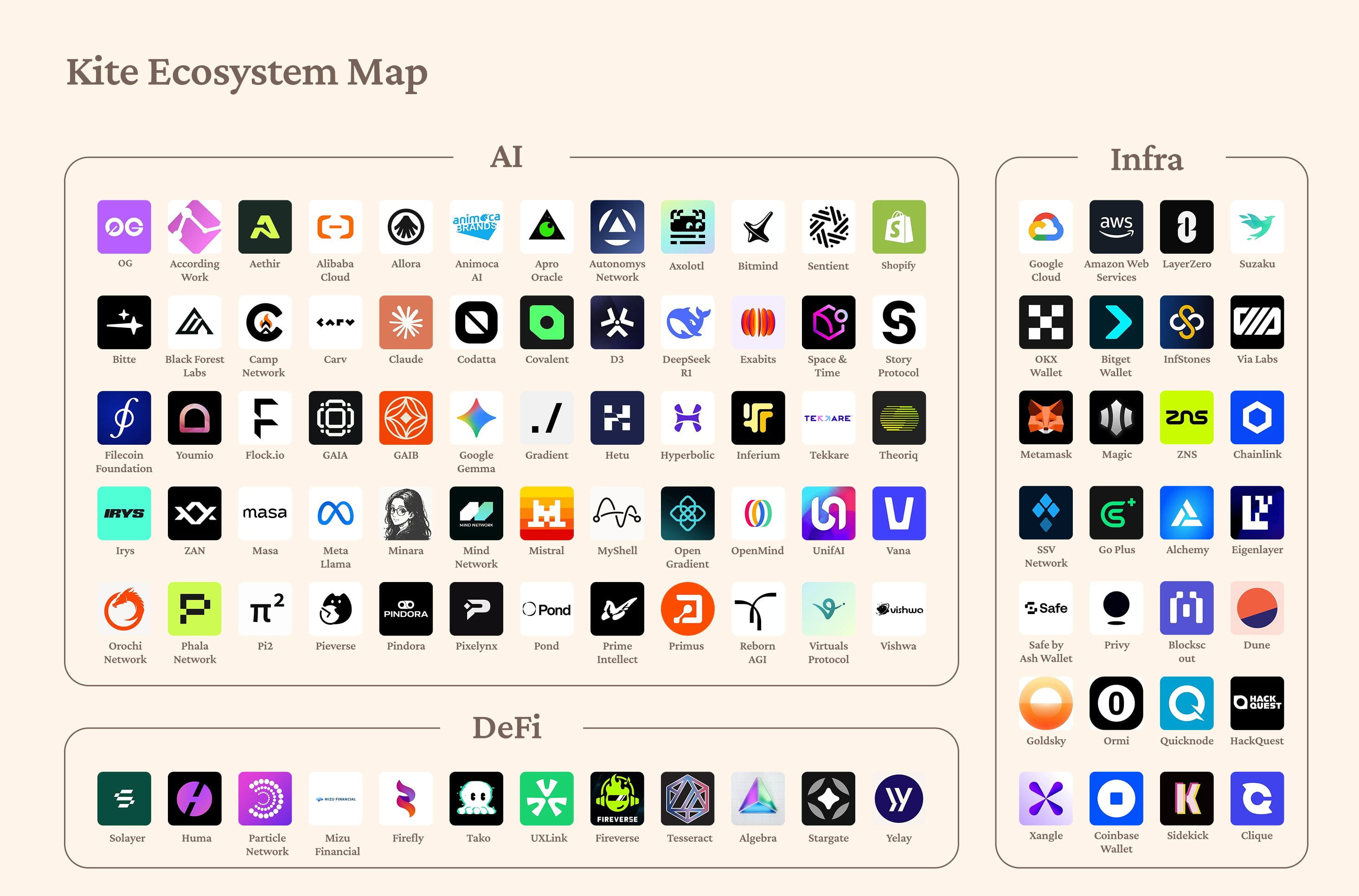

The narrative deepens when we realize we are dealing with the democratization of access to the global 'brain.' In centralized models, processing power and intelligence are kept in silos, inaccessible digital ivory towers. The Kite fragments these towers. It proposes a model where the creation of AI agents and the use of large language models (LLMs) do not depend on permission but on participation. It is a concept reminiscent of the mycelial structure of fungi in a forest: a vast underground network, invisible to the naked eye, that connects distant trees and redistributes nutrients. The Kite is the mycelium of Web3. It connects solitary developers to large infrastructures, allowing a small node in the network to have the same weight of validation as a giant, as long as the quality of its data is irrefutable. This capillarity is what ensures the resilience of the system; there is no single point of failure because intelligence is distributed, pulsing in thousands of servers simultaneously.
However, the true technical revolution disguised as an economic narrative lies in the scalability of trust. How do you trust a system without trusting anyone? Through continuous cryptographic verification. The Kite ecosystem implements mechanisms where reputation is not social, it is algorithmic. The 'proof of contribution' here is more than consensus; it is an immutable historical record of who did what. In a future where deepfakes and automated misinformation could start wars or collapse markets, the ability to trace the genesis of data to its primary source through the Kite protocol becomes the planet's most valuable resource. The value of the token, then, reflects the demand for that certainty. It is a bet on the human need to know what is genuine.
When observing the trajectory of this asset, we must not fall into the linear trap of predicting prices based on past trends. Time in the crypto market is not linear; it folds upon itself based on technological innovation. The Kite is positioned at the intersection of three massive vectors: the explosion of AI, the need for decentralized infrastructure, and the attention economy. The combination of these factors creates a network effect that distorts the gravity of the traditional market. We are not just talking about 'community engagement' in the banal sense of likes and retweets; we are talking about a community that is literally training the next generation of synthetic intelligence. Each participant running a node or contributing data is teaching the machine to think.
The climax of this architecture is the perception that the end user is not just an investor, but an architect of a new type of digital civilization. The protocol offers the tools — development kits, interoperability, speed — but it is the unpredictability of human nature, combined with the precision of the machine, that defines the outcome. The Kite is not the destination; it is the vehicle that allows us to navigate through the storm of information without losing our humanity. Ultimately, investing time and resources in this technology is an act of faith in logic, a belief that, even in a chaotic and rapidly expanding digital universe, we can build structures that stand tall, defying time, entropy, and oblivion.