


Author: Lawrence Lee, Researcher, Mint Ventures
1. Key points of the report
1.1 Core investment logic
Gelato has been deeply involved in the field of developer services for many years and has formed a relatively complete developer service suite. It is expected to achieve business breakthroughs in combination with the RaaS service they launched at the end of 23.
RaaS projects have entered a period of intensive currency issuance. Altlayer, Dymension, and Saga have all issued coins in the near future. In addition, there are also Conduit and Caldera with excellent financing backgrounds in the track. The RaaS track is expected to gain continued attention from the market in the future.
1.2 Main risks
Difficulty in earning income. Gelato's two main businesses: smart contract automation and RaaS business models determine that it is more difficult to obtain revenue.
Competitors are strong. Chainlink in the smart contract automation field, Altlayer, Conduit, Caldera and Dymension in the RaaS field all constitute Gelato's strong competitors, but Gelato's competitive advantage is not strong enough.
Token use cases are thin.
1.3 Valuation
Since revenue data for the tracks in which Gelato's main business is located are generally unavailable, we are unable to make an accurate valuation.
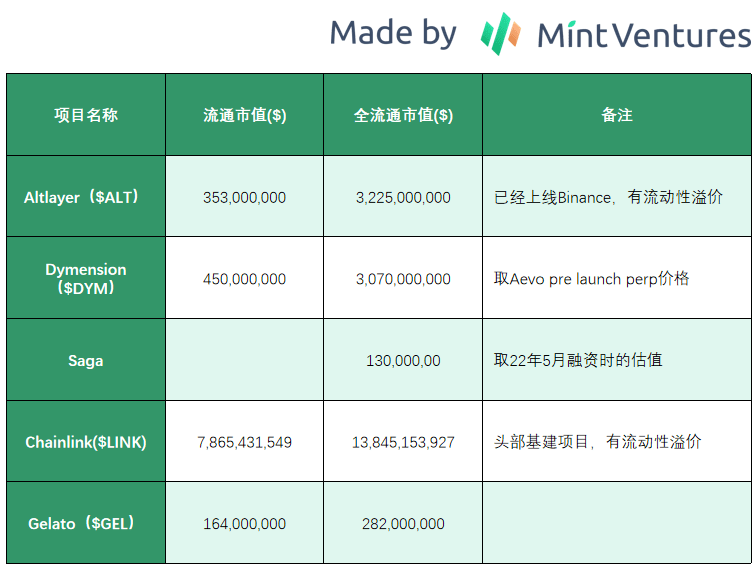
From the perspective of circulation market value and full circulation market value, Gelato's current market value is somewhat attractive compared to its competitors.
2.Basic situation of the project
2.1 Project business scope
2.1.1 Automate
Regarding Gelato, Mint Ventures released a research report in December 2021. Interested friends can check it out.
At that time, Gelato's main business was "automatic execution of smart contracts". To be specific, "when condition A occurs, make the smart contract execute operation B". The products/features it launched include the following three:
AMM limit order (A=token price reaches a certain value, B=trade). Gelato's limit order service was once launched as a separate product, Sobert Finance, and has also been directly integrated on the official page by PancakeSwap, QuickSwap (Polygon's largest Dex), and SpookySwap (Fantom's largest Dex), showing partners' recognition of Gelato's products.
Loans are exempted from liquidation (A=The LTV of the loan reaches a certain value, B=Retrieve the collateral, swap the collateral as debt, and repay the debt). This feature of Gelato once launched the C-side product Cono Finance. Because of this feature, it received Grants from Aave and was integrated by Instadapp.
For Uniswap V3's position management tool G-UNI (A=token price reaches a certain value, B=adjust LP market making period), MakerDAO added GUNI's USDC-DAI LP as a collateral that can generate DAI in September 21 , GUNI's TVL once rose to nearly 2 billion US dollars. In 2022, Gelato separated GUNI into Arrakis Finance and prepared to issue a separate currency. However, as MakerDAO's business focus shifted to RWA in 2022, Arrakis' TVL dropped significantly.
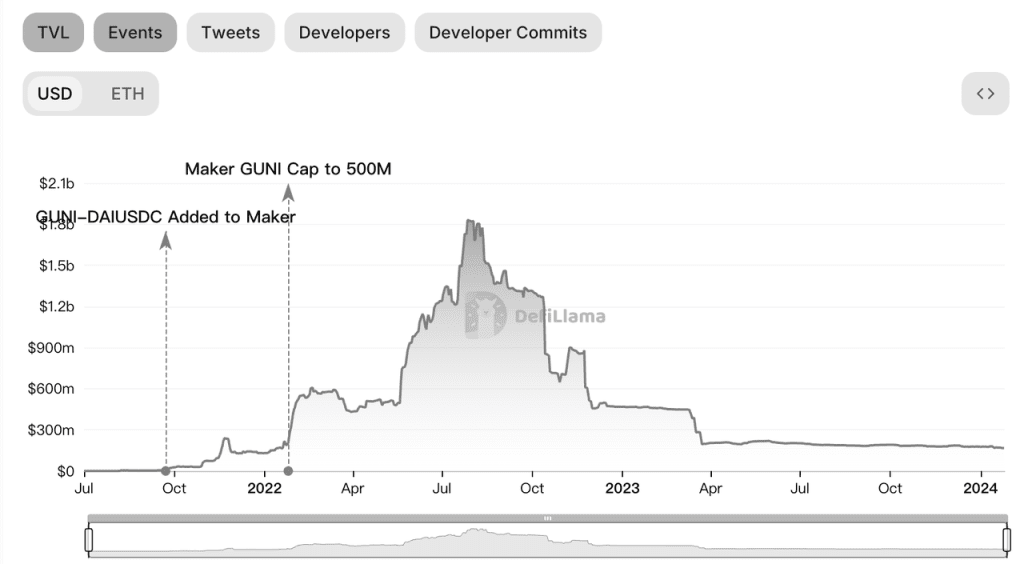
Arrakis TVL changes Source: Defillama
In addition to the above three typical functions, Gelato's Automate also has many other use cases and is also used by many DeFi projects: such as helping the Yield Framing protocol to automatically obtain income, updating oracles, etc.
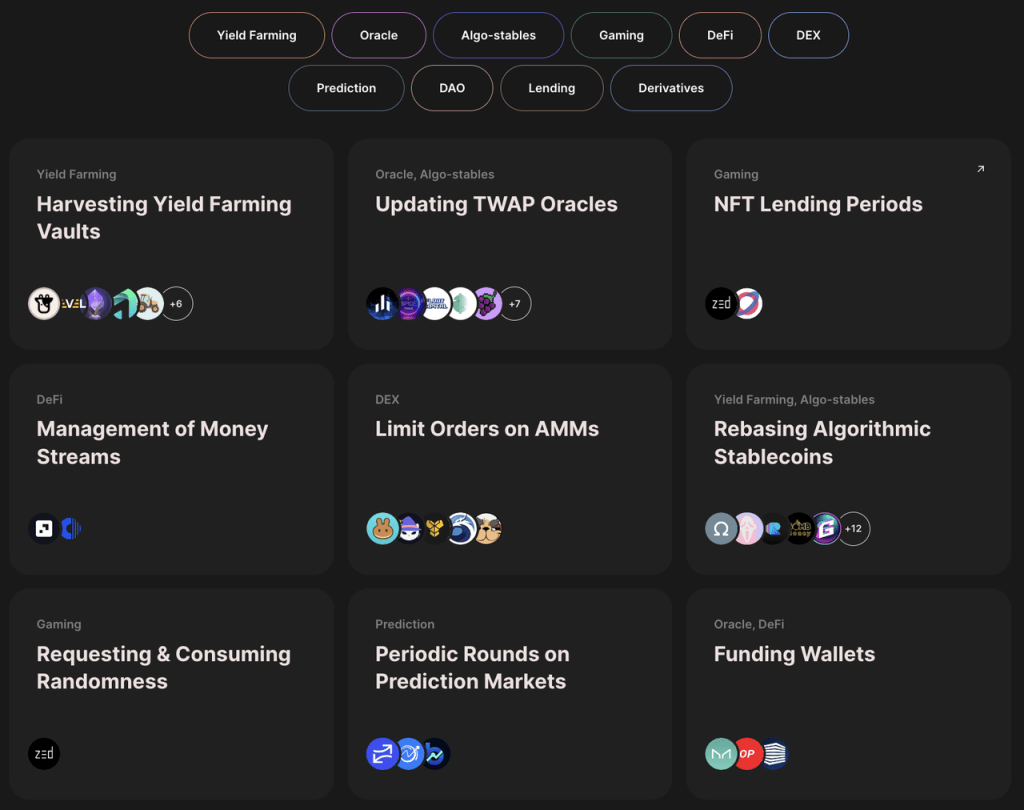
Source: Gelato official website
Overall, Gelato's automated business provides many useful products and brings many conveniences to encryption developers and users.
Gelato plans to upgrade the automation service to "Web3 Function" in June 2024, which will support more trigger conditions, allowing developers to execute on-chain transactions based on any off-chain data (API/subgraph, etc.) and calculations. Trigger conditions will be stored on IPFS and finally submitted to Gelato for execution.
2.1.2 Rollup as a service
Gelato officially launched the Rollup as a service (hereinafter referred to as RaaS) service at the end of 2023. RaaS can help developers choose the appropriate technology stack to easily deploy a Rollup. With the rapid development of ETH L2, leading L2 projects have launched their own open source frameworks (Optimism launched OP stack, Arbitrum launched Arbitrum Orbit, Polygon launched Polygon CDK) to help developers quickly deploy a Rollup. Therefore, a large number of third-party service providers such as Gelato have emerged to help developers deal with "some needs related to the blockchain."
Although RaaS is an emerging track, the current competition is fierce. We will analyze it in detail in section 3.1 Industry Space and Competition Landscape.
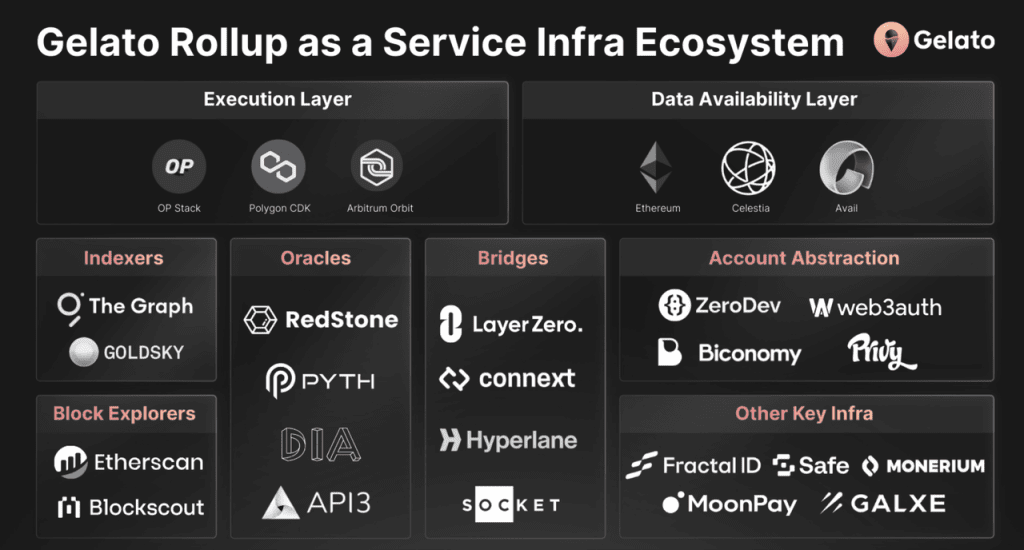
Gelato's RaaS service has currently integrated many infrastructure service providers:
Integrates OP stack, Polygon CDK and Arbitrum Orbit at the execution layer
Integrated Ethereum, Celestia and Avail at the DA layer
Integrated Layerzero and Connext in terms of cross-chain
Integrates Redstone, Pyth and API3 on oracles
Integrated with The Graph and Goldsky for indexing
Other legal currency payments are integrated with Moonpay and Monerium, KYC services are integrated with Fractal ID, wallet services are integrated with Safe, etc.
Basically, except for Chainlink, which competes with Gelato in some businesses, Gelato has completed integration with most infrastructure service providers and can provide developers with a relatively comprehensive suite.
Gelato's RaaS currently has 2 users: Astar Network ($ASTR) and Lisk ($LSK). Astar network completed a US$22 million financing led by Polychain in January 22. It is a well-known public chain in Japan. They plan to use Gelato's RaaS service launches zk Rollup based on Polygon CDK; Lisk is an old application chain project that recently announced its transformation into ETH's L2.
Another user in the expansion is Ape. Gelato has made a proposal in the ApeDAO governance forum and wants to become ApeChain's RaaS service provider. It is currently in the governance forum discussion stage.
2.1.3 Relay
Gelato launched the Relay service in 2021. The Relay service allows protocols to pay gas on behalf of users, thereby lowering the threshold for introducing users to the Web3 world.
Some typical use cases include:
Helping users of the NFT protocol to mint NFT without gas, the NFT creation and collection protocol Zora uses Gelato's Relay function.
Help cross-chain bridge protocol users cross chains without gas. Specific users include Connext Network and Kinetex.
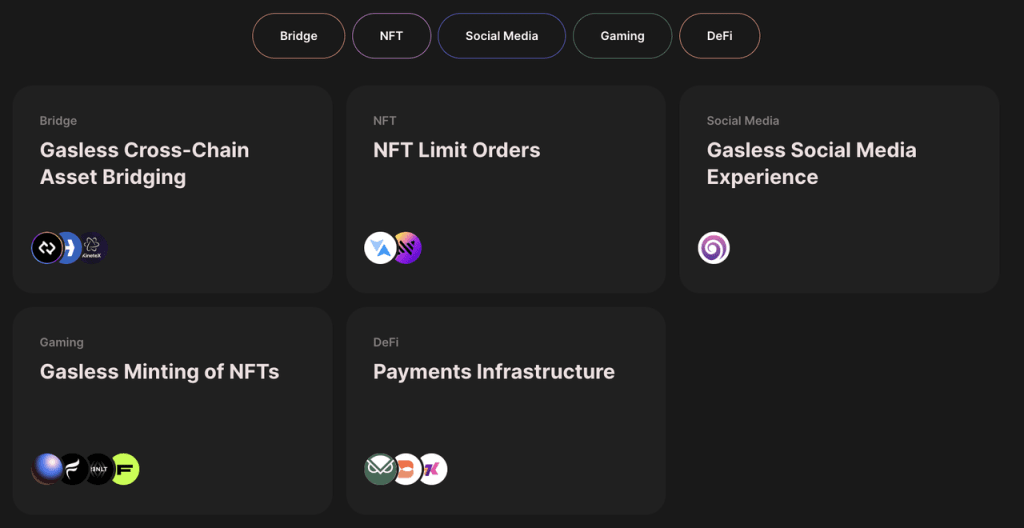
Source: Gelato official website
According to information provided by IOSG, from 2022 to 2023, nearly half of Gelato's business volume will come from Relay, and the revenue from the Relay network has become a key source for the team to survive the bear market. However, the Gelato team did not disclose the revenue from the Relay service.
2.1.4 Other infrastructure services
Gelato also provides many other infrastructure services, such as:
Verifiable Random Function (VRF) provides verifiable random number services to the cryptographic world and can be used in games, NFT and other projects.
Account Abstraction, a smart wallet based on the ERC-4337 standard
Multi-chain payment service 1Balance. 1Balance can help developers handle various payment issues more easily, and also supports payment for all Gelato businesses.
The above infrastructure services have also been integrated into Gelato's RaaS component. Years of deep work in the web3 developer service industry and the rich development kits they have brought may give them a major advantage over other RaaS competitors.
2.2 Team situation
The two co-founders of Gelato, Hilmar Orth (X: @hilmarxo ) and Luis Schliesske (X: @gitpusha ), are both developers, and the original core functions of the Gelato product were written by them. The two have been close friends since college and have been working together since then. Before Gelato, they had co-founded a start-up company focused on helping large European companies explore new business models using smart contracts. Later, they participated in a series of hackathons such as ETHParis, ETHBerlin, ETHCapetetown, and Kyber Defi Hackathon, and achieved good results and influence. It was also because of this that they were able to obtain the Grants from Gnosis and MetaCartel and create Gelato Network.
According to Linkedin information, the Gelato team has a total of 29 people and is a medium-sized encryption team. Judging from the recruitment situation on the official website, the team has a strong desire to continue to expand in BD and the market.
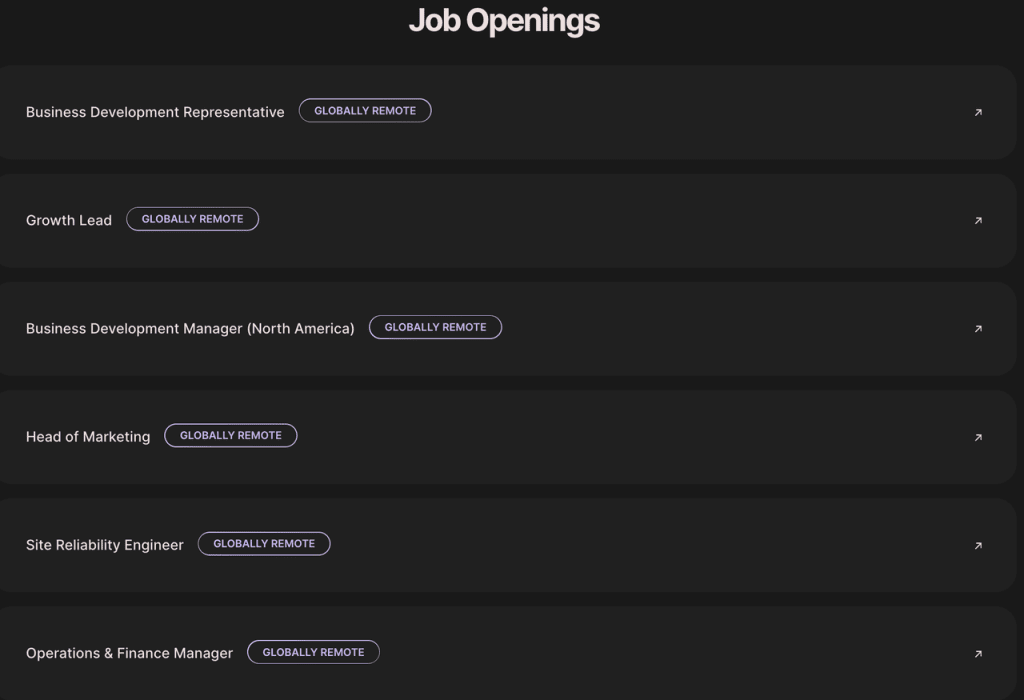
Judging from past development, Gelato can provide relatively useful products, but it has not invested much in BD. According to posts on the governance forum, their total budget for marketing and BD in 2022 is only US$103,600. .
The importance of investment in BD and marketing for infrastructure projects can be clearly seen from the development history of Chainlink and Polygon. Whether it can effectively increase investment in BD and marketing may be a key point for Gelato's subsequent development.
2.3 Financing and important partners
Gelato has had a total of 4 rounds of fundraising, including 3 rounds of private placement and 1 round of public placement. The details are as follows:
The seed round took place in September 2020, raising US$1.2 million from investors: IOSG, Galaxy Digital, D1 VC, The LAO, Ming Ng, MetaCartel, Christopher Jentzsch. The cost of $GEL corresponding to this round of financing is US$0.019.
In September 2021, Gelato announced a fundraising of US$11 million from investors: Dragonfly, Parafi, IDEO, Nascent, Stani Kulechov (founder of Aave). The cost of $GEL corresponding to this round of fundraising is US$0.2971.
The public offering will also be held in September 2021, raising US$5 million. The cost of $GEL corresponding to this round of financing is also US$0.2971.
In the past December, Gelato completed an expansion round of financing, led by IOSG. The amount and method of financing were not disclosed.
In addition, when the project was first established, they received Grants from Gnosis and MetaCartel.
In terms of partners, since Gelato is in the developer services industry and also provides external RaaS services, they have many partners, which we have basically listed above.
In addition, Gelato has been the winner of BNB Chain’s Most Valuable Builders iii in 2021.
3.Business analysis
3.1 Industry space and competition landscape
We will mainly analyze the smart contract automation service and RaaS market.
3.1.1 Smart contract automation service
Regarding the market space and competitive landscape of smart contract automation services, we have already conducted a relatively detailed analysis in previous articles. Our views have not changed so far. Here we only excerpt the core views:
There are widespread scenarios in the Web3 world that require automatic execution of smart contracts, such as regular reinvestment returns, regular salary payments, liquidity rebalancing, etc. For developers, it costs a lot of labor and time to design and execute a complete set of monitoring, calculation, and running programs by themselves. Automation service providers can help developers avoid "reinventing the wheel"; for service providers such as Gelato Generally speaking, the marginal cost of providing services to new users is very low. There is no difference between Uniswap's limit order and Quickswap's limit order. Therefore, the cooperation between the two parties here is more "economical" for both parties and has solid business logic.
However, the problem may be that because the threshold for the services provided by Gelato is not high in nature, the fees developers are willing to pay are relatively limited. In practice, the difficulties they encounter may be similar to those encountered by web2 automation service provider IFTTT: "Can There is a useful product, but not many people are willing to pay for it.”
In the field of smart contract automation, Chainlink and Gelato are currently widely used. Although the Keeper network ($KP3R) created by Andre Cronje also focused on this market, over time, the Keeper network has basically withdrawn from this field, and the main use case of the KP3R token has become to obtain Fixed Forex protocol income.
According to IOSG disclosures, Gelato currently accounts for 80% of the smart contract automation market. It is not easy to gain an advantage in the market segment in which Web3 infrastructure leader Chainlink participates. But unfortunately, high market share has not brought stable income. The current product is in a state of "applause but not popular", and commercialization is slightly difficult.
From a competitive point of view, although Gelato entered the market earlier than Chainlink and occupies the current leading position in the market, in the medium and long term, Chainlink has a stronger brand than Gelato and more urgent developer access channels. , richer team capital reserves, and the ability to form cross-sales with other self-owned services, it is not easy for Gelato to stay ahead in the competition with Chainlink.
3.1.2 RaaS
RaaS has been a popular sub-field in the infrastructure field for 23 years. Recently, with the launch of Altlayer on Binance’s Launch Pool, this field has attracted much market attention.
With the rapid development of ETH L2, the scalability problems that ETH once faced seem to have been largely solved through Rollup. Especially after the upcoming Dencun upgrade is completed, the cost of Rollup will be reduced by an order of magnitude again, which gives Rollup a certain basis for large-scale commercial promotion.
The Ethereum system currently has the most complete infrastructure in the web3 field (including wallets, browsers, oracles, indexes, etc.), and the user experience in the EVM system is also the most widely accepted among current web3 users. For application developers, instead of creating a chain to handle many "chores" related to the operation of the chain, it is a good choice to become a Rollup of ETH, allowing them to focus on the application itself.
On the one hand, we see that teams such as Coinbase, Consensys, Mantle, and Blur that have made very good results in other areas of web3 have all chosen L2 when building a chain in 2023 (correspondingly, Binance in 2020 , OKX all built L1).
On the other hand, we can also see more and more L1 decisions being converted to Rollup, including:
Celo, a stablecoin project that is somewhat similar to Luna, proposed in July 23 that they would transition to ETH’s L2
Lisk, which was established in 2016, announced in December 23 that it would use the Gelato service to transform into ETH’s L2
We expect this trend to continue in the future. In the process of developers building Rollup, there are still a series of issues and trade-offs that developers need to consider, such as how to choose a Rollup that suits their own characteristics, how to build and run Sequencer, how to solve the MEV problem, and what kind of oracle and index to choose. etc. As an "integrated service provider" directly facing developers, RaaS service providers obviously have relatively solid demand in this context.
In November 23, Binance released a research report on the RaaS track, which mainly mentioned five projects: Conduit, Altlayer, Caldera, Gelato and Lumoz. The other four projects can be said to directly compete with Gelato.
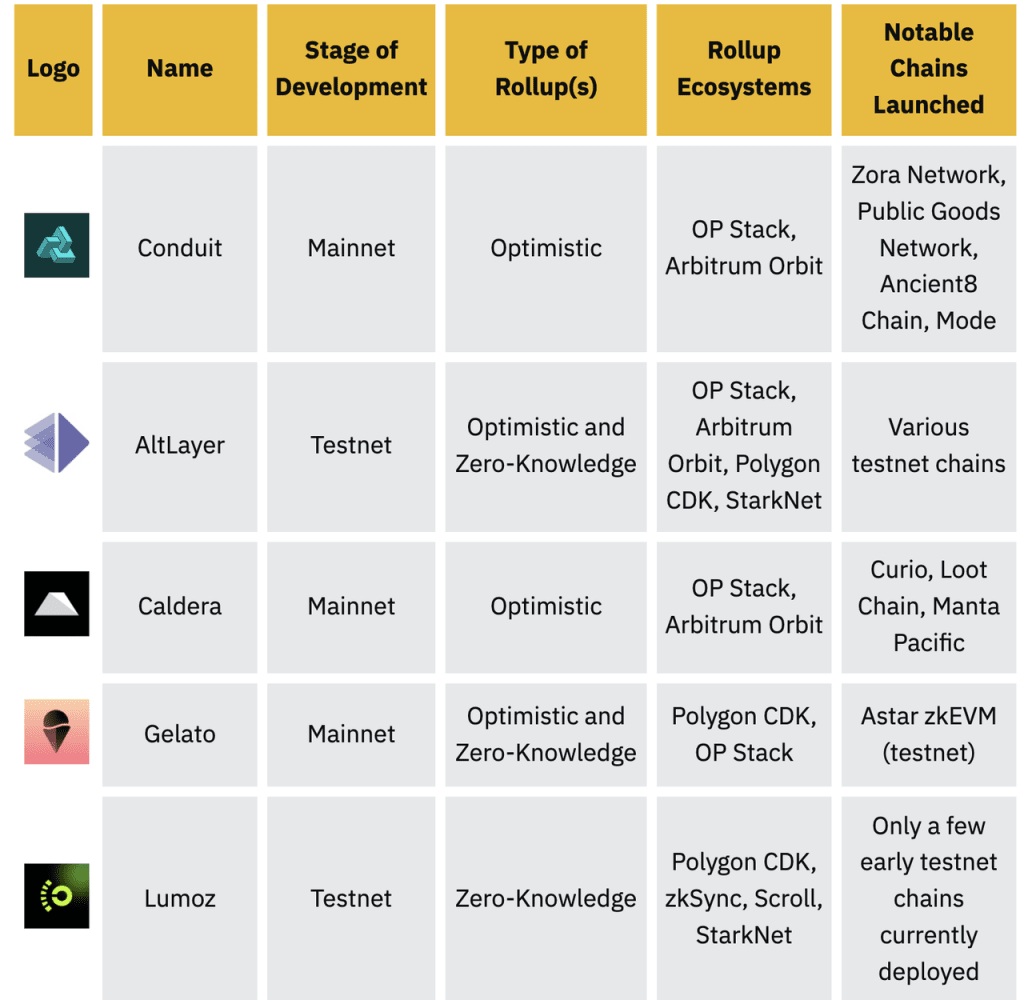
Source: Binance RaaS research
The above protocols can all be regarded as the Ethereum ecosystem. In fact, for developers, their goal is to create an application chain that better meets their needs, and they don’t particularly care whether this chain is Rollup or Cosmos’ IBC chain. . Although the infrastructure of the Ethereum system is relatively complete, the Ethereum system is not the only option.
Based on the above reasons, we count the “one-click chain” service providers of the Cosmos ecosystem as Gelato’s competitors. Gelato’s competitors in the field of RaaS or AppChain as a service are as follows:
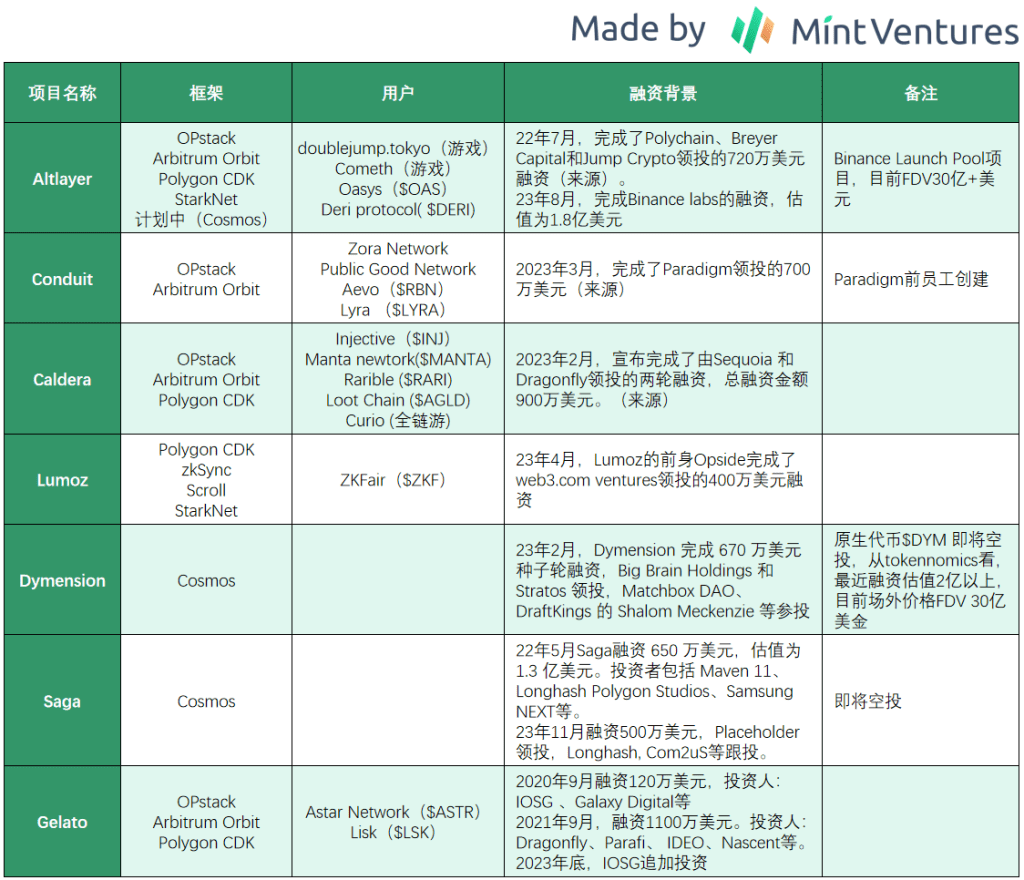
(In fact, there are other participants in the RaaS field such as Astria, Gateway.fm, Karnot, Snapchain, Vistara, Zeeve, etc. Due to space limitations, we will not introduce them in detail.)
From the above project information, we can see that although the RaaS track is an emerging track, there are already many players in the field, and the leading VCs have already participated in the RaaS project. The competition is fierce. Since the second half of 2023, there have been more and more protocols using RaaS to deploy Rollup, and in addition to Altlayer, there are also Cosmos-based Dymension and Saga that are about to issue coins, and the entire track has entered a small climax.
Judging from the current several actual online RaaS rollups, it seems that there is no charge for providing the RaaS service itself. Several RaaS service providers hope to capture more value from future derivative services.
In order to explore how the RaaS track obtains revenue, we take Optimism as an example to understand Rollup’s revenue and cost structure:
The Gas paid by Rollup users is generally paid to the following three layers:
execution layer. The execution layer directly faces users, collects Gas fees paid by users, and pays fees to the DA and settlement layer.
DA layer. The DA layer ensures data availability for Rollup. This part is the main place where users pay for gas, and it is also the bulk of the L2 project cost. In addition to Ethereum, DA is also provided by the recently popular Celestia, Polygon's independent Avail, and Eigenlayer.
Settlement layer. The problem with the settlement layer is that there are relatively few fees that can be captured. Optimism currently only pays Ethereum around 0.05ETH in settlement fees per day (source).
For Optimism and any other Rollup, its income = execution layer income, expenditure = DA expenditure + settlement layer expenditure, and gross profit = execution layer income - DA expenditure - settlement layer expenditure.
First of all, from the perspective of cost items, the expenditure on the settlement layer is very small. Optimism currently only pays about 0.05ETH in settlement fees to Ethereum every day.
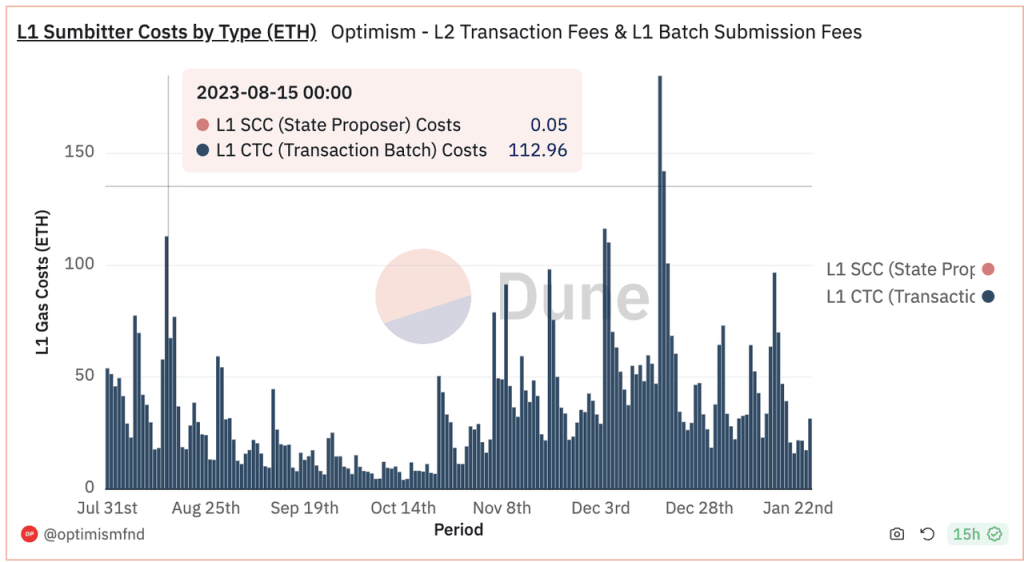
Optimism’s fees paid to the DA layer (dark blue) and settlement layer (largely invisible orange) (Source)
Then from the perspective of total revenue, due to the high DA cost, Optimism’s “gross profit” space is not large.
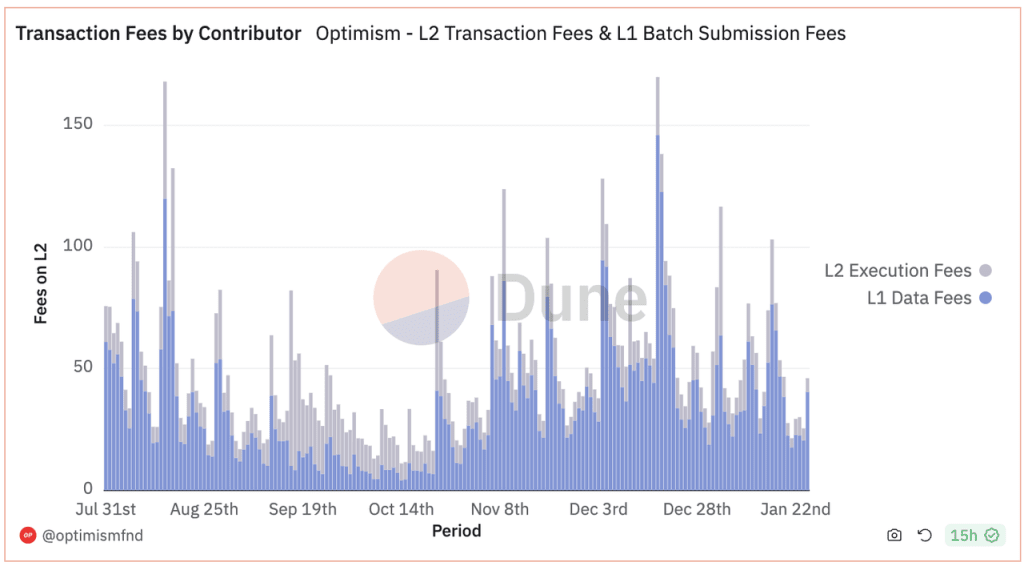
The absolute value of Optimism execution layer gross profit (gray) and DA layer expenditure (blue) (source as above)
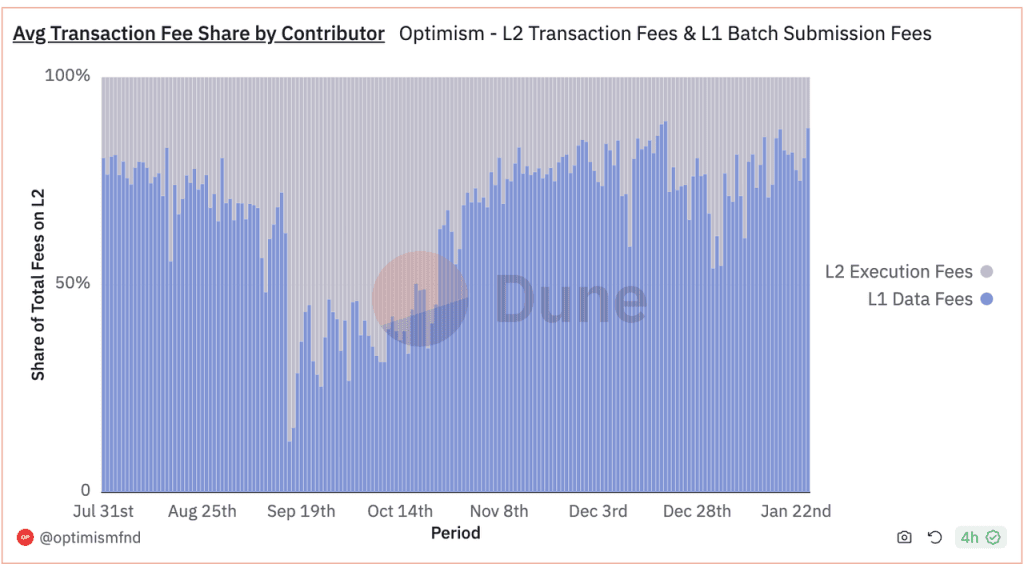
The proportion of Optimism execution layer gross profit (gray) and DA layer expenditure (blue) (source same as above)
We can see that in the entire Rollup ecosystem, DA has captured the greatest profits. As RaaS service providers, if they want to obtain income, they need to take another 10% from the "gross profit" of Optimism (= execution layer income - DA cost - settlement layer cost), which is generally difficult.
Judging from the current comprehensive information, possible ways for RaaS to obtain revenue/capture value include:
Obtain more benefits at the execution layer by hosting sequencer, MEV, etc. This is also the most reasonable and possible source of income.
Earn revenue by becoming a settlement layer for Rollup/Appchain (e.g. Dymension)
Fees are not collected through user transactions, but through other infrastructure such as integrated wallets, browsers, or other technical consulting services.
Similar to traditional SaaS subscription fees
Of course, there is also the Restaked rollup that Altlayer hopes to achieve in its recent cooperation with Eigenlayer. They use $ALT more as an economic bandwidth to capture value for the token through the combination with Restking, but this value capture is inconsistent with the RaaS service it provides. It has little relevance per se.
Generally speaking, because there are fewer RaaS projects actually online, the revenue acquisition method has not yet been determined. However, from the analysis of Rollup's revenue and cost structure, it is difficult to obtain revenue from RaaS.
In terms of competition, since the users of RaaS service providers are developers/project parties, how to attract developers/project parties is the main direction of RaaS service providers. Although different RaaS service providers have different technical characteristics, the services that RaaS service providers can provide are largely determined by the underlying framework, so we believe that the services provided by RaaS service providers are generally homogeneous. characteristics.
With relatively homogeneous service content, the influence of the project itself may be an important factor in the decision.
For unissued currency projects, the main focus is on investment capital. On the one hand, the endorsement of leading investment capital can effectively lower the psychological threshold for developers/project parties to use services and increase their likelihood of using services. On the other hand, leading investment capital has rich developer/project resources in the industry, which can bring a natural customer base to RaaS service providers. We can see that Conduit users show obvious Paradigm characteristics.
For issued currency RaaS projects, the market value of the project is a simple quantitative indicator of its influence.
For RaaS projects with good influence, the team's own BD capabilities are the key factor that determines the ceiling of the RaaS project in the long run.
In a market like RaaS that seems like a blue ocean but may actually be close to a red ocean, compared to its competitors, Gelato does not have an advantage in terms of influence and BD capabilities. Its advantage lies more in the fact that the team has specialized in the field of developer services for many years. This provides a more comprehensive development tool suite.
3.2 Token model analysis
The total supply of Gelato Network’s governance token $GEL is 420,690,000, and its distribution is as follows:
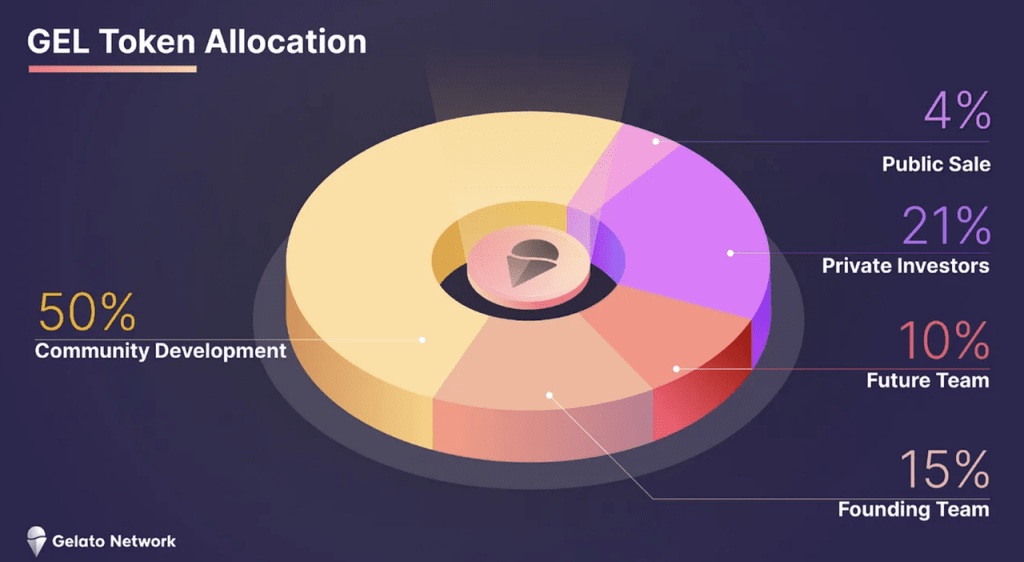
50% allocated to community development (20% was later set aside for further financing following a governance vote last March)
4% is allocated to the public offering in September 21
21% is allocated to investors in private placements, and half of the investors’ tokens will be released in September 2022 and September 2023 respectively (later, after a governance vote, the tokens originally scheduled to be released in September 2023 were advanced to February 23 freed).
25% is allocated to the team, 15% of which is allocated to the current team; 10% is allocated to the future team. 25% of the team tokens will be released after one year of lock-up, and the remaining portion will be released linearly over three years.
According to the lock-up terms, all public and private investors’ shares are currently in circulation. The community part has locked 27% of the tokens, and the remaining 15% of the team’s tokens are in lock-up status. The overall circulation ratio is 58%.
Through the analysis of on-chain data, we found that among private equity investors, four addresses including IOSG and Dragonfly have not sold their $GEL tokens. The above four addresses hold a total of 12.4% of $GEL.
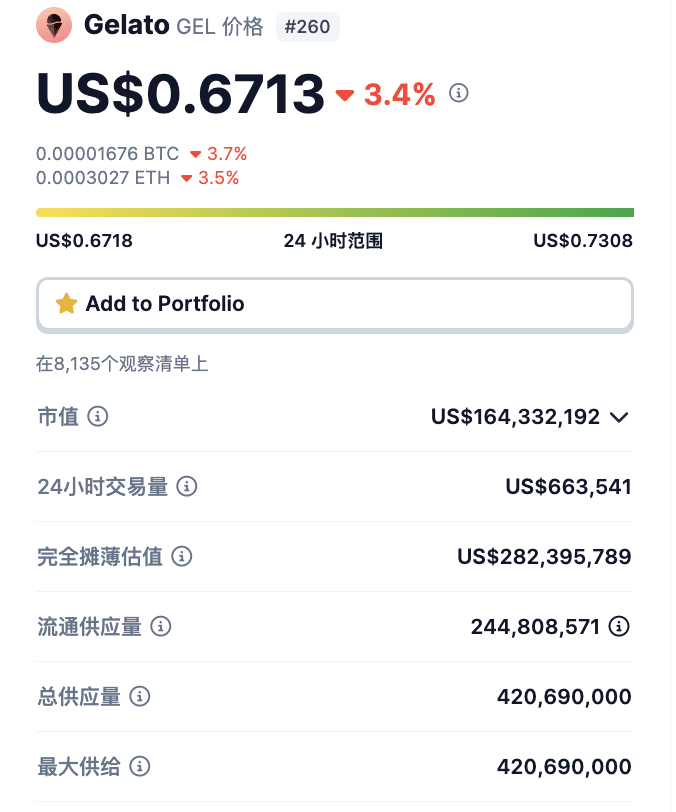
Currently, GEL has a circulating market value of US$164 million and a full circulating market value of US$282 million.
According to the official documentation, the use cases for $GEL are governance and staking.
But in fact, since its launch, Gelato has not had many matters that need to be managed. There are only 10 votes in total on Snapshot; $GEL has no real online staking function (except for pledging $GEL in 22 years to obtain Arrakis’ governance tokens) .
Overall, $GEL’s token use cases are thin.
3.3 Risks
The risks faced by Gelato are as follows:
Difficulty in obtaining income: Whether it is smart contract automation or RaaS business, its business model determines that it is difficult to obtain income.
Strong competitors: Chainlink in the field of smart contract automation, Altlayer, Conduit, Caldera and Dymension in the RaaS field all constitute Gelato's competitors. Compared with its competitors, Gelato's competitive advantage is not strong enough.
4 Valuation levels
Whether it is smart contract automation or RaaS, we are currently unable to obtain accurate revenue data for projects in the track, so we cannot accurately conduct valuations. Here we mainly list the circulating market value and market value of several projects that compete with Gelato. Full circulation market value for your reference.
5. Reference content and acknowledgments
https://www.neelsomani.com/blog/rollups-as-a-service-are-going-to-zero.php
https://twitter.com/_RayXiao/status/1742869034222182890
https://mirror.xyz/hismrti.eth/I-aOI7SfOItFb51prXpX3hhy-3_9EYu-jaMdIsQExXc
https://mirror.xyz/hismrti.eth/SOq1l9dU-rWOd_pUoUZZAHIJDf_SuBudRZO8ux-3XNw
https://www.neelsomani.com/blog/rollups-as-a-service-are-going-to-zero.php