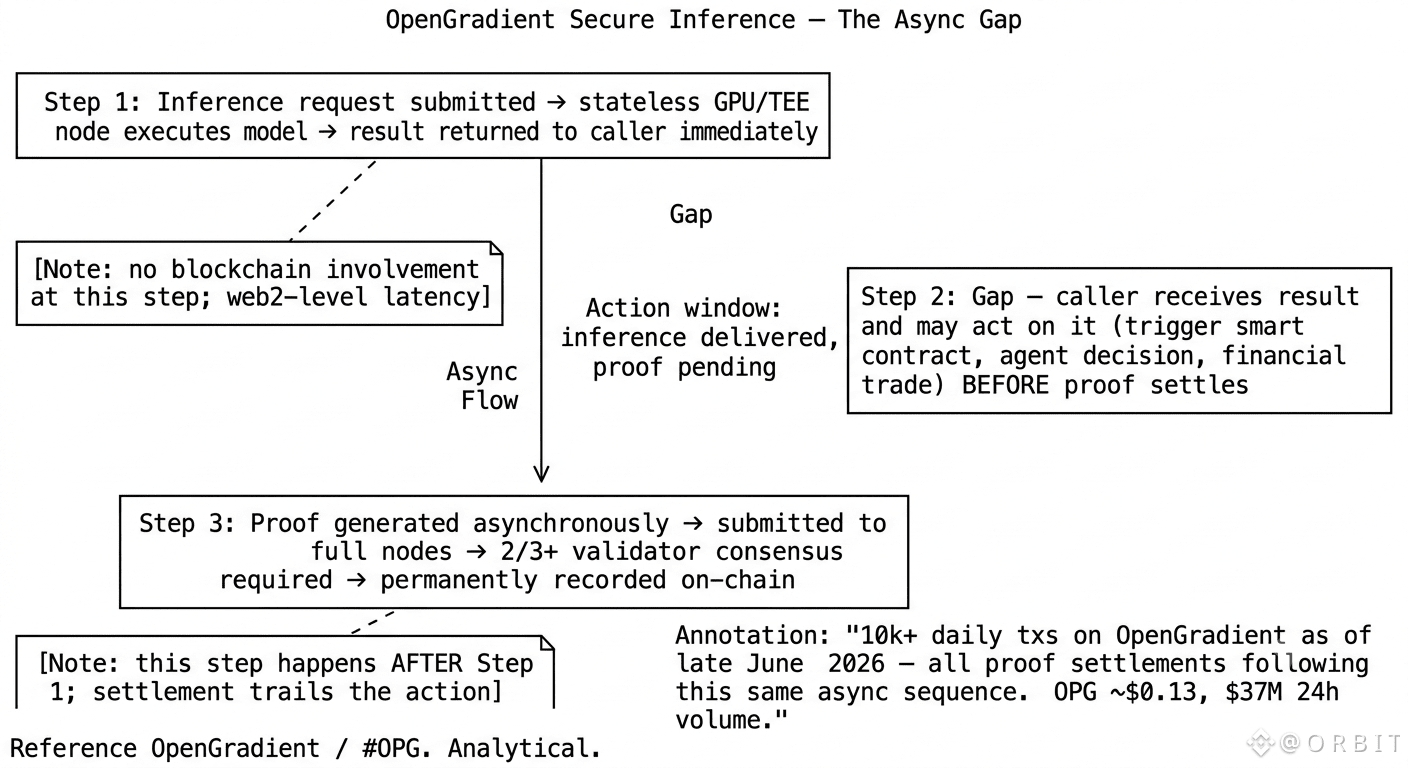
What caught me during this task wasn't the marketing — it was a line buried in the architecture docs. OpenGradient's inference nodes are explicitly stateless. They don't hold state between requests. The actual result gets returned to the caller immediately, while verification and settlement happen asynchronously in the background. @OpenGradient calls this "secure inference." In practice, it means you get the answer before the proof commits. $OPG #OPG
That's the real behavior: a user or agent receives the output first, then the network's 2/3+ validator consensus catches up and permanently records the proof. The network is right now doing 10k+ daily transactions against 4.2M+ blocks produced since TGE — all of those proof settlements trailing their inferences by at least one consensus round. With $OPG trading around $0.13 this week with $37M in 24h volume, the market is certainly not pricing in that subtle ordering.
I kept thinking — for most use cases, fine. Agentic workflows probably don't care. But for a DeFi contract or an autonomous agent making an irreversible on-chain decision based on an inference result… the action can execute before the proof that justified it actually lands. That's a window. Maybe small, maybe inconsequential, but real.
Does asynchronous verification actually work as a security guarantee when the downstream action doesn't wait for it?
That's the real behavior: a user or agent receives the output first, then the network's 2/3+ validator consensus catches up and permanently records the proof. The network is right now doing 10k+ daily transactions against 4.2M+ blocks produced since TGE — all of those proof settlements trailing their inferences by at least one consensus round. With $OPG trading around $0.13 this week with $37M in 24h volume, the market is certainly not pricing in that subtle ordering.
I kept thinking — for most use cases, fine. Agentic workflows probably don't care. But for a DeFi contract or an autonomous agent making an irreversible on-chain decision based on an inference result… the action can execute before the proof that justified it actually lands. That's a window. Maybe small, maybe inconsequential, but real.
Does asynchronous verification actually work as a security guarantee when the downstream action doesn't wait for it?