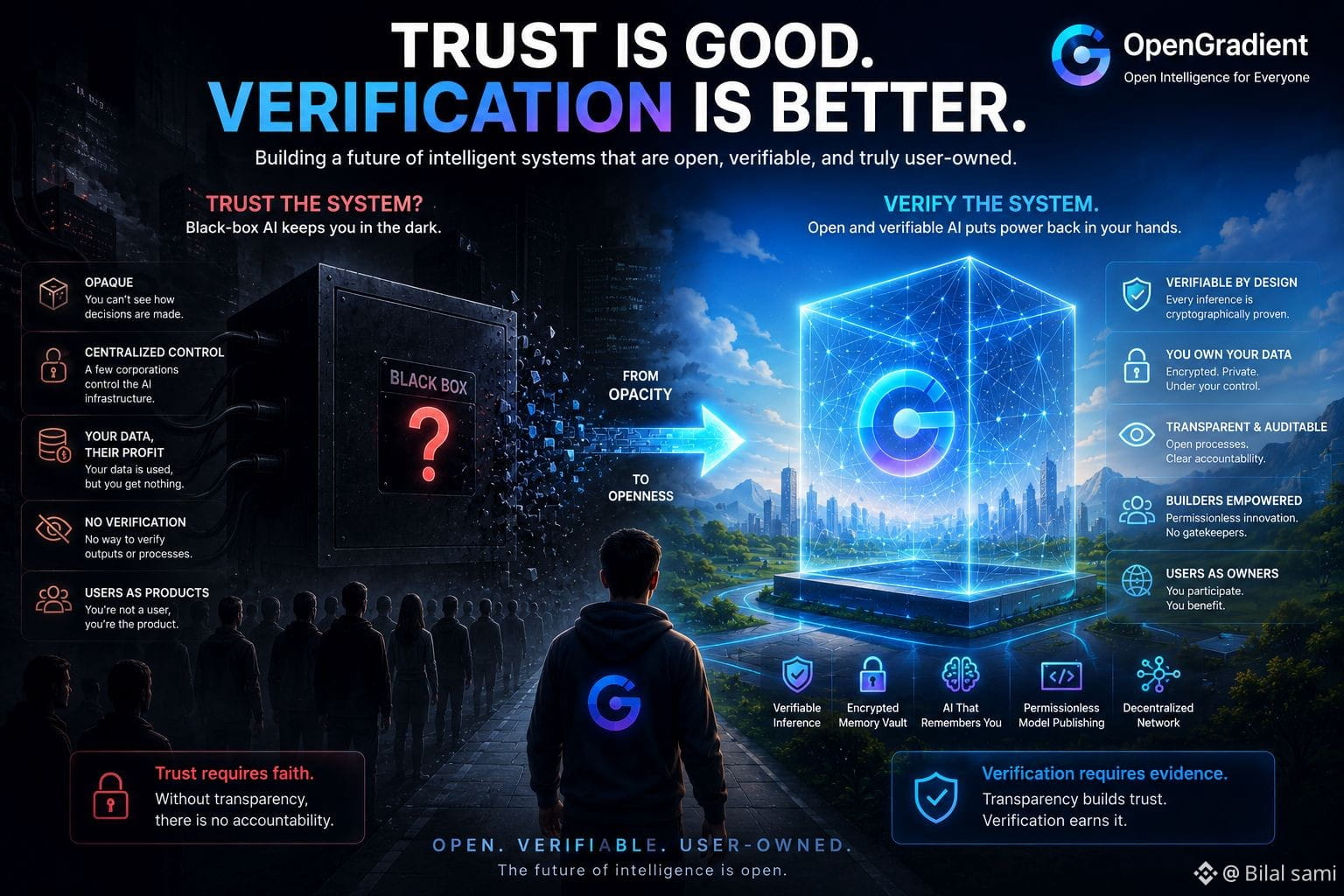
Trust Is Good. Verification Is Better.
For centuries, societies have been built on trust. We trust banks to protect our money, institutions to uphold the rules, and technology companies to act in our best interests. Trust makes cooperation possible. But in the digital age, trust alone is no longer enough.
Artificial intelligence is becoming deeply embedded in our lives. It recommends what we watch, influences what we read, helps businesses make decisions, and increasingly acts on our behalf. Yet most AI systems operate as black boxes. We are expected to trust their outputs without seeing how they arrived at them, what data they used, or whether their results can be independently verified.
That model is beginning to break down.
The next generation of AI won't be built on blind trust—it will be built on verifiable truth. Instead of asking users to simply believe that a system is behaving correctly, verifiable intelligence allows them to confirm it for themselves. Every action, every inference, and every decision can be proven rather than assumed.
This is the philosophy behind OpenGradient. By combining decentralized infrastructure with cryptographic verification, OpenGradient is helping create an ecosystem where transparency is built into the foundation. Users retain control of their data, developers can build without gatekeepers, and AI outputs can be independently validated.
The difference is profound. Trust depends on reputation. Verification depends on evidence.
As artificial intelligence becomes more powerful, accountability will become just as important as capability. The platforms that thrive in the future will not be the ones asking for more trust. They will be the ones providing more proof.
Because in a world increasingly shaped by AI, trust is good.
But verification is better.#opg $OPG @OpenGradient
For centuries, societies have been built on trust. We trust banks to protect our money, institutions to uphold the rules, and technology companies to act in our best interests. Trust makes cooperation possible. But in the digital age, trust alone is no longer enough.
Artificial intelligence is becoming deeply embedded in our lives. It recommends what we watch, influences what we read, helps businesses make decisions, and increasingly acts on our behalf. Yet most AI systems operate as black boxes. We are expected to trust their outputs without seeing how they arrived at them, what data they used, or whether their results can be independently verified.
That model is beginning to break down.
The next generation of AI won't be built on blind trust—it will be built on verifiable truth. Instead of asking users to simply believe that a system is behaving correctly, verifiable intelligence allows them to confirm it for themselves. Every action, every inference, and every decision can be proven rather than assumed.
This is the philosophy behind OpenGradient. By combining decentralized infrastructure with cryptographic verification, OpenGradient is helping create an ecosystem where transparency is built into the foundation. Users retain control of their data, developers can build without gatekeepers, and AI outputs can be independently validated.
The difference is profound. Trust depends on reputation. Verification depends on evidence.
As artificial intelligence becomes more powerful, accountability will become just as important as capability. The platforms that thrive in the future will not be the ones asking for more trust. They will be the ones providing more proof.
Because in a world increasingly shaped by AI, trust is good.
But verification is better.#opg $OPG @OpenGradient