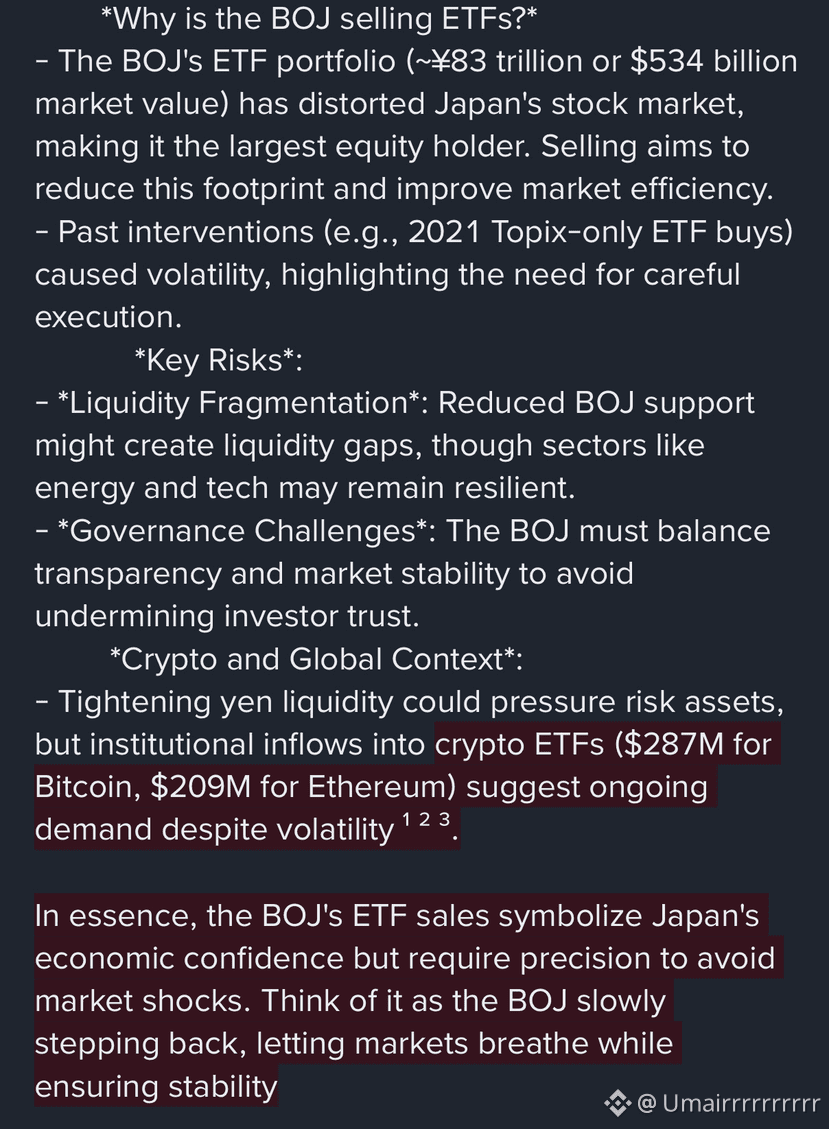
Must read the Screenshot ‼️
The Bank of Japan (BOJ) is set to start selling over $500 billion worth of Exchange-Traded Funds (ETFs) as early as January 2026, marking a historic shift in Japan's monetary policy. This move is part of the BOJ's gradual exit strategy from its massive ETF holdings, accumulated over years to stabilize markets and boost confidence during deflationary periods.
*What does it mean?*
1. *Normalization of Monetary Policy*: The BOJ is transitioning from ultra-loose policies to a more normalized approach, signaling confidence in Japan's economic stability and inflation sustainability.
2. *Impact on Markets*:
- *Short-term Volatility*: Equity markets may face initial volatility as the BOJ reduces its role as a major buyer, especially in sectors heavily owned through ETFs.
- *Long-term Stability*: Gradual sales (¥330 billion annually at book value) aim to minimize disruption, potentially restoring market price discovery and healthier capital allocation.
3. *Global Implications*:
- The move could influence global liquidity flows, currency markets (yen strength), and bond markets, given Japan's central role in global finance.
- Higher Japanese interest rates (BOJ might hike to 0.75% this Friday) could tighten global liquidity, affecting risk assets like cryptocurrencies and carry trades.
*Why is the BOJ selling ETFs?*
- The BOJ's ETF portfolio (~¥83 trillion or $534 billion market value) has distorted Japan's stock market, making it the largest equity holder. Selling aims to reduce this footprint and improve market efficiency.
- Past interventions (e.g., 2021 Topix-only ETF buys) caused volatility, highlighting the need for careful execution.
*Key Risks*:
- *Liquidity Fragmentation*: Reduced BOJ support might create liquidity gaps, though sectors like energy and tech may remain resilient.
- *Governance Challenges*: The BOJ must balance transparency and market stability to avoid undermining investor trust.
$BTC $ETH $SOL
#USJobsData #BTCVSGOLD #CPIWatch
The Bank of Japan (BOJ) is set to start selling over $500 billion worth of Exchange-Traded Funds (ETFs) as early as January 2026, marking a historic shift in Japan's monetary policy. This move is part of the BOJ's gradual exit strategy from its massive ETF holdings, accumulated over years to stabilize markets and boost confidence during deflationary periods.
*What does it mean?*
1. *Normalization of Monetary Policy*: The BOJ is transitioning from ultra-loose policies to a more normalized approach, signaling confidence in Japan's economic stability and inflation sustainability.
2. *Impact on Markets*:
- *Short-term Volatility*: Equity markets may face initial volatility as the BOJ reduces its role as a major buyer, especially in sectors heavily owned through ETFs.
- *Long-term Stability*: Gradual sales (¥330 billion annually at book value) aim to minimize disruption, potentially restoring market price discovery and healthier capital allocation.
3. *Global Implications*:
- The move could influence global liquidity flows, currency markets (yen strength), and bond markets, given Japan's central role in global finance.
- Higher Japanese interest rates (BOJ might hike to 0.75% this Friday) could tighten global liquidity, affecting risk assets like cryptocurrencies and carry trades.
*Why is the BOJ selling ETFs?*
- The BOJ's ETF portfolio (~¥83 trillion or $534 billion market value) has distorted Japan's stock market, making it the largest equity holder. Selling aims to reduce this footprint and improve market efficiency.
- Past interventions (e.g., 2021 Topix-only ETF buys) caused volatility, highlighting the need for careful execution.
*Key Risks*:
- *Liquidity Fragmentation*: Reduced BOJ support might create liquidity gaps, though sectors like energy and tech may remain resilient.
- *Governance Challenges*: The BOJ must balance transparency and market stability to avoid undermining investor trust.
$BTC $ETH $SOL
#USJobsData #BTCVSGOLD #CPIWatch