


Sober Options Studio × Derive.XYZ Joint Production

Written by Sober Options Studio Analyst Jenna @Jenna_w5
1. Macro Barometer: Powell's 'Non-Farm Blunder' and Market Game in the Yen Rate Hike Wave
This week, the cryptocurrency options market has shown significant oscillation characteristics under the intertwining of multiple complex macro signals. On one hand, Federal Reserve Chairman Powell's rare acknowledgment of the 'systematic overestimation' of non-farm payroll data has greatly strengthened market expectations for accelerated interest rate cuts; on the other hand, the Bank of Japan is about to end the negative interest rate era and is preparing for multiple interest rate hikes, which may trigger large-scale unwinding of global liquidity providers—yen carry trades—bringing uncertainty to global markets. Coupled with the tightening of liquidity as the year-end approaches and the U.S. Supreme Court's ruling on the legality of Trump's tariffs, market sentiment is complex, and options data also reflects sustained high demand from investors for hedging against downside risks.
Powell acknowledges non-farm 'systematic overestimation': A signal to accelerate interest rate cuts?
At the recently concluded December FOMC meeting, the Federal Reserve announced an expected interest rate cut of 25 basis points and initiated the 'Reserve Management Purchase' (RMP) plan. However, the biggest highlight of the meeting was not these routine actions, but Chairman Powell's unprecedented acknowledgment that U.S. non-farm payroll data may be subject to 'systematic overestimation.'
Powell explained that official data may be overstated by about 60,000 per month. If this overstatement is excluded, the actual employment growth may have been a 'monthly decrease of 20,000.' The core of such a large deviation lies in the 'Birth-Death Model' used by the U.S. Bureau of Labor Statistics (BLS). This model aims to estimate the contribution of new and old businesses to employment, but at economic turning points, it often systematically overestimates employment growth due to inertia. Historical data shows that in the preliminary estimate released by the BLS in September 2025, employment growth was overestimated by 911,000 for the year ending in March 2025. This correction is not the first, but the public acknowledgment by the Federal Reserve Chairman undoubtedly elevates its significance. Impact and pathways:
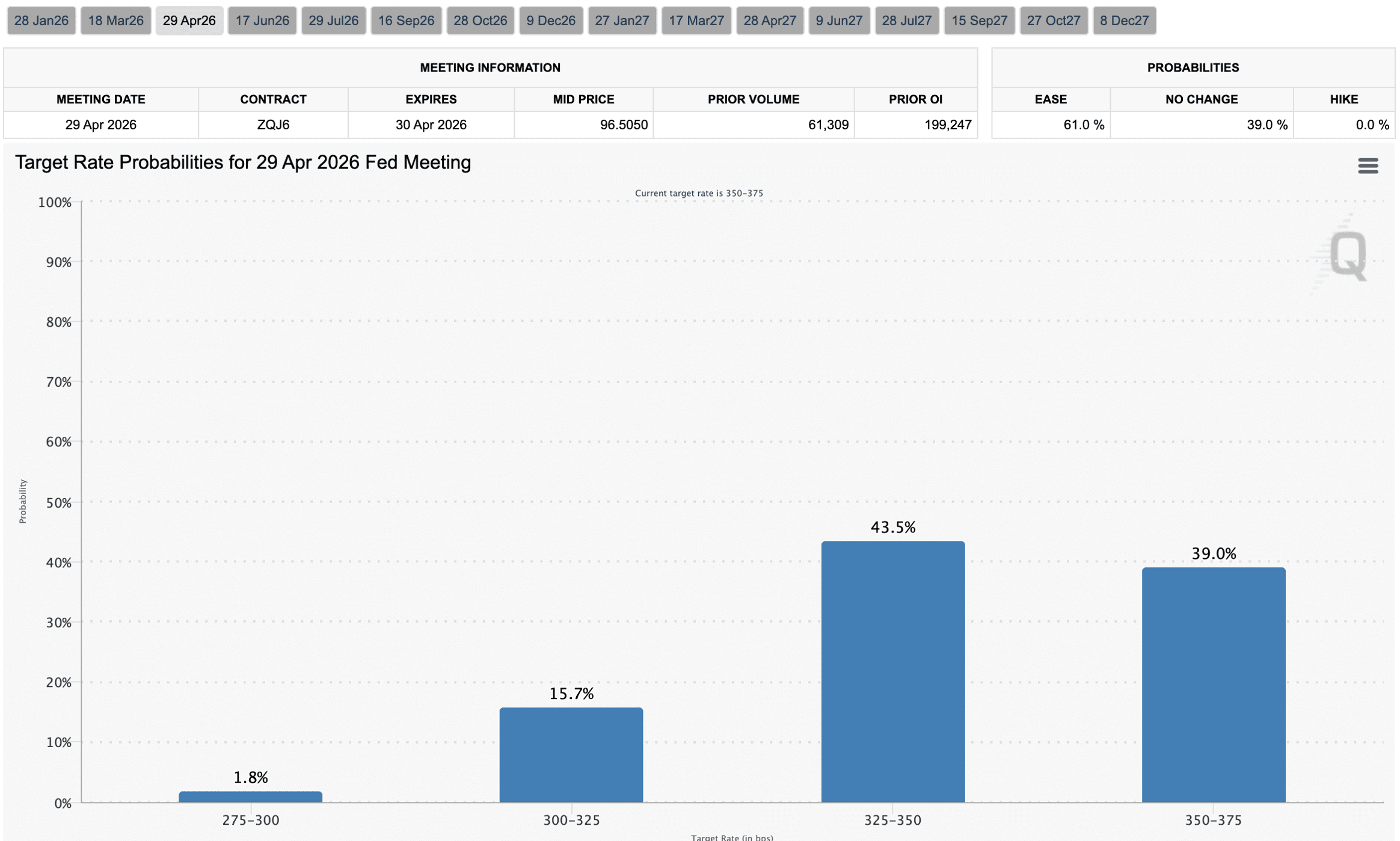
Accelerated interest rate cut expectations: Powell's candor directly implies that the U.S. labor market may be far weaker than what the official data reflects. This severe situation will cause the Federal Reserve's balance to tilt more significantly towards 'protecting jobs.' The market generally expects that the rise in unemployment will 'force' the Federal Reserve to accelerate interest rate cuts, and may even adopt more aggressive easing policies. CME Group Fed Watch data shows that market expectations for two rate cuts (a total of 50 basis points, in April and September) in 2026 have significantly increased compared to last week.
Balance sheet expansion non-QE: Liquidity injection: Meanwhile, the Federal Reserve also announced the first round of approximately $40 billion in short-term Treasury RMP plans, which is not quantitative easing (QE). QE aims to lower long-term rates by purchasing long-term Treasuries and MBS to stimulate the economy. The purpose of RMP is more technical, aimed at ensuring that there is enough liquidity in the 'pipeline' of the financial system to prevent excessive pressure in the overnight financing market and ensure control over the federal funds rate. It injects liquidity into the market by purchasing short-term Treasuries (T-bills), increasing bank reserves, thereby enhancing banks' lending capacity. Although the purposes differ, it still provides funding support to the market.
Impact on risk assets: Weakness in the labor market, combined with the Federal Reserve's dovish turn and liquidity injection, theoretically constitutes a long-term positive for risk assets like cryptocurrencies. However, the market still requires time to digest this information, and in the short term, may exhibit fluctuations or wait for further data confirmation after the 'positive news is realized.'
Yen interest rate hike: A potential 'sucker' for global liquidity
In stark contrast to the dovish turn of the Federal Reserve, the Bank of Japan is preparing to end its decades-long zero interest rate policy and is expected to raise interest rates multiple times. After years of fighting deflation, Japan is facing rising inflationary pressures, and economic data also show certain resilience, providing conditions for the central bank to raise interest rates.
Impact and pathways:
Yen carry trade reversal: For a long time, the yen has been an important funding currency for global carry trades. Investors borrow low-interest yen to invest in high-yield assets (such as USD, cryptocurrencies, or emerging market assets). An interest rate hike in Japan means higher borrowing costs for the yen, which may trigger large-scale unwinding of yen carry trades.
Global liquidity tightening: The unwinding process of carry trades will lead investors to sell high-yield assets to repay yen debts, thereby reducing dollar liquidity in the global market. This could exert selling pressure on risk assets, including cryptocurrencies, and increase volatility in the global market. This is one of the important reasons for the market's 'up-and-down, exhibiting fluctuations' state this week.
Market fluctuations: This structural change in global liquidity has far-reaching and complex impacts, which will increase the frequency and amplitude of market fluctuations in the short term.
Year-end uncertainty: Liquidity and legal rulings
December is typically a special period for global financial markets, with liquidity tightening due to Christmas and New Year holidays. Additionally, the U.S. Supreme Court will rule in December on the legality of the large-scale reciprocal tariffs implemented during the Trump administration.
Impact and pathways:
Year-end liquidity tightening: Institutional trading activities decrease, market depth declines, making any sudden events or large transactions potentially amplified, thereby increasing price volatility. This adds additional vulnerability to liquidity shocks caused by yen interest rate hikes.
Supreme Court ruling: This ruling will have far-reaching implications for the future direction of trade policy.
If the Supreme Court (despite a majority of conservative justices, but with existing doubts) rules that tariffs are illegal, it will help stabilize global trade expectations and be beneficial for risk assets.
However, if the ruling supports the existing policy, it may reignite uncertainties in medium- to long-term trade policy, raising related risk premiums and negatively impacting market sentiment.
This week, the market seeks a balance between the Federal Reserve's strong dovish signals and global liquidity tightening, as well as trade policy uncertainties. Powell's correction of the non-farm data is undoubtedly a heavy positive, driving the certainty of interest rate cut expectations. However, the Bank of Japan's policy shift may tighten liquidity globally, compounded by year-end effects and unresolved issues from the Supreme Court, making it difficult for the market to find a clear direction in the short term, with fluctuations becoming the norm. Investors need to capture the positive effects of interest rate cuts while remaining vigilant against global liquidity shocks and geopolitical risks.
2. In-depth analysis of BTC & ETH options market data
Combining chart data provided by Amberdata & Derive.XYZ, this week the BTC and ETH options market, amidst macro uncertainty, has exhibited a unique volatility structure. While the stabilization of interest rate cut expectations brings short-term positive effects, the deeply negative Delta 25 Skew and volatility risk premium (VRP), along with specific shapes in the term structure, indicate that the market remains highly focused on short-term event risks and continues to be vigilant about downside tail risks.
Skew: Significant bearish sentiment remains in the longer term
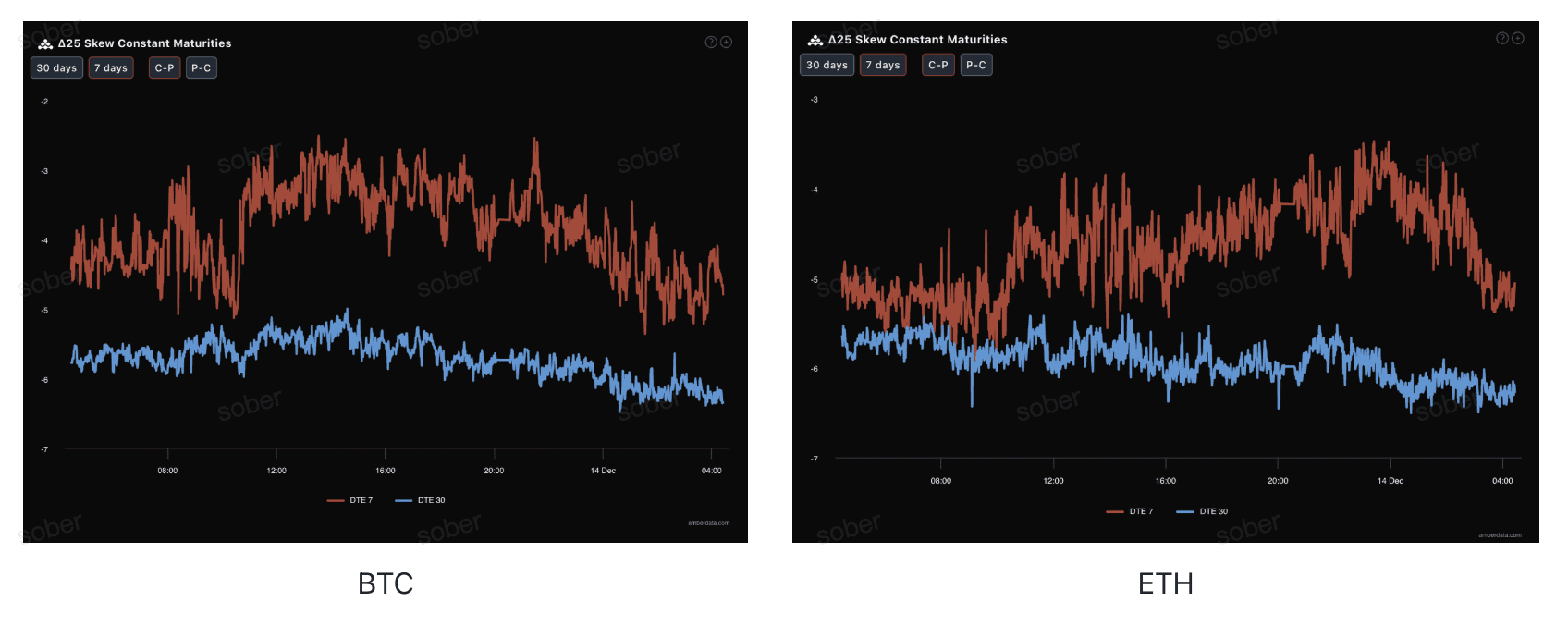
By observing the Delta 25 Skew (implied volatility of call options - implied volatility of put options), the negative value reflects market demand for hedging against downside tail risks.
Normalization of deep negative values: The 25 Delta skew of BTC and ETH remains in the negative range, indicating that the demand for put options still exceeds that for call options, as the market continues to guard against tail downside risks.
Term structure: Bearish sentiment for longer-term (30 days) is more significant than for the shorter-term (7 days). Compared to last week's analysis, while the overall negative values are normalizing, the recent negative values may have slightly narrowed compared to before, which aligns with the short-term easing of sentiment brought by clear interest rate cut expectations from the Federal Reserve. However, concerns over potential macro risks (such as Japanese interest rate hikes, tariff rulings, year-end liquidity) have not diminished and may have even deepened.
Term structure: The 'hump' has disappeared, and medium/long-term IV remains high
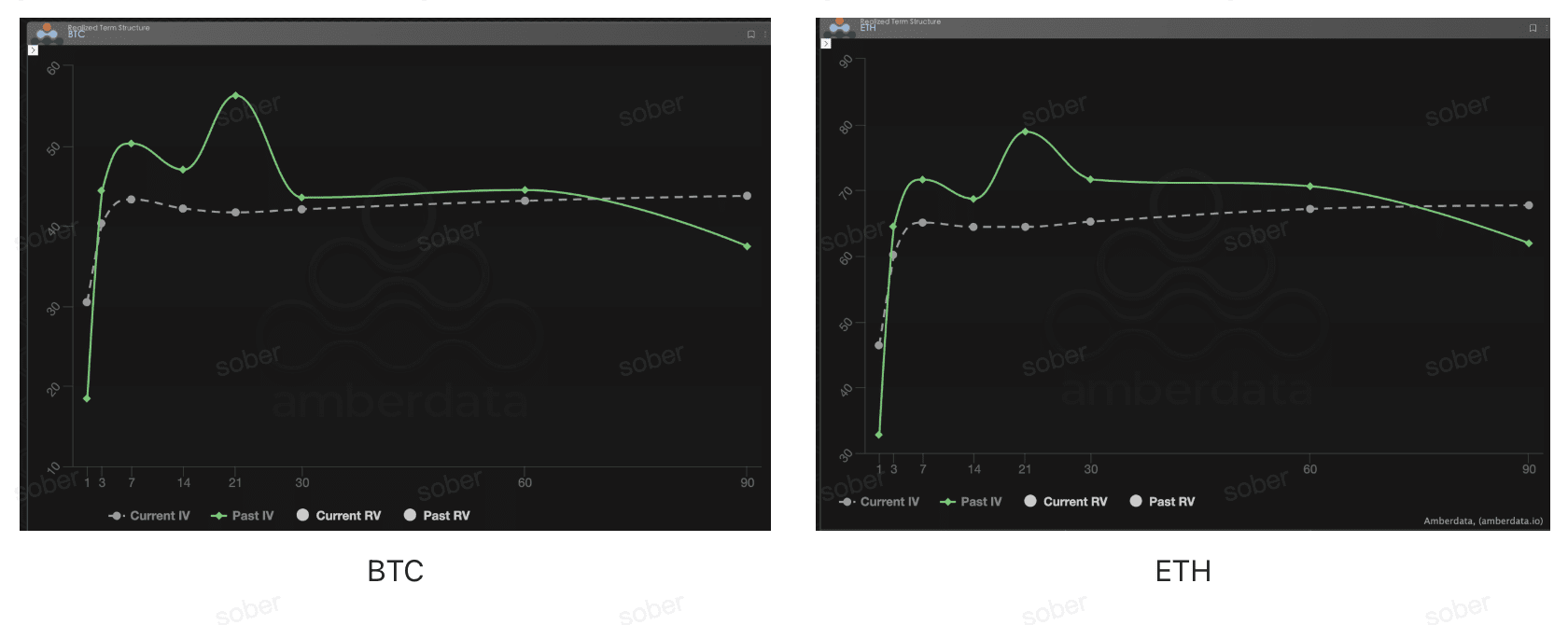
From the perspective of the term structure, the implied volatility curves of BTC and ETH do not exhibit the typical Contango (near low, far high) shape, no longer showing last week's clear 'hump' shape, but rather presenting an 'inverted L' structure.
L-shape: Last week, the market exhibited a clear 'hump' shape at 7 days DTE, reflecting short-term pricing for events such as the FOMC meeting. This week's Current IV curve has changed, aligning more with an 'inverted L shape.' There is still a slight increase at 7-14 days DTE, but subsequently (30-60 days), the curve remains at a relatively high level and tends to flatten.
The typical Contango (near low, far high) structure has not appeared: instead, the medium to long-term implied volatility (IV) remains elevated, suggesting that the market is no longer focusing solely on a single event (such as the FOMC) but is pricing in a combination of risks from the end of the year to early next year (including potential global liquidity tightening due to Japanese interest rate hikes, Supreme Court rulings, year-end liquidity constraints, etc.). This structure reflects the market's concerns about uncertainty over a longer period ahead.
Volatility risk premium (VRP): Deeply negative, sellers still need to be cautious
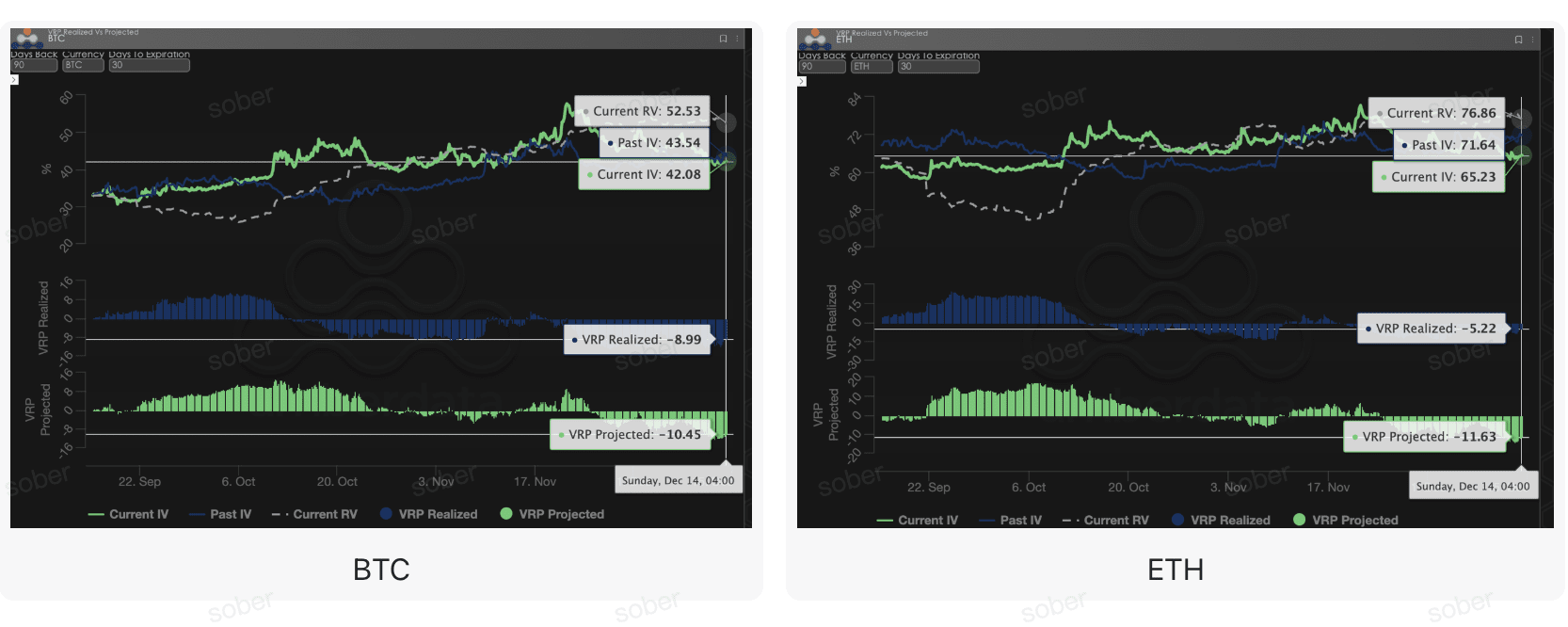
VRP (volatility risk premium = implied volatility IV - realized volatility RV) is an important indicator for assessing the reasonableness of options pricing. The current market is in a correction phase.
Deeply negative VRP: Whether realized or projected, VRP remains in the deeply negative range. This indicates that the actual volatility (Realized Volatility, RV) has consistently and significantly exceeded the implied volatility (Implied Volatility, IV) over the past period, putting enormous pressure on option sellers. This means that the pricing of option contracts relative to actual volatility is undervalued.
Projected VRP even more negative: More notably, this week, the negative value of VRP Projected is deeper than that of VRP Realized. This conveys a key message: the implied volatility currently priced by the market is not only lower than the actual volatility that has occurred but also that market participants generally expect the actual volatility in the next 30 days to be significantly higher than the current implied volatility.
3. Options strategy recommendation: Bear put spread to lock in downside risk
Given the currently complex macro environment, the dovish signals from the Federal Reserve contrast with Japan's potential hawkish actions, coupled with year-end liquidity tightening and uncertainties regarding tariff rulings, along with the continuously deep negative skew and negative VRP in the options market data, we believe that the market may still face potential downside risks. Therefore, we continue to recommend using bear put spreads for defensive positioning.
Strategy objective:
Defend against potential downside risks triggered by year-end liquidity constraints.
Limit risk and costs, avoiding the risks of deeply negative VRP naked sellers.
Fully take advantage of the high premiums for puts brought by deep negative skew to achieve low-cost entry.
Strategy construction (using BTC/ETH as an example):
Buy a put option with a higher strike price that is slightly out of the money (Slightly OTM).
Sell a put option with a lower strike price, with the same expiration date (Short Put).
Expiration date selection:
Considering the impact of the Supreme Court ruling in December and year-end liquidity tightening, it is recommended to choose mid-term contracts with DTE of 30 days or 60 days to cover the entire uncertainty window.
Core advantages:
By selling puts with low strike prices to collect premiums, the cost of buying puts is significantly reduced, while locking in the maximum loss to the net premium spent. This is more cost-effective than directly buying put options (Long Put).
The current skew remains deeply negative, and selling puts can achieve higher premiums, further optimizing the profit-loss ratio of the spread.
4. Disclaimer
This report is based on publicly available market data and options theoretical models, aiming to provide investors with market information and professional analytical perspectives. All content is for reference and communication purposes only and does not constitute any form of investment advice. Cryptocurrency and options trading carry high volatility and risks, which may lead to total loss of principal. Before adopting any trading strategy, investors should fully understand the characteristics of options products, risk attributes, and their own risk tolerance, and must consult professional financial advisors. The analysts of this report do not bear any responsibility for any direct or indirect losses arising from the use of this report's content. Past market performance does not predict future results; please make rational decisions.
Co-produced: Sober Options Studio × Derive.XYZ