
According to the Bitcoin custodian, using the USDC stablecoin will allow members to deposit and withdraw funds without fees.

Bitcoin custodian and licensed private bank Xapo Bank partners with fintech firm Circle to integrate USD Coin
Central Bank of the United States $1.00
Payment rails as an alternative to SWIFT. Payment rails refer to the infrastructure and technology used to facilitate the movement of funds between parties in a financial transaction. Payment rails come in many forms, including traditional bank wires, credit card networks, and blockchain-based platforms.
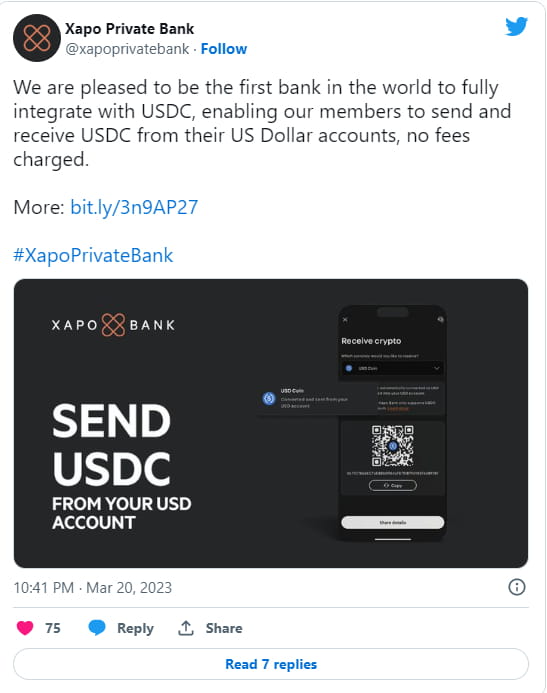
Xapo Bank said the new feature allows its members to bypass the cumbersome and expensive SWIFT payment system through "outrails" added to its existing USDC on-ramp. By using the USDC stablecoin, members can deposit and withdraw funds from Xapo for free and enjoy a one-to-one conversion rate from USDC to US dollars. In addition, all USDC deposits are automatically converted to US dollars, and members can earn up to 4.1% annual interest returns.
According to the announcement, Xapo Bank is a fully licensed and regulated bank and a member of the Gibraltar Deposit Guarantee Scheme (GDGS), which provides depositors with up to $100,000 in protection for their USD deposits. In addition, Xapo Bank stated that it does not participate in the collateralization of any cryptocurrency deposits, and all deposits are automatically converted to USD upon receipt by the bank. Xapo claims that this reduces exposure to any risks associated with the volatile crypto market.
Xapo claims that its business model is different from traditional banks because it does not engage in lending activities and does not rely on fractional reserve banking to generate profits. Instead, private banks keep all customer funds as reserves and invest them in "short-term, highly liquid assets" to pass on the interest earned to customers.
As Cointelegraph previously reported, Moody’s Investors Service warned that USDC’s depegging could negatively impact stablecoin adoption and lead to increased regulatory scrutiny. The credit rating agency believes that recent turmoil in the traditional banking industry and USDC’s depegging could increase resistance to fiat-backed stablecoins.
USDC’s decoupling occurred after the sudden collapse of Silicon Valley Bank on March 10. SVB’s collapse was a major risk event for USDC issuer Circle Internet Financial, which had $3.3 billion in assets with the bank.