


In March 2000, the NASDAQ peaked.
In the following two years, the index plummeted nearly 80%.
During that round of the bubble, hardware giants like Cisco and Sun Microsystems created prosperity in a seemingly rational way: lending money to downstream companies so they could purchase their equipment.
On paper, the revenue looks great. In reality, the risks have quietly shifted across the entire supply chain.
Until those downstream companies can't pay back the money, the chain will snap instantly.
26 years later, a similar script seems to be playing out again.
Only this time, the scale is larger, the methods more hidden, and everything seems legal and compliant.
So, who might fall first in this round?
The answer may not be NVIDIA, OpenAI, or Microsoft.
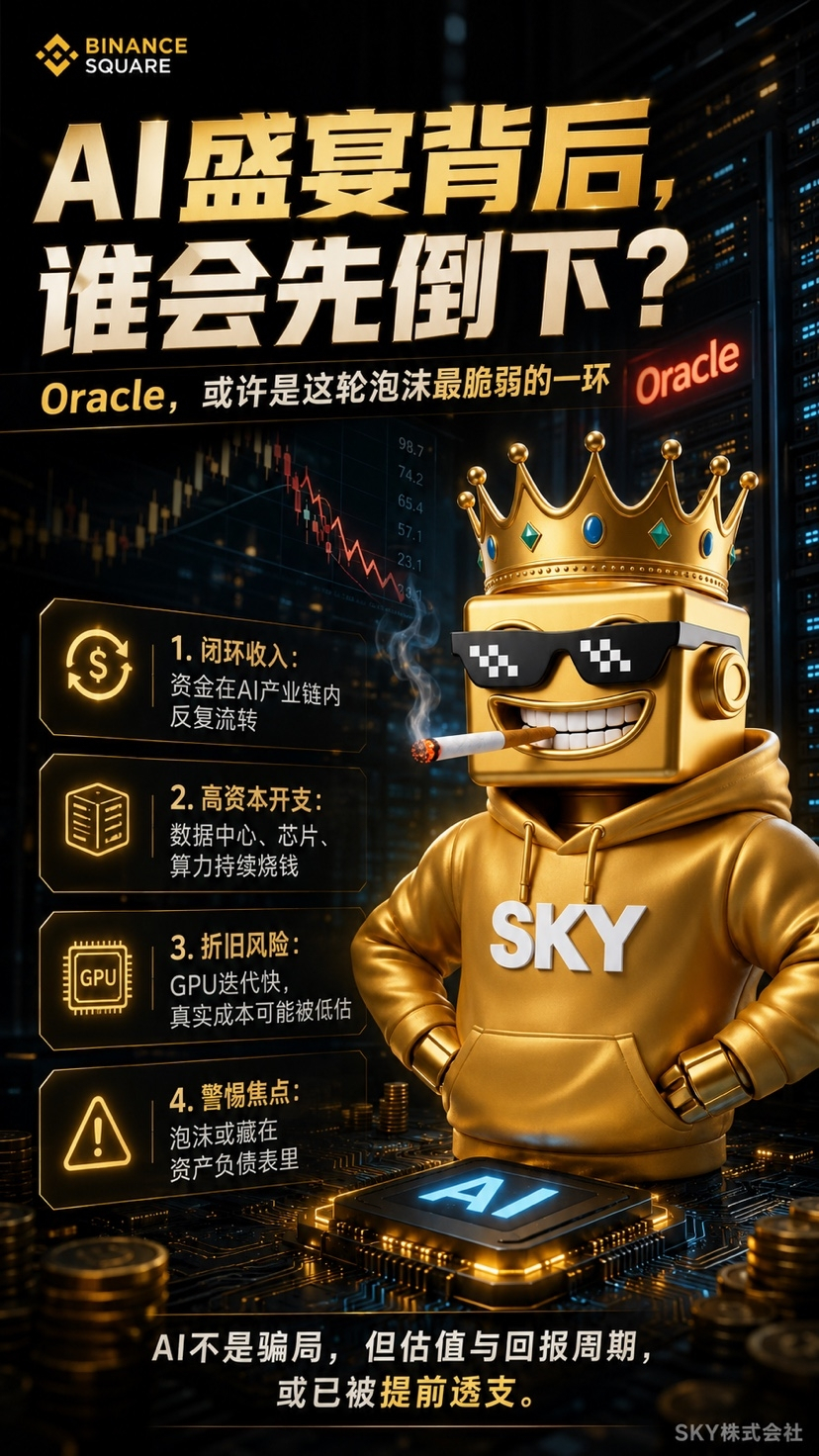
But it's a company that many didn't expect: Oracle.
Two, the 'closed loop income' in the AI supply chain.
Let's first look at how a sum of money flows in the US AI circle.
Microsoft invests in OpenAI. OpenAI uses this money to purchase Microsoft cloud computational power. After Microsoft receives the revenue, they continue to buy NVIDIA chips. NVIDIA receives the money and reinvests it back into OpenAI. OpenAI then buys more computational power and chips.
Every flow of funds is recorded as income.
With each rotation, the book revenue of the supply chain inflates.
You might say: isn't this just normal business transactions? There are always fund flows between suppliers and customers.
The question is: what if that money never really left this circle from start to finish?
For example: you and a friend run into the woods. You pay him $1,000 to dig a hole. He then pays you $1,000 to fill the hole back up. You each generated $1,000 in income.
After a repeated cycle, both individuals on paper show 'skyrocketing incomes'. But in the real world, it's just a numbers game.
Of course, the AI industry is much more complex than this metaphor. These companies are indeed creating technological value.
But the core issue is: how much of that book growth comes from real profit? And how much comes from repeated counting of funds within the circle?
Three, NVIDIA sells shovels, Oracle builds mines, OpenAI is responsible for mining.
If we liken the AI boom to gold mining:
NVIDIA sells shovels. Oracle builds mines. OpenAI is responsible for mining. Microsoft, Google, Meta, and Amazon are continuously expanding infrastructure.
Everyone reinforces the narrative to attract more funds into the mines.
But the problem is: so far, the real 'gold' has not been mined on a large scale.
OpenAI's valuation is high, but there remains a huge gap between revenue and losses.
AI must generate extremely large real profits in the future to cover today's capital expenditure.
Otherwise, the whole story will shift from a 'growth flywheel' to a 'financial closed loop'.
Four, vendor financing: the old script of the internet bubble.
During the internet bubble, hardware giants had previously provided significant financing to downstream .com companies.
After these startups get the money, they go buy servers and network equipment from upstream companies. As a result, upstream companies see their revenues skyrocket.
But essentially, they have tied their fate to a group of cash-flow weak, debt-laden startups.
Later, when the Federal Reserve raised interest rates and liquidity tightened, .com companies couldn't refinance, cash flows broke down, leading to many bankruptcies.
What’s the result? Second-hand servers and equipment flood the market, prices plummet, no one buys new equipment anymore, and orders from upstream hardware giants disappear instantly, leading to a cliff-like revenue decline.
This is the cruelest part when the bubble bursts: during prosperity, everyone proves each other's growth; during collapse, everyone amplifies each other's risks.
Five, why is Oracle dangerous?
Oracle's role today is very subtle.
During the internet bubble, it was more like an upstream provider of equipment and software. Today, it has become a heavy asset purchaser in the AI infrastructure race.
To catch up with AI cloud infrastructure, Oracle needs to build a large number of data centers, purchase chips, and expand computational power.
This means: capital expenditures soar, debt financing increases, balance sheets come under pressure, and credit ratings face stress.
When a company relies on constant borrowing to participate in a capital-intensive race, what the market is really worried about is not whether it has a story, but whether it can hold out until the story becomes profit.
If AI demand continues to explode, Oracle may emerge as the winner.
But if demand falls short of expectations or the financing environment worsens, it could also become the weakest link.
Six, there's an even more hidden issue: depreciation.
AI infrastructure is not an ordinary asset.
GPU iterations are too fast.
From H100 to H200, then to the B series and subsequent new architectures, the speed of computational power improvement far exceeds traditional hardware cycles.
The tech companies' expensive equipment, which they purchased with huge sums, may soon face obsolescence with the next generation of products.
In theory, these assets should depreciate faster.
But many companies still adopt longer-term linear depreciation methods.
This brings up a problem: the real costs have already occurred, but the book costs are being gradually spread out.
So short-term profits look much better.
It's like you spend $10,000 on a flagship phone. Then the manufacturer releases a more powerful model every few months. Your phone's second-hand value rapidly declines.
But if you still amortize costs over 6 years, the book value will long exceed the market value.
This is the risk in AI capital expenditures that is most easily overlooked: the speed of technological depreciation may far exceed the speed of accounting depreciation.
Seven, why is this round of bubbles harder to see?
Historical tech bubbles often have visibly excessive construction.
In the 19th century British railway mania, you could see tracks laid in the wilderness that were never used. During the internet bubble, you saw tons of idle fiber optics and servers.
But this round of AI bubble is different.
What was bought for 600 billion dollars?
It's not about tracks. It's not about fiber optics. It's about computational power.
Computational power is hidden in data centers. Data center costs are hidden in financial reports. Financial report costs are gradually spread out over depreciation cycles.
So this time, the bubble may not appear on the streets or in warehouses. It might be hidden in the balance sheets.
Eight, AI is not a scam, but prices may have already overdrawn the future.
This doesn't mean AI has no future.
On the contrary, AI is likely to change the way human society operates, just like the steam engine, electricity, and the internet.
But the issue is: 'The future will change the world' does not equal 'Today's valuations and capital expenditures are reasonable.'
There is a huge gap between technological revolution and business profit.
Now, the market seems to be temporarily filling this gap with accounting treatments, capital expenditures, vendor financing, and closed-loop transactions.
But accounting magic can't replace cash flow forever.
Nine, why Oracle?
The name Oracle originally means 'prophecy'.
In ancient Greece, people went to the Oracle of Delphi seeking prophecies. The priestess would read prophecies in a trance.
Those prophecies never directly tell you the answer. They simply give signals.
Those who understand will survive. Those who don't will consider it madness.
Today’s Oracle may be issuing some sort of prophecy through the bond market.
Debt is rising. Capital expenditures are surging. Credit pressure is increasing. The market demands higher yields.
These signals, viewed in isolation, are not fatal.
But placed against the backdrop of the AI capital race, they may imply: the weakest parts of the bubble are not necessarily in the most dazzling stories. But in those who are chasing the story and continually leveraging.
Conclusion
AI might really change the world.
But any technological revolution does not mean that the capital market can ignore cash flow, depreciation, debt, and return cycles.
The internet ultimately changed the world. But internet stocks from 2000 can still plummet by 80%.
This time is no different.
The future of AI may indeed be great.
But on the road to the future, a number of companies that appear to be working the hardest on paper, but are highly leveraged in reality, may fall first.
And Oracle may just be the 'prophecy' that the market is giving.
Not because it lacks a story. But because it needs the story to be fulfilled too much.