#opg $OPG Guys, don’t get fooled by the narrative of 'hash power intermediaries'; that’s just grunt work for miners!
Last night, I was having some skewers with a few brothers who mine DePIN, and the more we talked, the more I got worried. You’re spending big bucks running a private model on-chain, and node miners can easily siphon off your weights; even crazier, some of these guys are just using random numbers to fake inference results to save on electricity costs. This isn't decentralization; this is a 'trust black box' ripping off the big players!
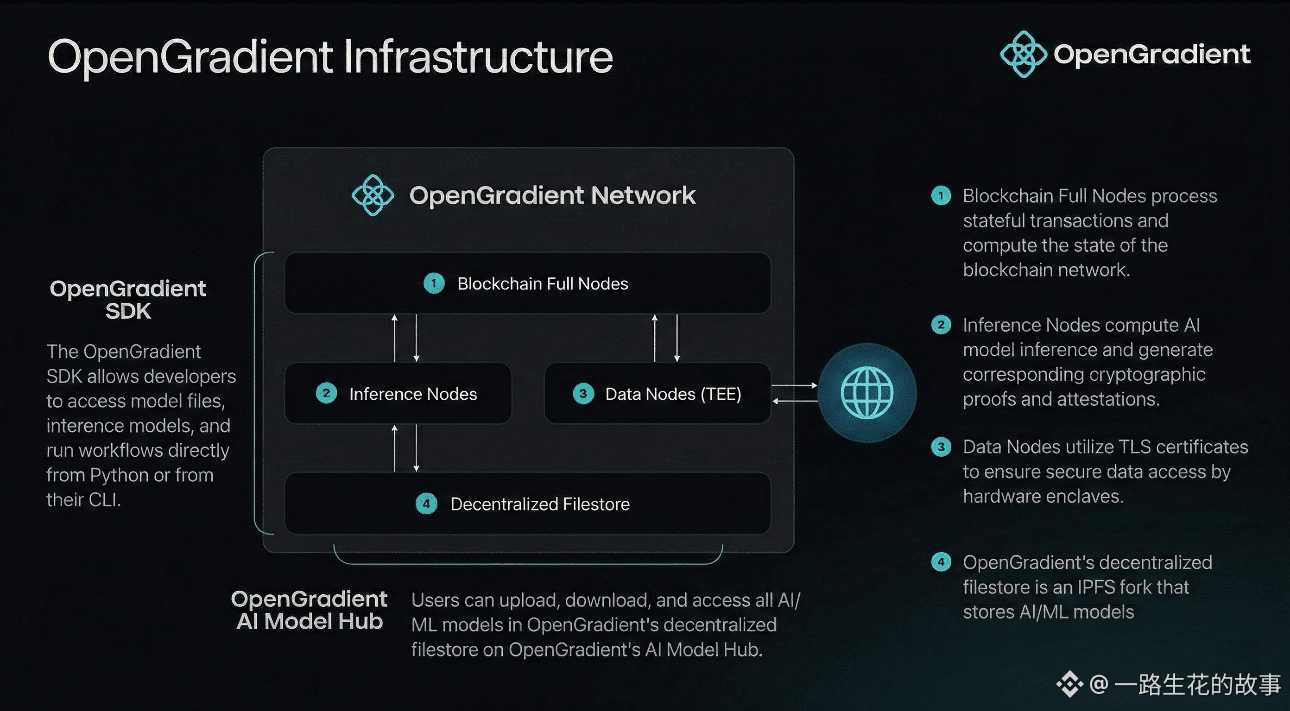
It wasn't until I dug into the white paper of @OpenGradient that I discovered what dimensionality reduction really means. It doesn’t compete with you on the number of GPUs, but rather insists on 'trusted execution'. What blew my mind was its HACA architecture—this thing splits 'doing the work' and 'auditing' into two separate lines!
Where do traditional projects go wrong? They insist on having 100 nodes run the big model over and over to validate results, which is as costly as it gets. But OPG's approach is incredibly clever: inference nodes run the model in a TEE (Trusted Execution Environment), and once done, they generate a cryptographic proof backed by hardware; full nodes don’t need to re-run the data, they just need a millisecond to verify this proof's authenticity. This completely decouples the 'heavy lifting' of AI inference from the 'light settlement' of on-chain consensus!
What does this mean? Miners can't touch my model weights (TEE isolation), and they can't bamboozle me with fake results (the cryptographic proof is recorded on-chain). What they’re selling isn’t cheap compute power, but rather 'verifiable certainty'.
This ecosystem position is terrifying; it’s not just about the DePIN space getting crowded, it’s aiming to be the Chainlink of the AI era—an absolute necessity for privacy computing. a16z is leading the investment, and the team is packed with tech geeks from Two Sigma and Palantir. $OPG isn’t anchored to electricity costs, but rather to the 'toll fees' that financial and medical AI must pay. Once the mainnet rolls out fully, the valuation ceiling of traditional DePIN will look like a small fry next to it. Once this washout ends, I’m going in heavy; the landscape is opening up for @OpenGradient .
Last night, I was having some skewers with a few brothers who mine DePIN, and the more we talked, the more I got worried. You’re spending big bucks running a private model on-chain, and node miners can easily siphon off your weights; even crazier, some of these guys are just using random numbers to fake inference results to save on electricity costs. This isn't decentralization; this is a 'trust black box' ripping off the big players!
It wasn't until I dug into the white paper of @OpenGradient that I discovered what dimensionality reduction really means. It doesn’t compete with you on the number of GPUs, but rather insists on 'trusted execution'. What blew my mind was its HACA architecture—this thing splits 'doing the work' and 'auditing' into two separate lines!
Where do traditional projects go wrong? They insist on having 100 nodes run the big model over and over to validate results, which is as costly as it gets. But OPG's approach is incredibly clever: inference nodes run the model in a TEE (Trusted Execution Environment), and once done, they generate a cryptographic proof backed by hardware; full nodes don’t need to re-run the data, they just need a millisecond to verify this proof's authenticity. This completely decouples the 'heavy lifting' of AI inference from the 'light settlement' of on-chain consensus!
What does this mean? Miners can't touch my model weights (TEE isolation), and they can't bamboozle me with fake results (the cryptographic proof is recorded on-chain). What they’re selling isn’t cheap compute power, but rather 'verifiable certainty'.
This ecosystem position is terrifying; it’s not just about the DePIN space getting crowded, it’s aiming to be the Chainlink of the AI era—an absolute necessity for privacy computing. a16z is leading the investment, and the team is packed with tech geeks from Two Sigma and Palantir. $OPG isn’t anchored to electricity costs, but rather to the 'toll fees' that financial and medical AI must pay. Once the mainnet rolls out fully, the valuation ceiling of traditional DePIN will look like a small fry next to it. Once this washout ends, I’m going in heavy; the landscape is opening up for @OpenGradient .