
Binance Alpha's recent airdrop projects have delivered solid returns, and many folks are starting to pay attention to points and the claiming thresholds again.
Taking this opportunity to quickly recap the airdrop data since Binance Alpha went live.
According to the @binance App Alpha Event airdrop page stats:
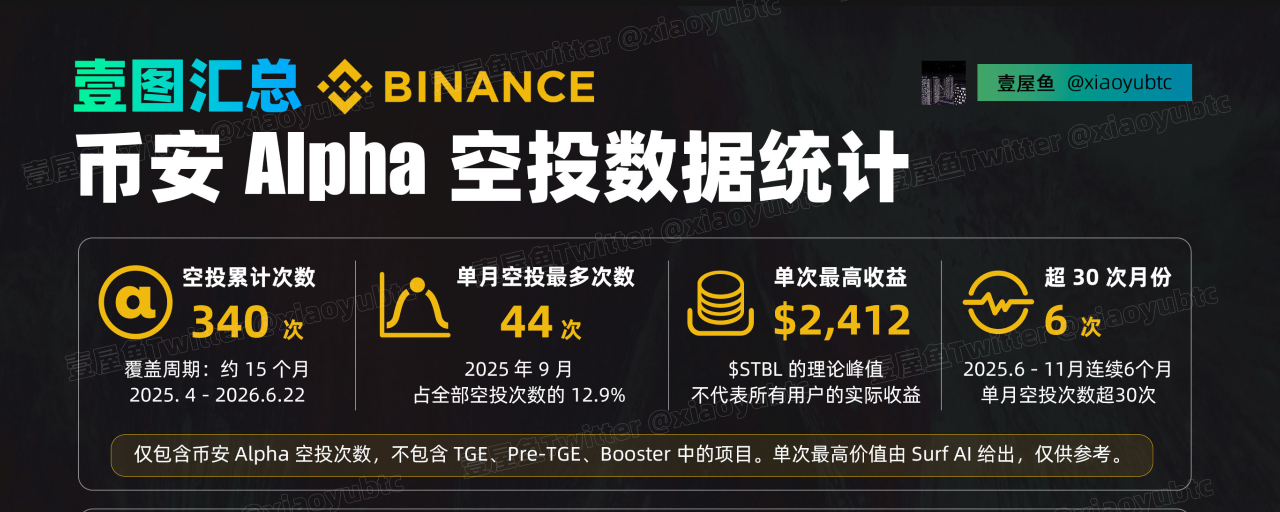
From April 2025 to June 22, 2026, Binance Alpha has conducted a total of 340 airdrops, covering a period of about 15 months.
My stats here only include Binance Alpha airdrops, excluding TGE, Pre-TGE, and Booster projects.
Here are a few noteworthy data points:
▰ The highest number of airdrops in a single month was 44, in September 2025.
▰ In 6 consecutive months, the number of monthly airdrops exceeds 30
▰ The project with the highest theoretical peak single-round return is STBL, at about $2,412
Of course, ATH is only a theoretical peak and doesn’t mean most users can sell at the very top.
//
Based on monthly data, Alpha’s development can roughly be divided into three stages.
First stage: Launch phase
From April to May 2025, Alpha conducted 16 airdrops in total.
This stage is more like a mechanism-testing period. Binance is still exploring transaction snapshots, point thresholds, and ways to get users to participate. Meanwhile, the market’s understanding of Alpha points hasn’t fully formed yet.
/
Second stage: Breakout phase
From June to December 2025, Alpha conducted 248 airdrops, accounting for 72.9% of the total airdrops, with an average of about 35.4 times per month.
This stage can basically be seen as the peak of Binance Alpha’s dividend period.
On one hand, the project launches and TGE activity are strong, and Binance needs Alpha to take on more early-stage projects;
On the other hand, users’ understanding of the points system gradually matured, and point-farming, point-holding, and calculating the cost to claim became important strategies at the time.
But having many airdrop rounds doesn’t mean every single one is worth claiming.
As claiming begins to deduct points, users essentially need to make a decision between two choices:
Do you want to claim this project right in front of you, or keep your points and wait for the next higher-value airdrop?
Starting from this stage, Alpha’s core is no longer just whether there are points, but how to improve the efficiency of using points.
Alpha’s gameplay has also been adjusted over time. The entire change process, in essence, is about solving two problems:
First, how to allocate limited airdrop shares to more active users;
Second, how to prevent a large amount of rewards from going unissued because the thresholds are too high.
So Alpha’s rules have become increasingly complex. It’s not simply to drive more internal competition; it’s about finding a balance between activity level, allocation efficiency, and user reach.
/
Personally, I think Alpha has already entered its third stage: the cooling-off period
From the data, since 2026, the number of Alpha airdrops has clearly fallen:
In the first six months of 2026, a total of 76 airdrops were recorded, averaging about 12.6 per month—already far below the explosion period of 2025.
At its core, Alpha still depends on the supply of early projects.
The overall market is in a relatively weak phase, with project financing, token issuance, and TGE schedules all slowing down—so Alpha’s airdrop frequency naturally declines.
However, in February this year, Binance launched the Alpha Box blind box, which combines multiple project tokens into a prize pool and distributes them randomly. In essence, when project supply is insufficient, it continues to provide users with additional sources of Alpha income.
//
My assessment of Alpha going forward is:
In the short term, the airdrop frequency won’t return to the high peak levels of 2025, but as long as Binance continues to treat Alpha as an important entry point for distributing early projects and filtering users, there will still be periodic high-return projects worth participating in.
So, there’s no need to blindly increase transaction costs just to maintain points, and there’s no need to give up entirely just because the frequency drops. A more reasonable strategy is to control the cost of farming points, preserve point flexibility, and wait for projects that are truly worth claiming.