


The Federal Reserve announced another rate cut, with policy differences intensifying market volatility.
The Federal Reserve announced at the latest FOMC meeting that it would lower the benchmark interest rate by 25 basis points, bringing the range down to 3.5%~3.75%. This is the third rate cut this year and the lowest level since 2023. This move aligns with market expectations, but the rare public disagreement among decision-makers makes this rate cut more symbolic.
Nine members supported a rate cut, but two hoped to maintain the status quo, while another advocated for a single rate cut of 50 basis points.
Despite the interest rate decision leaning towards easing, officials maintained the outlook of only one rate cut in 2026 in the latest forecast, indicating that the future policy path is highly data-dependent. The outside world is also concerned that this might be the last meeting during Chairman Jerome Powell's tenure, as U.S. President Trump has publicly begun searching for a successor. The market generally believes that candidates advocating for a more aggressive easing have the highest voice, adding greater uncertainty to the monetary policy outlook.
Global markets reacted quickly, with crypto assets experiencing significant volatility.
After the interest rate decision was announced, global markets reacted immediately. US stocks rose, and the yield on the 10-year Treasury bond slightly retreated to around 4.12%, with overall capital sentiment significantly improving. The crypto market reacted even more intensely, with Bitcoin ($BTC) quickly surging after the announcement, briefly reaching about $93,000 and experiencing wild fluctuations between $92,000 and $94,000. As of the time of writing, Bitcoin's price is $90,986.
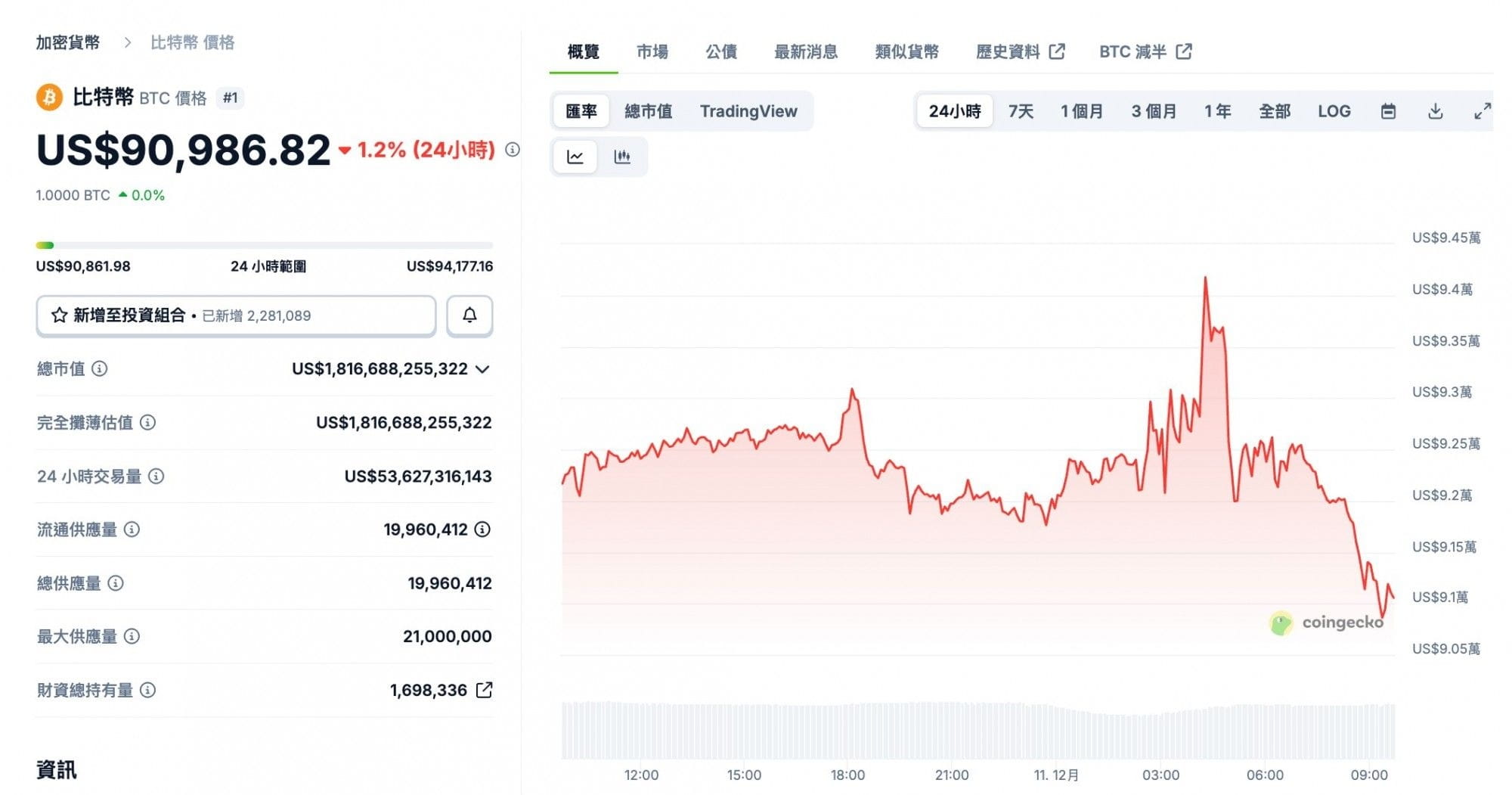 Bitcoin briefly rose to $93,000, and the current price is $90,986. CoinGecko
Ethereum ($ETH) also rose about 3%, trading around $3,300, while other mainstream coins like Solana ($SOL), Ripple ($XRP), and Binance Coin ($BNB) also saw price increases ranging from 2% to 6%. Several analysts pointed out that against the backdrop of the rate-cutting cycle, the market generally believes that the Federal Reserve will re-provide liquidity, allowing 'risk assets to breathe'.
Additionally, the Federal Reserve announced that it will resume purchasing short-term government bonds starting December 12, with plans to buy up to $40 billion in T-bills over the next 30 days. While the official term is 'reserve management operation', the market generally views it as a 'QE-like' liquidity release, which directly benefits asset prices.
The rate cut was not as expected, and the market will still look to the data.
Although the market is euphoric in the short term, Powell's press conference tone is seen as 'neutral'.
According to the CME FedWatch tool, the market expects the probability of another rate cut in January 2026 to be only about 22.1%, indicating that traders are not entirely convinced about subsequent monetary easing. Some Wall Street economists even believe that if inflation rebounds or the labor market tightens again, the Federal Reserve may be forced to pause the rate-cutting cycle.
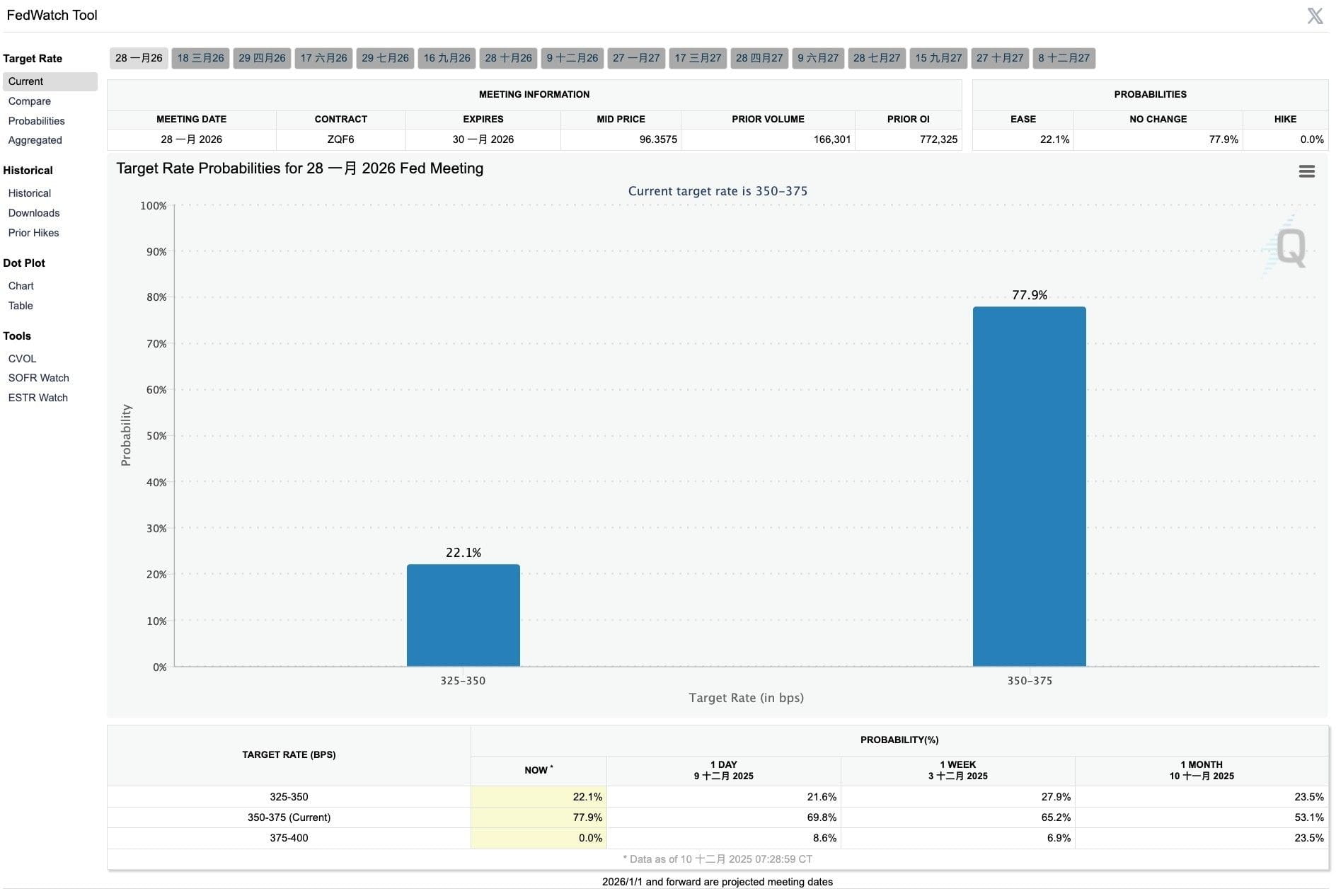 The market expects the probability of another rate cut in January 2026 to be only about 22.1%. CME FedWatch
However, some analysts hold a more optimistic view. CryptoQuant points out that if subsequent policies clearly shift to a more dovish stance, Bitcoin has the opportunity to challenge key resistance levels between $99,000 and $102,000; a researcher from 21Shares bluntly stated that the rate cut itself equates to injecting lower-cost funds into the market, and historical evidence shows it will ultimately drive crypto assets stronger again.
Bitcoin breaks through $93,000, with the market betting on a new liquidity cycle.
After this rate cut, Bitcoin briefly broke through $93,000, indicating that the market has regarded it as a beneficiary of a new liquidity cycle. In the past several FOMC meetings, Bitcoin has often shown a structure of 'rising first, then fluctuating', and this trend is even more robust.
However, most analysts warn that what truly affects Bitcoin's trend will be the policy rhythm in 2026, global inflation trends, and the Federal Reserve's balance sheet management. Powell has hinted that the current stage is not full easing, but rather 'carefully advancing amidst multiple risks', indicating that the market still needs to digest more signals before judging the trend.
The greatest uncertainty in the current market comes from the selection of the next Federal Reserve chairman. If a candidate appointed by Trump tends to favor significant rate cuts or rapid balance sheet expansion, it may trigger an early start to the capital market; conversely, if policies shift to a conservative stance, Bitcoin's upward momentum may also slow.
Nevertheless, Bitcoin's appeal in a rate-cutting environment is still considered strong, with risk assets generally benefiting, and market sentiment leaning optimistic in the short term. Under the resonance of overall economic policy, capital inflows, and market structure, Bitcoin may again enter a high volatility market, testing investors' risk tolerance and judgment.
This article is authorized for reprint from (Crypto City)
More reports
After six out of seven Fed meetings this year resulted in sharp declines, how will Bitcoin perform after this week's rate cut?
The call for Fed 'shadow chairman' Hassett is rising; one article introduces Trump's favored candidate for the Federal Reserve chair.
The Fed opens the door to cryptocurrency discussions for the first time! Proposing a 'simplified main account' concept, rewriting the payment landscape.