

On June 15th, Li Auto (02015.HK) held the Livis Day event in Beijing, unveiling their software and AI advancements.
The event showcased a brand new generation of Li Auto's interactive experience, their self-developed embodied intelligence model, the world's first dynamic data flow AI chip, the Mach M100, as well as embodied intelligence products and experiences, and announced continuous OTA growth milestones for the entire year.
Recently, Li Auto's CEO, Li Xiang, has shared his thoughts on AI and embodied intelligence on several occasions, stating that Li Auto aims to transform into an 'AI enterprise.' However, skepticism from the public hasn't ceased—'car companies should focus on building cars, not getting sidetracked.'
A few days before the launch, Li Xiang himself stated on Weibo, 'We believe that embodied intelligence based on automotive forms may be the first AI robot to enter the physical world.' He also set the tone for this launch with the phrase 'extremely dedicated.'
You could say this launch event stripped away the conceptual layers of Li Auto's AI ambitions, revealing its full tech backbone. It was also a systematic report from Li Xiang addressing external doubts.
Li Xiang stated, 'Li Auto insists on being the best version of itself; don’t expect us to become someone else.'
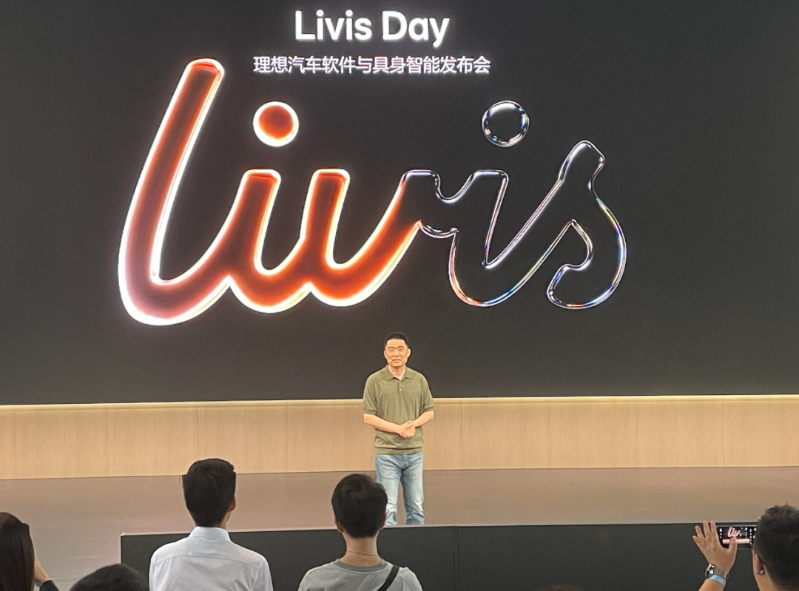
Li Auto defines embodied intelligent vehicles.
A lot of folks got to know Li Auto through their 'refrigerator, color TV, big sofa' approach, even dubbing it the 'dad car.'
In the past few years, as Li Auto's sales have steadily increased, this label has been both the key to its precise penetration of the family car market and gradually an invisible shackle restricting the brand's upward breakthrough.
Now, Li Auto has officially put forth a complete definition of embodied intelligent vehicles.
At the launch, Li Xiang himself first presented his judgment. He pointed out that over the past decade, the industry has recognized three core definitions for smartphones and smart cars: software defines hardware, they must be able to connect to the internet, and systems can undergo continuous upgrades.
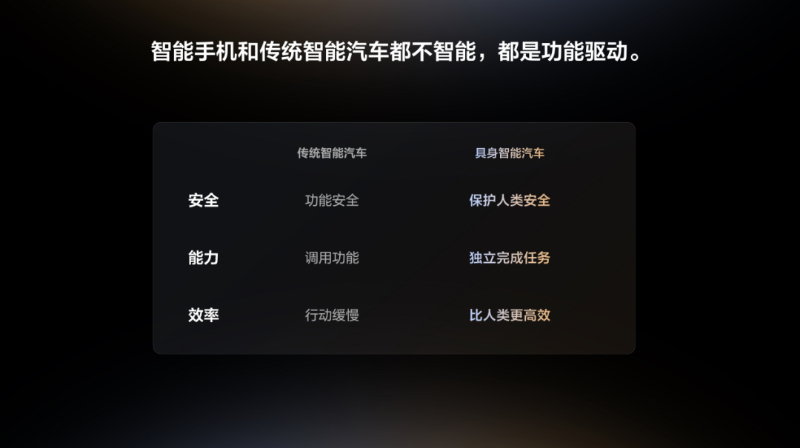
'But today I want to present a different perspective: although it’s tagged as smart, today’s smartphones and smart cars aren’t truly intelligent; they’re fundamentally function-driven, not vibrant intelligent agents.'
Under Li Xiang's newly defined framework, the 'embodied intelligent vehicle' has three core differences from 'smart vehicles': protecting human safety, completing tasks independently, and being more efficient than humans.
Based on this, Li Xiang provided a complete definition of the embodied intelligent vehicle as a 'four-in-one' entity: it’s an electric vehicle that has a body, can move, and genuinely participates in users' lives; it’s a professional driver that understands roads and risks, always ready to safely and reliably complete travel tasks; it’s an AI computer that processes complex information and completes tasks; and it’s a life assistant that understands user habits, manages information, and handles affairs, becoming a long-term trusted partner. The electric vehicle and AI computer are 'embodied,' while the professional driver and life assistant are 'intelligent.'
Li Auto's technological trump card.
Beyond strategic definitions, the most hardcore part of the launch was the concentrated showcase of Li Auto's self-developed technological achievements.
At the event, Li Auto's CTO Xie Yan unveiled the self-developed chip — the Mach M100. This chip adopts a 5nm automotive-grade process with a single-chip computing power of 1280 TOPS, making it the strongest-performing automotive-grade inference chip currently in mass production, with actual operational efficiency exceeding 82%. More than half of the chip's wafer area is allocated to the neural network processor, consisting of 56 computing units and 1 data processing module. The CPU uses a 24-core ARM A78AE automotive flagship core with a frequency of 2.3 GHz; it is equipped with an 8-channel LPDDR5X subsystem, boasting a high bandwidth of 273 GB/s. Directly competing with mainstream chips in the smart driving assist field, the Mach M100 has achieved several times the performance lead in multiple industry standard tests.
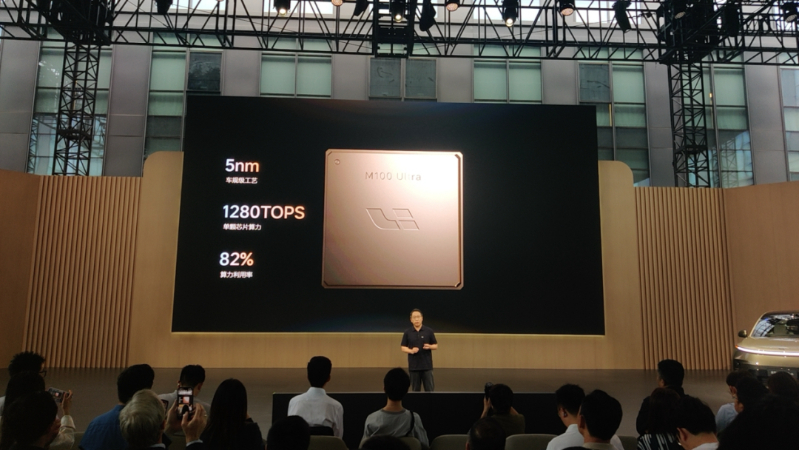
Xie Yan also revealed that the Mach M100 architecture paper has been selected for the International Symposium on Computer Architecture (ISCA) 2026 Industrial Track, making Li Auto the first automotive company to have a paper accepted at this top-tier conference.
(Sing Tao) It’s understood that since officially launching the project in 2022, after three and a half years of continuous refinement, Li Auto's self-developed Mach M100 chip achieved mass production in May 2026, becoming the world's first mass-produced dynamic data flow AI chip. With the deployment of the Mach M100, Li Auto has realized full-stack self-development of chips, compilers, operating systems, AI algorithms, and domain controllers.
Beyond the Mach M100 chip, Li Auto aims to build a complete foundation of embodied intelligent technology.
At the launch, Zhan Kun, head of Li Auto's base model, provided an introduction. He pointed out that the brain of embodied intelligence is composed of a deep fusion of language intelligence and machine intelligence. Language intelligence is carried by Li Auto's self-developed Mach Mind-Pro and Mach Mind-Edge, responsible for language and logical thinking, understanding commands, and extrapolating action plans; machine intelligence is carried by the self-developed Mach VLA, responsible for three-dimensional visual perception and body motion control, seeing the physical world and executing operations accurately.
Zhan Kun also detailed the enhancements in efficiency and capability of the Mach VLA, stating that its capabilities will continue to evolve in the second half of this year. In Q3, Li Auto will push a new trimmed version of the Mach VLA model to existing owners of the Orin and Thor platforms; in Q4, the intelligent driving model capabilities will align with Tesla's FSD V14.
At the launch, Li Auto announced the milestone for the Livis embodied intelligence system OTA growth in the second half of this year.
July's theme is 'Intelligent driving efficiency improved by 30%', assisting users through complex scenarios like width-restricted bumps and height restrictions. The travel guide-related Agent skills are officially launched, along with new features like intercoms for car buddies, a two-day per kilowatt-hour sentry mode, and convenient tire changing.
September's theme is 'Reversing like a human,' achieving full-scene autonomous reversing capabilities such as narrow road passing and yielding while reversing, actively handling complex road surfaces with the suspension system, controlling smart locks and garage door openings, and enabling Agent connections to computers and phones, with new Super CarPlay.
December's theme is 'Safety and efficiency surpassing humans,' adding features like active protection against accidental steering wheel touches, emergency evasion compensation, obeying traffic police commands, and Face ID account switching, with end-to-end response speed reaching 0.2 seconds, 56% faster than humans, fully surpassing human capabilities.
Behind this roadmap is Li Auto's control over the commercialization pace of embodied intelligence. 'In the past decade, we created a moving home. In the next decade, we will give cars and homes life,' Li Xiang stated.