


Financial Supervisory Commission: If the cryptocurrency special law is passed, unlicensed solicitation will be illegal
Taiwan's cryptocurrency industry special law (Virtual Asset Service Act) has entered the final stage of review by the Executive Yuan.
Regarding the public's concerns about the regulation of foreign virtual currency traders, Huang Zhonghao, Deputy Director of the Securities and Futures Bureau of the Financial Supervisory Commission, recently stated to (Central News Agency) that although the current framework under the (Anti-Money Laundering Act) does not explicitly prohibit unlicensed operators from solicitation, foreign operators can also apply for registration in Taiwan, provided they comply with internal control, cybersecurity, and fiat currency custody regulations.
The Financial Supervisory Commission emphasizes that if the (Virtual Asset Service Act) special law is successfully passed in the future, operators must obtain a permit to conduct business solicitation; otherwise, it will be considered illegal.
(Crypto City) Previously reported, the Financial Supervisory Commission (FSC) has adopted a phased management strategy and announced in September this year the first batch of completed money laundering prevention registration, including 9 operators such as Modern Wealth Technology (MaiCoin/MAX), Bito, and HOYA BIT. However, foreign exchanges commonly used by Taiwanese crypto investors, such as Binance and OKX, have not yet completed the money laundering prevention registration to become officially compliant Virtual Asset Service Providers (VASP).
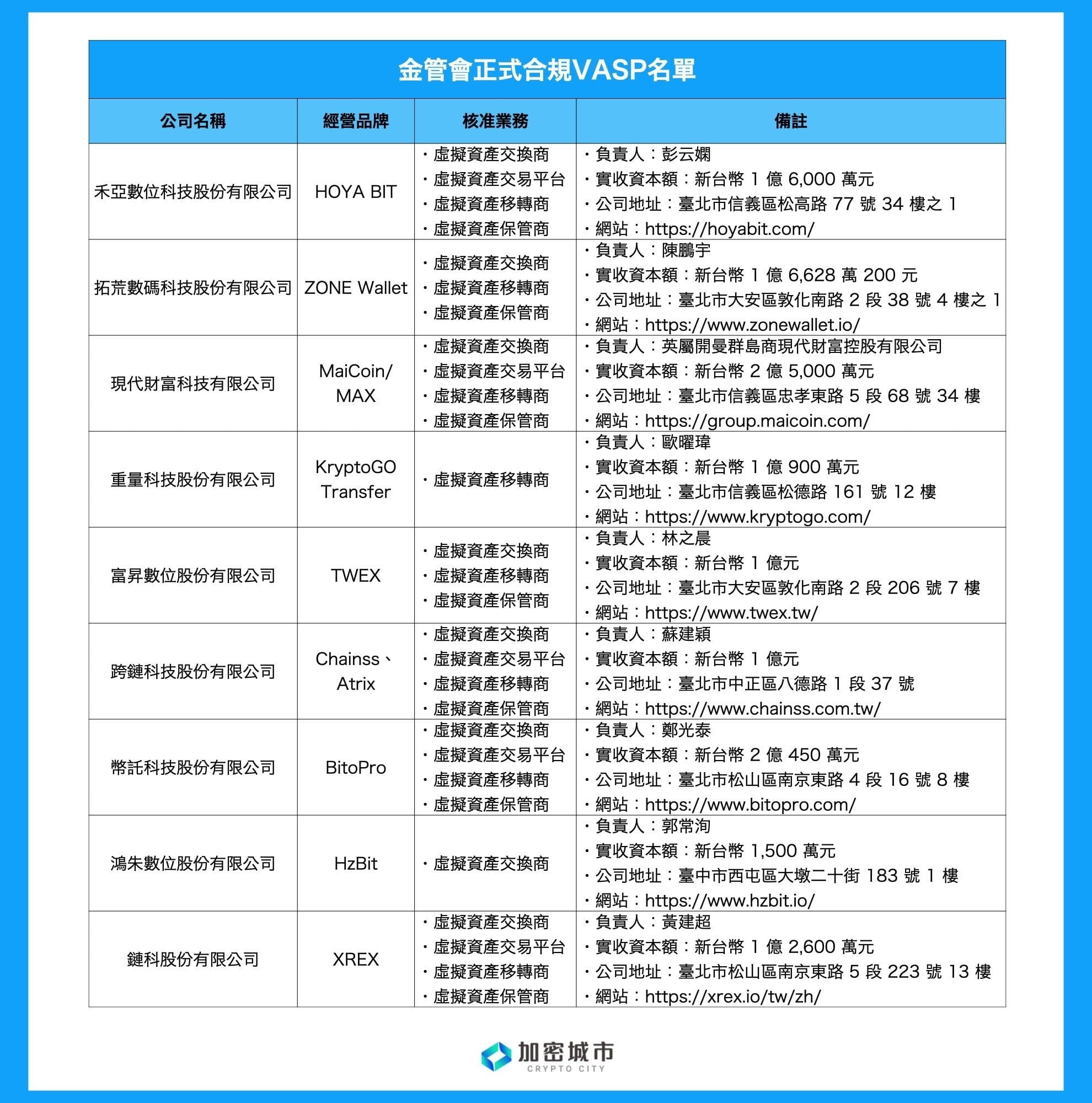
The special law provides a transition period for licensing, and foreign operators need to establish branch offices.
Regarding the specific regulations of the special law draft, the (Virtual Asset Service Act) draft clearly requires service providers to obtain permission and licenses from the competent authority according to the type of business in order to operate.
The draft stipulates a transition period, requiring operators to complete license applications and obtain licenses within 15 months after the implementation of the law; those who fail to obtain a license by the deadline are prohibited from continuing operations.
For foreign virtual asset service providers (such as overseas exchanges), if they wish to establish branches in Taiwan, they must also obtain permission from the competent authority and acquire a license.
According to Article 6, Paragraph 1 of the (Money Laundering Prevention Act), foreign operators must also register the establishment of a company or branch in Taiwan to implement on-the-ground supervision.
(Note: The draft is not the final version of the bill and must be reviewed and amended by the Executive Yuan and undergo a third reading in the Legislative Yuan before the official contents of the bill can be established.)
The inclusion of lending business in the Virtual Asset Service Act helps enhance trust.
According to (Chain News), National Taiwan University associate professor Yang Yueping pointed out that the draft of the (Virtual Asset Service Act) officially includes 'virtual asset lending business' for the first time, which involves investors lending stablecoins to operators to earn interest returns.
Yang Yueping analyzed that the lending business is still one of the few areas clearly regulated by law internationally. Compared to the current registration system, this is an important breakthrough. If Taiwan can take the lead in regulation, it will help enhance the market's trust in the industry and strengthen the international competitiveness of regulations.
The special law is expected to undergo a third reading in the next legislative session, with stablecoin regulations likely to be established by 2026.
FSC Chairman Peng Jinlong previously revealed that the (Virtual Asset Service Act) is in the final stage of review by the Executive Yuan, and there is a high degree of consensus within the council. The FSC aims to push for its inclusion in the current legislative session agenda and hopes to complete the third reading in the next session.
Peng Jinlong further explained that after the parent law is passed, the FSC still needs about 6 months to formulate 8 subordinate laws, including the (Stablecoin Issuance Permit Management Regulations).
Therefore, if the legislative process goes smoothly, the relevant regulatory framework could be established as early as the first half of 2026, which also means that the comprehensive legalization of Taiwan's virtual asset market and compliant stablecoins may officially emerge in the second half of 2026.
This article is authorized for reproduction from (Crypto City)
More reports
Taiwan's 'Stablecoin National Team' countdown begins! The special law is expected to be implemented in 2026, led by banks for trial.
The central bank has publicly stated for the first time that it will regulate stablecoins! The blueprint for the 8 subordinate laws of the VASP special law has been established.
The FSC has submitted the special law on virtual assets to the Executive Yuan, focusing on stablecoin regulation and combating fraud.