


The United States published its national security strategy, identifying 3 key technologies as the core of the strategy.
The White House recently released the latest national security strategy document, conveying a strategic blueprint centered on America First, redefining the global objectives and means of the United States under the Trump administration.
The purpose of the latest national security strategy is to ensure the survival and prosperity of the United States as an independent sovereign republic based on the principle of 'peace through strength.'
In terms of technological development, the United States has clearly identified artificial intelligence (AI), biotechnology, and quantum computing as key areas to ensure its technological leadership.
The strategy states that the United States must ensure that standards are established and lead the world in these areas to prevent foreign actors from harming the U.S. economy or dominating key industries.
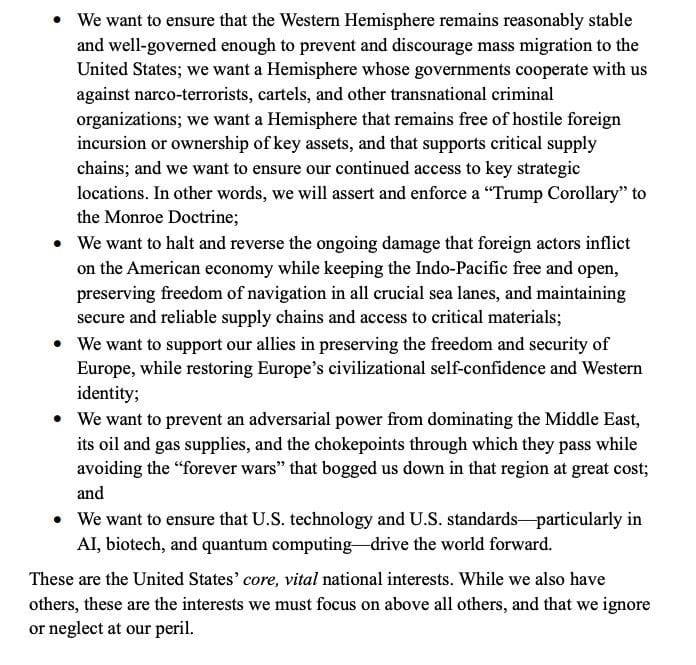 United States (National Security Strategy) document.
At the same time, the strategy mentions enhancing U.S. domestic strength by eliminating anti-competitive practices, unleashing energy productivity, and reindustrializing.
U.S. strategy towards China: combining deterrence with economic discipline.
It points out that China is circumventing sanctions by strengthening supply chain control over low-income countries (with a per capita GDP below $13,800).
Data shows that from 2020 to 2024, China's exports to low-income countries have doubled, now reaching nearly four times the amount of exports to the U.S. Although China's direct exports to the U.S. have decreased from 4% of its GDP during Trump's first term to just over 2%, China still exports indirectly to the U.S. through proxy countries like Mexico.
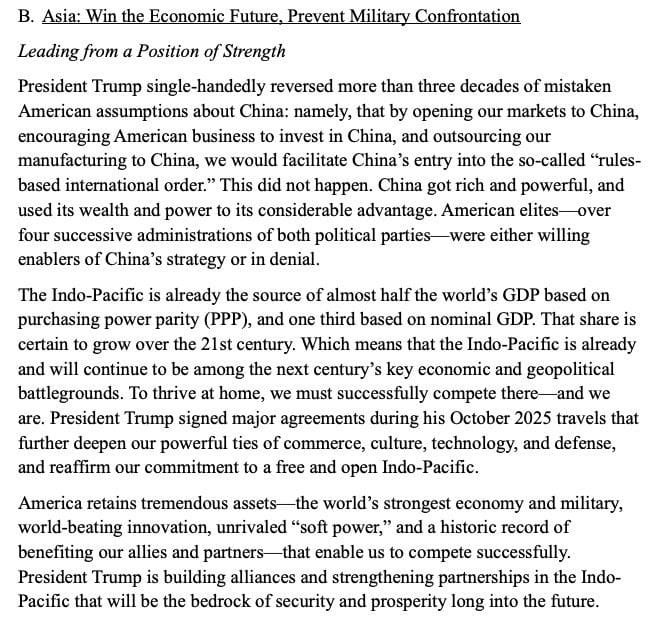
In response, the Trump administration proposed to adopt a strategy that combines deterrence with economic discipline. On one hand, establishing strong military deterrence in the Indo-Pacific region to prevent war and create space for economic actions; on the other hand, bringing productivity back to the United States by eliminating trade deficits and de-risking the supply chain.
 United States (National Security Strategy) document.
The strategy emphasizes that the Indo-Pacific region accounts for nearly half of the global purchasing power parity GDP, and the United States must win economic competition in the region to ensure domestic prosperity.
Centering on the Russia-Ukraine ceasefire, pessimistic about Europe's prospects.
In addition to the Asia-Pacific strategy, the document's assessment of European allies is unusually harsh and clearly states that 'quickly ending Ukrainian hostilities' is a core U.S. interest. The strategy document bluntly states that Europe's share of global GDP has fallen from 25% in 1990 to 14% today and faces a crisis of civilization elimination, including social conflicts caused by immigration policies, collapsing birth rates, and excessive regulation.
Regarding the Russia-Ukraine war, the White House believes that the war has intensified Europe's, especially Germany's, external dependencies and criticized German chemical companies for building large processing plants in China due to the inability to obtain cheap Russian natural gas domestically, creating a dual dependency.
To stabilize the European economy and rebuild strategic stability with Russia, the United States has declared its intention to facilitate negotiations through diplomatic means. At the same time, the document expresses support for patriotic parties in Europe, encouraging European allies to regain confidence in civilization and their Western identity to avoid becoming unrecognizable in the next 20 years.
United States (National Security Strategy) document.
According to reports from (BBC), Russia has welcomed this. Kremlin spokesperson Dmitry Peskov believes that the strategy aligns broadly with Moscow's vision, especially regarding opposing large-scale immigration and restoring traditional values.
The strategic document does not mention digital assets, raising concerns in the industry.
Although the Trump administration has taken a series of cryptocurrency-friendly measures since returning to the White House, foreign media (CoinDesk) pointed out that this latest national security strategy statement does not mention Bitcoin, blockchain technology, or digital assets at all.
The media pointed out that although the Trump administration had signed executive orders to reverse Biden-era unfriendly policies towards cryptocurrencies, established a digital asset market working group, and even promoted stablecoin regulatory legislation (GENIUS Act), digital assets were not considered as strategically important as AI or quantum computing in this document concerning the nation's long-term competitiveness.
Reports analyze that the latest national security strategy's neglect of digital assets may indicate that President Trump and the American establishment still tend to view cryptocurrencies as a mere financial asset rather than a strategic tool that could provide geopolitical advantages to the United States.
Additionally, while Trump did establish a strategic reserve for Bitcoin, the reserve currently utilizes seized Bitcoin funds rather than being funded through a new purchasing plan.
The U.S. strategy hints at fiscal expansion; what is the impact on Bitcoin?
Even though Bitcoin is not directly mentioned in the U.S. National Security Strategy, the overall economic environment it influences may still have far-reaching effects on the cryptocurrency market.
The strategy strongly demands NATO allies to fulfill their responsibility to share costs, raising defense spending significantly to 5% of GDP, while the U.S. will also strengthen military investment in the Indo-Pacific region.
(CoinDesk) analysis indicates that the U.S. strategy emphasizing global fiscal expansion and military spending will inevitably lead to increased government borrowing. The rise in global bond supply may push up bond yields and inflation, making it difficult for central banks to significantly lower interest rates.
In an environment of rising fiscal deficits and inflation risks in the United States, assets traditionally seen as inflation hedges, such as gold, have risen about 60% this year, but Bitcoin, which supporters call 'digital gold', has performed relatively weakly this year.
As the national security strategy pushes the world into an era of fiscal expansion, whether Bitcoin can evolve into a true hedging asset will be the focus of the market going forward.
This article is authorized for reprint from (Crypto City).
More reports.
Fed 'shadow chair' Hassett's voice is rising; an article to understand Trump's supported candidate for Federal Reserve chair.
[Perspective] After the joint governance of thirteen departments, is Hong Kong's Web3 at a historical crossroads? Revealing the insider story of the abrupt turn in RWA and stablecoin policies.
SEC opens the door! 'Innovation exemption' to be launched within a month, plans to comprehensively update market rules.