


Sober Options Studio × Derive.XYZ Joint Production

Written by Sober Options Studio Analyst Jenna @Jenna_w5
1. Macroeconomic Barometer: Divergence in U.S. and Japanese Monetary Policies and Year-End Liquidity Challenges
This week, the global macroeconomic landscape presents complex and contradictory signals. On one hand, the expectations for the Federal Reserve to cut interest rates are gradually settling, and discussions about a technical 'balance sheet expansion' are even beginning, providing a hint of easing warmth to the market; on the other hand, the potential actions of the Bank of Japan to raise interest rates are like a stone thrown into water, generating ripples in the global financial markets, especially posing a potential shock to the global liquidity that has long depended on yen carry trade. Coupled with the seasonal tightening of liquidity at the year-end and the approaching ruling of the U.S. Supreme Court on the legality of Trump’s tariffs, the market is showing a noticeable oscillation pattern under the pull of these multiple forces.
Fed rate cuts and 'technical balance sheet expansion': from easing expectations to a clear path.
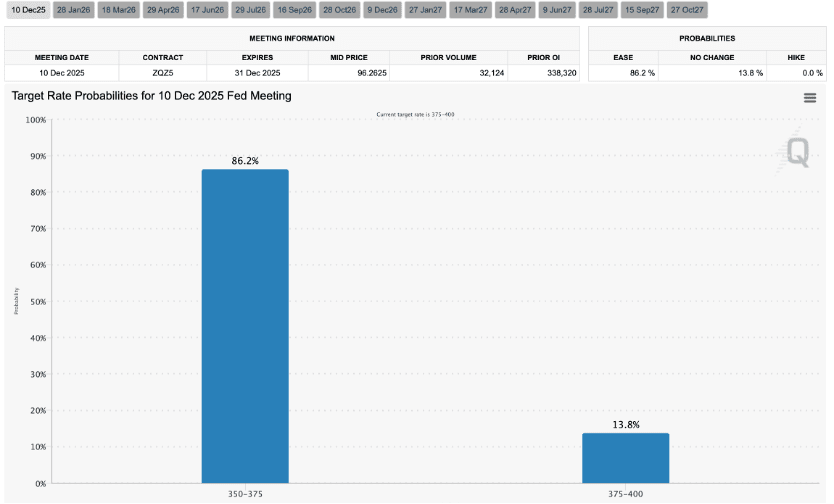
According to the latest data from CME Group FedWatch, the market's probability of the Fed making its third rate cut of the year on December 10 has reached 86%, consistent with last week's expectations, almost confirming the arrival of rate cuts. This certainty has calmed the short-term market volatility that arose from the unclear prospects of rate cuts.
More importantly, the Fed's balance sheet strategy is undergoing subtle changes. Although the end date for Quantitative Tightening (QT) is set for December 1, 2025, the market has started discussing the possibility of the Fed entering the era of Reserve Management Purchases (RMP).
RMP is not traditional Quantitative Easing (QE); its main goal is to ensure that the financial system has sufficient bank reserves to prevent repo market rates from soaring and liquidity shortages. By purchasing short-term Treasury bills (T-bills), the Fed can conduct 'technical balance sheet expansion' without directly lowering long-term rates or overheating the economy.
Such operations indicate that the Fed will be more dovish on a policy level, committed to maintaining stability in financial markets and ensuring ample liquidity. For the cryptocurrency market, the Fed's dovish tilt is often interpreted as favorable, as it lowers the attractiveness of traditional financial assets and may stimulate investment in risk assets.
Japan's rate hike turmoil and global arbitrage trading: potential risks of liquidity reversal.
Just as the Fed turns dovish, the Bank of Japan signals a possible end to the negative interest rate era, triggering market expectations for a rate hike in yen. Japan's zero or even negative interest rate policy has long been an important cornerstone of global arbitrage trading (Carry Trade).
Arbitrage trading refers to investors borrowing low-interest-rate currencies (such as yen) and then investing them in high-interest-rate currency assets or risk assets to earn the interest differential. The yen, as a long-term low-interest currency, has been the main financing currency for global investors conducting arbitrage trading. If the Bank of Japan raises interest rates and ends the negative interest rate policy, it will significantly increase the borrowing costs of yen, triggering large-scale unwinding of arbitrage trades. Investors would sell high-yield assets and buy back yen to repay loans.
This will lead to:
Global liquidity tightening: withdrawing a large amount of funds from global markets.
Risk assets under pressure: Funds flowing back to Japan may lead to selling pressure on risk assets, including cryptocurrencies.
Strengthening dollar: Rising risk aversion and capital inflows may also push up the dollar. This policy divergence of 'Fed dovish, Bank of Japan hawkish' is the core driving force of market volatility this week, bringing structural uncertainty to global financial markets.
Year-end seasonality and Trump tariffs: potential 'hidden reefs'.
Every December, affected by Christmas and New Year holidays, institutional trading activity significantly decreases, and market liquidity typically shrinks considerably. In an environment of insufficient liquidity, any sudden events or large trades can be amplified, leading to severe price fluctuations and increasing market instability.
Additionally, the U.S. Supreme Court is expected to announce its ruling on the legality of large-scale reciprocal tariffs from the Trump era in December. If the ruling finds the tariffs illegal, it will bring more certainty to international trade policy, likely further boosting market sentiment. If the ruling supports the existing policy, it may reignite concerns about trade protectionism, increasing geopolitical and macroeconomic uncertainties, and pushing up risk premiums. Currently, conservative justices hold a majority on the Supreme Court, and previous justices have expressed doubts about the legality of the tariffs, leaving the outcome of the ruling still quite uncertain.
Overall, the market this week stabilized under the dovish signals from the Fed, but the potential rate hike in Japan looms like a Damocles sword over global liquidity. Coupled with year-end liquidity constraints and unresolved legal rulings, the market remains in a state of oscillation between bulls and bears. In such an environment, investors need to hedge against potential downside risks and remain highly vigilant.
Two, In-depth analysis of BTC & ETH options market data.
Combining chart data provided by Amberdata & Derive.XYZ, the BTC and ETH options market this week has shown a unique volatility structure amidst macro uncertainty. While the stability of interest rate cut expectations brings short-term positive effects, the deeply negative Skew and VRP structure, along with the 'hump' in the term structure, indicate that the market remains highly focused on short-term event risks and continues to be vigilant about downside tail risks.
Skew: Bearish sentiment remains significant for the longer term.
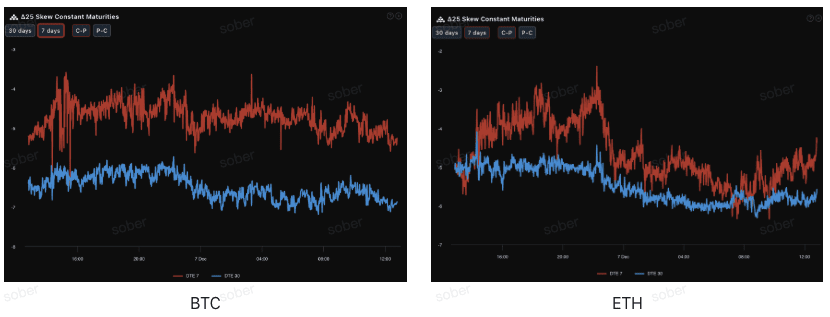
By observing the Delta 25 Skew (implied volatility of call options IV - implied volatility of put options IV), the negative extent of this indicator reflects the market's hedging demand for downside tail risks.
Normalization of deeply negative values: The 25 Delta skew of BTC and ETH continues to remain in the negative range, indicating that the demand for put options still exceeds that for call options, as the market continues to guard against tail risk to the downside.
Term structure: The bearish sentiment for the longer term (30 days) is more pronounced than for the shorter term (7 days). Compared to last week's analysis, although overall negative values have normalized, the recent negative extent may have slightly narrowed compared to before, which corresponds with the short-term easing brought by clear expectations of Fed rate cuts, but concerns about potential macro risks (such as interest rate hikes in Japan, tariff rulings, and year-end liquidity) have not diminished and may have even deepened.
Term structure: Event-driven 'hump' shape.
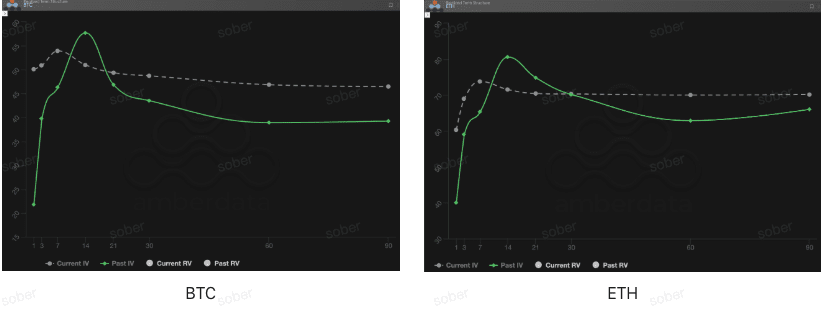
From the perspective of the term structure, last week's implied volatility curve for BTC and ETH was not in a typical Contango shape (low near, high far), but rather showed a significant rise in near-term IV, maintaining high levels at the far end, forming a 'hump' structure.
Abnormal curve shape: The current implied volatility curve is not in a standard Contango shape but shows a significant 'hump' around the 7-day mark, indicating that the market is pricing in the results of the December FOMC meeting.
Event-driven IV surge: Current IV is significantly higher than Past IV (green solid line) at the short end. This is not a normal market condition but a typical 'event hedging' pattern. The market is frantically buying short-term options around the December Fed meeting, resulting in a significant push-up of near-term IV. Such a structure typically appears on the eve of major uncertainty events.
Volatility Risk Premium (VRP): Deeply negative values persist, and sellers need to be cautious.
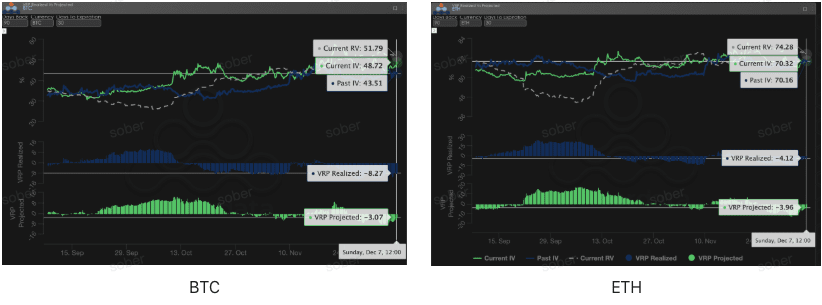
VRP (Volatility Risk Premium = Implied Volatility IV - Realized Volatility RV) is an important indicator for assessing whether options pricing is reasonable. The current market is in a correction phase.
This week's RV volatility has eased, causing the magnitude of negative VRP to narrow slightly. However, the deeply negative structure of the VRP has not changed, with both Realized VRP and Projected VRP remaining negative.
Although negative values have contracted, the sustained deep negative VRP strongly warns pure option sellers: current premiums may seem enticing, but may not be sufficient to compensate for future potential drastic price fluctuations. Especially against the backdrop of continued macro uncertainty, the risks of naked option selling remain high; it is recommended to adopt buyer or risk-controlled spread strategies to cope with potential volatility.
Three, Recommended Options Strategy: Bear Put Spread to lock in downside risks.
Given the current complex macro environment, the dovish signals from the Fed contrast with potential hawkish actions from Japan, coupled with year-end liquidity tightening and uncertainties from tariff rulings, as well as the persistently deeply negative Skew and VRP data in the options market, we believe the market may still face potential downside risks. Therefore, we continue to recommend using Bear Put Spreads for defensive positioning.
Strategy objectives:
Defensive positioning against potential downside risks caused by year-end liquidity constraints.
Limit risks and costs, avoiding the risks of deeply negative VRP for naked sellers.
Take full advantage of the high premiums of put options brought by deeply negative Skew to achieve low-cost entry.
Strategy construction (using BTC/ETH as an example):
Buy a put option with a higher strike price that is slightly out of the money (Slightly OTM).
Sell a put option with a lower strike price and the same expiration date.
Choose expiration date:
Considering the impact of the Supreme Court ruling in December and the tightening of liquidity at the end of the year, it is recommended to choose medium-term contracts with DTE 30 days or DTE 60 days to cover the entire uncertainty window.
Core advantages:
By selling puts with a low strike price to collect premiums, the cost of buying puts is significantly reduced, while locking in the maximum loss at the net premium expenditure. This is more cost-effective than directly buying put options (Long Put).
The current Skew remains deeply negative, and selling puts can achieve higher premiums, further optimizing the risk-reward ratio of the spread.
Four, Disclaimer
This report is based on publicly available market data and options theoretical models, aimed at providing investors with market information and professional analytical perspectives. All content is for reference and communication only and does not constitute any form of investment advice. Cryptocurrency and options trading carry extremely high volatility and risk, which may lead to total loss of principal. Before adopting any trading strategy, investors should fully understand the characteristics, risk attributes of options products, and their own risk tolerance, and must consult professional financial advisors. The analysts of this report do not assume any liability for any direct or indirect losses arising from the use of the content of this report. Past market performance does not indicate future results; please make rational decisions.
Co-produced: Sober Options Studio × Derive.XYZ