


Key points at a glance
Background: Kevin Hassett is the Chair of the Council of Economic Advisers under Trump’s second term and is currently viewed by the market as the most likely successor to Powell as the next Chair of the Federal Reserve. He has a mainstream macroeconomic background and has long provided economic policy advice to the Republican Party, garnering favor due to his loyalty to Trump and market recognition.
Connection to the cryptocurrency industry: Kevin Hassett has a significant intersection with the cryptocurrency industry. Since 2021, he has served as an advisor to a digital asset fund, later becoming an advisor to Coinbase following a business acquisition, and holds millions of dollars worth of Coinbase stock. In his current role, he is responsible for coordinating the White House's digital asset market working group and is seen as a key driver of U.S. cryptocurrency policy, favoring a 'friendly yet compliance-focused' approach.
Monetary policy stance and controversy: The market generally views Hassett as dovish, expecting he may push for more aggressive rate cuts. The biggest controversy is whether he will undermine the Fed's independence to cater to Trump's demand for rate cuts. Hassett publicly emphasizes that central banks should be independent of politics, but he also agrees to conduct a 'comprehensive review' of the Fed's responsibilities, with his future decisions constrained by inflation data, internal opinions from the Fed, and market reactions.
Market impact: Although the official nomination is expected to be announced in early 2026, Hassett has already been treated by the market as a 'shadow chair,' with his statements interpreted as signals for future monetary policy. If he takes office, the direct impact on the crypto market may mainly be realized through the overall monetary environment (interest rates, liquidity) and related financial stability policies (such as banks' exposure to crypto assets, stablecoin regulation).
The next Fed chair candidate
As Trump has repeatedly hinted in public that he has decided on the next Fed chair, White House National Economic Council (NEC) Director Kevin Hassett has been viewed by major media and prediction markets as one of the most likely candidates to succeed Powell.
Surrounding him are three intertwined narratives: a typical Republican conservative economist, an official with substantial interests and policy intersections with crypto assets, and a candidate labeled by some media as the 'Trump shadow chair' amid the controversy over 'Fed independence.'
How did Hassett come to the forefront as the 'next chair'?
Born in 1962 in Greenfield, Massachusetts, Hassett is a standard mainstream macroeconomist and Republican scholar. He received his bachelor's degree in economics from Swarthmore College and later earned both a master's and a Ph.D. in economics from the University of Pennsylvania.
Early in his academic career, he taught at Columbia University's business school and served as a senior economist on the Board of Governors of the Federal Reserve, focusing on macroeconomic and fiscal policy. In the think tank field, he long served at the conservative think tank American Enterprise Institute (AEI), where he was the director of economic policy research, influencing tax reform, corporate tax, and capital markets.
On the public front, his most well-known early work is the co-authored book (Dow 36,000) with conservative columnist James K. Glassman, which claimed in 1999 at the peak of the dot-com bubble that stock market valuations were still 'severely undervalued.' This judgment was later 'discredited' by market trends, but it also made him a prominent figure in conservative economic circles.
Before entering the White House, Hassett had already provided economic policy advice for Republican presidential candidates multiple times, including McCain in 2000 and 2008, Bush in 2004, and Romney in 2012. In 2017, Trump appointed him as the chairman of the Council of Economic Advisers (CEA), during which he frequently defended Trump's tax cuts and industrial policies in public, emphasizing that tax cuts would boost corporate capital spending and wage growth. In mid-2019, he left the CEA chairman position and immediately took on a visiting scholar role at the Hoover Institution, continuing to voice his opinions on tax and macroeconomic policies.
During the pandemic in 2020, Hassett was invited back to the White House by Trump to serve as a senior economic advisor to the president, participating in estimates regarding the economic impact of the pandemic and strategies for reopening. Hassett had no prior experience in epidemiology, but some of the pandemic models he led were seen as important guidelines within Trump's team. However, Hassett's models were criticized widely by scholars and commentators for contradicting public health experts' assessments.
By the end of 2024, after winning the election, Trump announced that Hassett would serve as the director of the National Economic Council (NEC) for his second term, responsible for coordinating economic policy in the White House. Starting from January 20, 2025, he officially took over this position, becoming the primary economic 'hub' for communication with the Treasury and the Fed.
In the early days of his second term, the Trump administration frequently signaled 'not intending to reappoint Powell' and began to have Treasury Secretary Scott Bessent lead the search for the next chair candidate. By the fall of 2025, multiple candidates, including former Fed Governor Kevin Warsh, current governors Christopher Waller, Michelle Bowman, and BlackRock senior executive Rick Rieder, were included on the list.
As we enter the fourth quarter, the situation of this candidate competition is gradually becoming clear—Hassett will stand out in this 'final circle.' The core reason Hassett is favored by Trump is that he meets Trump's two major standards for personnel: loyalty and market recognition.
As of December 5, on prediction market platforms like Polymarket, Hassett's likelihood of being elected was about 75%; mainstream media like Bloomberg had previously cited sources saying that Hassett had become the 'top favorite' to succeed Powell. Trump himself publicly stated that he had made a decision and would officially announce the candidate in early 2026, repeatedly praising Hassett in interviews.
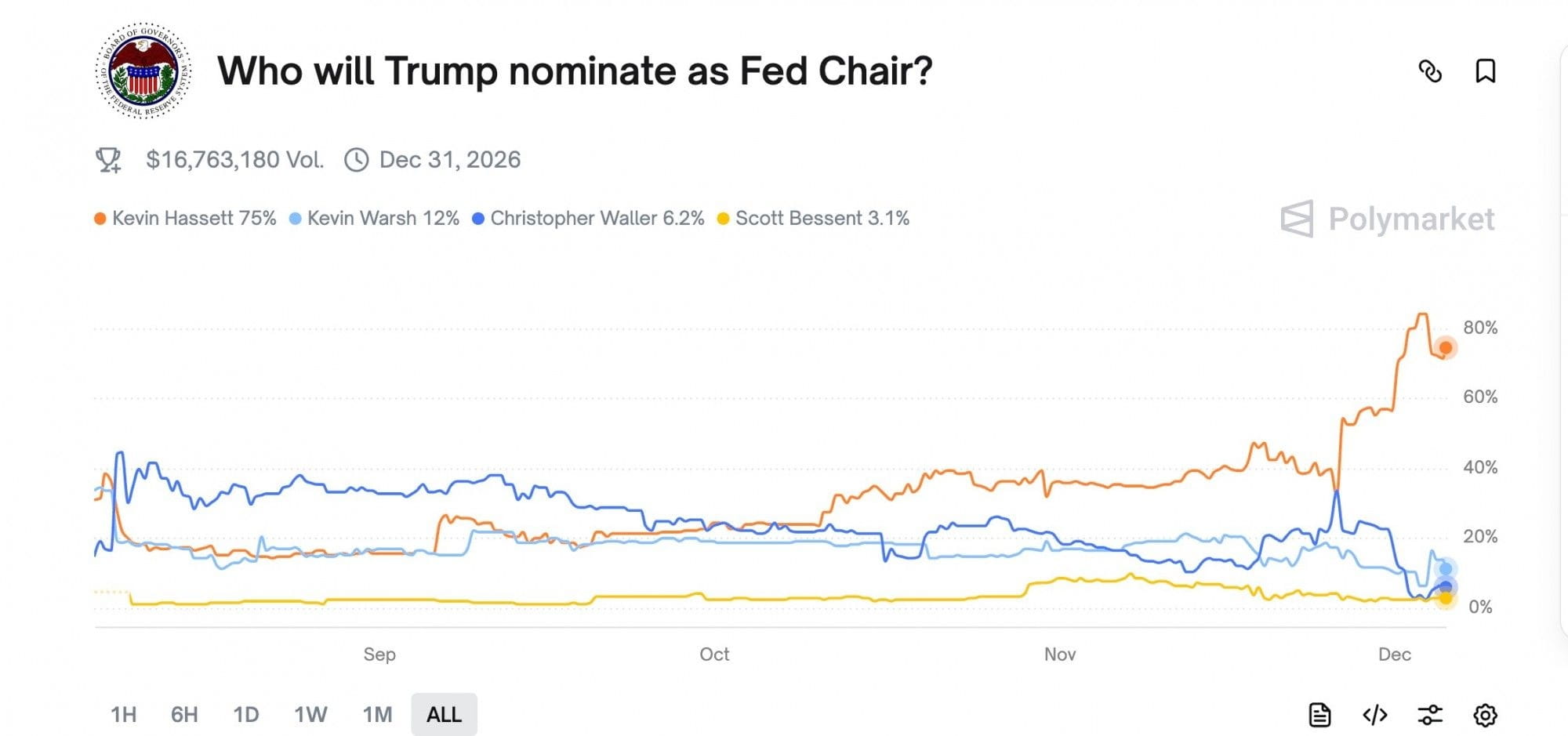
Even before the formal nomination was announced, the outside world had begun to refer to Hassett as the 'shadow Fed Chair for the next five months.' This is because the market believes he has a high probability of taking over, and every public statement he makes in the next six months could be viewed as a preview of the Fed's stance.
Coinbase advisor, shareholder, crypto industry friendly
For the cryptocurrency industry, compared to previous Fed chairs and other candidates, Hassett's 'substantive connection' with the crypto industry is the aspect that the community pays the most attention to, given his policy intersections in office and related investments on a personal asset level.
In 2021, the digital asset hedge fund One River Digital Asset Management announced the establishment of an 'Academic and Regulatory Advisory Committee,' of which Hassett is a key member. Although this role does not directly involve specific transactions, it means that Hassett has established formal ties with digital asset fund management since 2021 as an advisor. In this process, he is also viewed as an important bridge between traditional macroeconomics and emerging crypto assets.
In 2023, Coinbase acquired part of One River's asset management business and reorganized it into the Coinbase Asset Management Academic and Regulatory Advisory Committee, continuing the existing academic and regulatory advisory structure, thereby making Hassett a Coinbase advisor. Hassett is also an 'investor' in Coinbase, with a financial disclosure submitted to the government ethics office in June 2025 reporting that the value of the Coinbase Global (COIN) stock he holds is between $1 million and $5 million.
After taking office, Trump immediately signed a large number of executive orders. Among them, Executive Order 14178 (Strengthening U.S. Leadership in Digital Financial Technology) not only revoked relevant digital asset executive orders from the Biden administration but also explicitly prohibited the U.S. from launching a CBDC. At the same time, it established the Presidential 'Digital Asset Market Working Group,' tasked with proposing policy recommendations on crypto assets, stablecoins, market structure, consumer protection, and 'national digital asset reserves' within 180 days. This working group is organized under the White House AI and Crypto Affairs Special Advisor David Sacks, but administratively belongs to the National Economic Council (NEC) system, coordinated and organized by Hassett.
The first working group report released in the summer proposed a comprehensive set of recommendations for the U.S. digital asset regulatory framework— including how banks should hold and manage exposure to crypto assets, enhancing reserve transparency and compliance requirements in stablecoin regulation, clarifying crypto tax and anti-money laundering rules, and exploring feasible paths for national digital asset reserves, among others. In this process, Hassett is seen as a 'key driver of the White House digital asset agenda,' believed to favor a 'relatively friendly but compliance-focused crypto policy direction' when coordinating internally with institutions like the Treasury, SEC, CFTC, and Justice Department.
Compared to technical details, Hassett tends to express views from a macro and political economy perspective in public statements. He is categorized as 'crypto-friendly' by outsiders, believing he sees digital assets as part of U.S. financial innovation and geopolitical competition, hoping the U.S. maintains a leading position in this field.
Dovish 'shadow chair,' or a puppet of Trump?
The biggest controversy surrounding Hassett is not only his 'pro-crypto' stance but also whether he will act as an extension of Trump's will in monetary policy, thereby undermining the independence of the Federal Reserve.
From recent speeches and market interpretations, Hassett is generally viewed as a dovish candidate by mainstream institutions. Numerous bond investors and Wall Street firms have expressed concerns to the U.S. Treasury, believing that if Hassett were to become chair, he might 'more aggressively push for interest rate cuts,' even if inflation remains above the 2% target, citing his strong alignment with Trump’s demand for 'quicker and more significant rate cuts.'
Hassett has publicly stated that he 'sees no strong reason to stop cutting rates now,' downplaying the inflationary pressures caused by tariffs, believing that they can be offset through longer-term growth and structural measures. From the traditional 'hawkish/dovish' division, Hassett is clearly closer to the dovish end of 'willing to cut rates quicker and deeper even in a high inflation environment,' which is also one of the important reasons for the cautious or even worried attitude of bond market participants towards him.
Many foreign media reports suggest that regardless of who the candidate is, Trump places the most importance on whether this person is loyal to him to achieve his demand for the Fed to cut interest rates. Interestingly, amidst questions of 'whether he will become Trump's puppet,' Hassett himself has repeatedly emphasized the importance of Fed independence in public interviews.
In September 2025, he was directly asked in a CBS program: in a poll, a majority of Republican voters wished for the Fed to 'act according to Trump's will,' while a minority advocated complete independence; which side did he belong to? Hassett responded that he would choose 100% to ensure monetary policy was completely independent of political influences, including from President Trump. He also warned that historically, countries that allowed political leaders to control central banks often ended up facing surging inflation and costs to consumers.
However, Hassett also stated in the same interview that he agrees with Treasury Secretary Bessent's view that 'the Fed should undergo a comprehensive review, including its responsibilities and research paradigms,' and indicated that if he were to become chair in the future, he would be 'prepared to implement this vision.' That is to say, he emphasizes formal independence on one hand, while on the other hand, he agrees with a series of proposals initiated by the Trump administration to 'reshape the role of the Fed'—which also leaves room for interpretation.
Regarding whether he will 'become Trump's tool,' analyses have pointed out that Hassett supported typical mainstream conservative economic positions such as carbon taxes, immigration expansion, and free trade in his early years, but after long-term cooperation with Trump, he gradually shifted to support tariffs, hardline immigration policies, and more politically colored economic issues; if such a 'highly politicized economic advisor' takes over the Fed, it will pose a substantial test to the central bank's independence.
The future is difficult to predict, but it is certain that whether Hassett will cater to Trump's demands for 'more aggressive rate cuts' in specific decisions will still depend on several constraints: the actual trends of inflation and employment, the voting behavior of other governors and regional Fed chairs, and the market's tolerance for potential inflation and fiscal sustainability.
As for the crypto market, even if the chair is personally friendly to crypto, the direct influence he can exert is still mainly concentrated in two areas: first, the overall monetary environment, such as interest rates and liquidity, and second, his attitude when dealing with financial stability risks related to crypto, such as banks holding crypto exposure and the connection between stablecoins and payment systems.
According to Trump's statement at the White House cabinet meeting earlier this month, the nomination for the next Fed chair will be announced in early 2026. Although the official results have not yet been revealed, Kevin Hassett has already stepped into the spotlight, and the market is beginning to scrutinize every word he says as the 'next chair,' preparing for a potentially more 'dovish' and more knowledgeable about crypto assets new chair.
This article is collaboratively reprinted from: (PANews)
More reports
Bitcoin once stood back above $92,000! Will liquidity improve as the Fed ends QT on December 1?
The Fed opened the door to cryptocurrencies for the first time! Proposed 'streamlined main account' concept, rewriting the payment landscape
The Stablecoin Genius Act officially takes effect! Fed Governor warns: Structural gaps may lead to a 'FTX-like' crisis